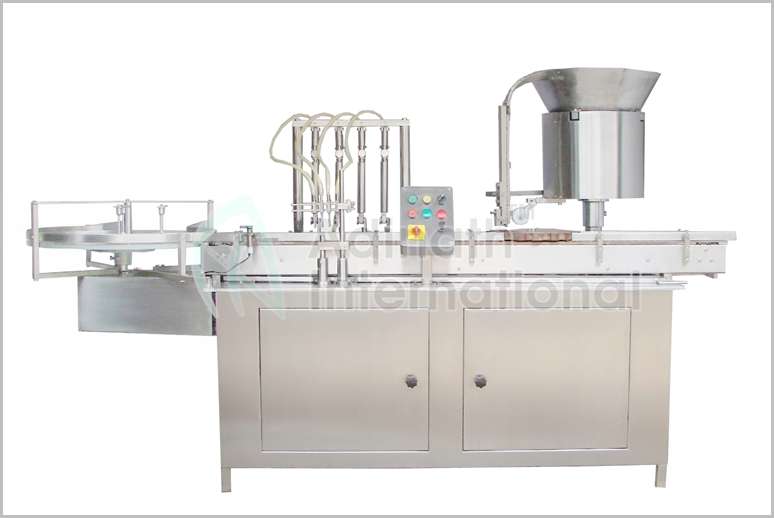

Plastic Vial Filling Machine is an automated or semi-automated piece of equipment primarily used in the pharmaceutical, biotechnology, cosmetic, and chemical industries to precisely fill, stopper, and seal plastic vials with liquids, semi-solids, powders, or suspensions. These machines ensure high accuracy, sterility, and efficiency, making them essential for producing injectable drugs, vaccines, oncology preparations, and other sensitive formulations. Unlike glass Vial Fillers, plastic vial machines are designed to handle the flexibility and chemical resistance of plastic containers, reducing breakage risks and interactions between the product and container while supporting ready-to-use (RTU) formats.
Unlike glass vial fillers, this machine is optimized for the flexible and lightweight nature of plastic vials. It ensures accurate dosing, gentle handling to avoid deformation, and reliable sealing while maintaining strict sterility standards. Controlled by a PLC system with touchscreen HMI, the machine offers consistent performance, easy operation, and full compliance with cGMP, FDA, and EU Annex 1 requirements.
Vial Filling Machine handle both sterile (aseptic) and non-sterile applications, with speeds ranging from small-batch (clinical trials) to high-volume production. They are valued for their cost-effectiveness, reduced particle generation compared to glass, and adaptability to formats like nested RTU vials.
If you need details on specific models, pricing, or comparisons with multi-head machines, let me know!
The incoming dry vials (sterilized and siliconized) are fed through the unscrambler and suitably guided on the moving Delrin slat conveyor belt at the required speed of the correct placement below filling unit.
The filling unit consists of Filling Head, Syringes & Nozzles; Syringes & Nozzles are made of AISI SS 316L materials. A Star Wheel is provided which holds the vial during filling operation. A sensor is provided for ”No Vial-No Filling” operation. Syringes are mounted on eccentric block and driving through bottom main gear box. Volume can be increase & decrease by increasing or decreasing stroke length of piston as per filling size. Syringes is having non return valve for sucking and delivering situation to avoid volume variation. Liquid reaches to filling nozzles through silicon transparent pipe. Nozzles having up & down movement with help of cam mechanism, and it come down when vial hold by starwheel for filling operation and starts filling when it starts to move up and after completion of filling operation, starwheel delivers two vials together on conveyor for rubber stoppering operation.
Stoppering unit consist of Star wheel, Vibrator unit and Bowl. The sterilized and siliconized rubber stoppers stored in the vibrator bowl moves vertically to the rubber stopper chute. The vial is hold firmly by starwheel, which will be in continuous rotary motion and vial which is coming from filling unit get in to starwheel and move in rotary direction along with starwheel, during movement it picks up the rubber stopper from the exit end of the chute and rubber stopper pressed by fix single pressing roller, which is spring loaded. Then vial further move on conveyor and collected on out feed starwheel for next sealing operation.
Model | ALVF-40 | ALVF-80 | ALVF-120 | ALVF – 250 |
Filling Heads | Two | Four | Eight | Twelve |
Production Rate | Up to 40 Vials/Minute | Up to 80 Vials/Minute | Up to 150 Vials/Minute | Up to 250 Vials/Minute |
Vial Diameter | 15mm to 70mm | 15mm to 70mm | 15mm to 70mm | 15mm to 70mm |
Vial Height | 25mm to 140mm | 25mm to 140mm | 25mm to 140mm | 25mm to 140mm |
Filling Precision | ±1% | ±1% | ±1% | ±1% |
Power Required | 1 H.P. | 1.5 H.P. | 2 H.P. | 2 H.P. |
Electrical Characteristics | 440 Volts, 3 Phase, 50 Hertz | 440 Volts, 3 Phase, 50 Hertz | 440 Volts, 3 Phase, 50 Hertz | 440 Volts, 3 Phase, 50 Hertz |
Overall Dimension | 2050mm (L) x 850mm (W) x 1700mm (H) | 2200mm (L) x 850mm (W) x 1700mm (H) | 3000mm (L) x 945mm (W) x 1700mm (H) | 3500mm (L) x 945mm (W) x 1700mm (H) |
* Power voltage can be adjusted as per customer’s domestic power voltage requirements.
* Rights of technical improvements & modification reserved.
* Illustrations & dimensions are shown for information purpose only.
A Plastic Vial Filling Machine is a fully automatic aseptic filling and closing system designed specifically for filling sterile liquids into plastic vials (HDPE, LDPE, PP, COP, or PET). It integrates precision filling, rubber stoppering, and capping/sealing in one compact unit. Controlled by a PLC with touchscreen HMI, this machine is ideal for producing injectable solutions, ophthalmic drops, veterinary products, and other parenterals where lightweight, shatterproof plastic packaging is preferred over glass.
Key advantages include:
It is especially suitable for high-volume or hospital-use sterile products.
The machine is built for aseptic processing in ISO Class 5 / Grade A environments, often with RABS or isolator compatibility. It uses advanced filling technologies such as peristaltic pumps or servo-driven piston pumps for precise dosing. Features like “No Vial – No Fill” interlock, smooth plastic-friendly vial handling, SS316L product contact parts, and easy-to-clean design help maintain sterility and achieve consistent fill volumes with minimal particulate generation.
Production capacity usually ranges from 60 to 300+ vials per minute, depending on the number of filling heads and product viscosity. It can handle a wide range of plastic vial sizes from 0.5 ml to 100 ml (and sometimes higher). The machine is optimized for lightweight plastic formats, offering fast changeover and reliable performance even at high speeds.
Choose a Plastic Vial Filling Machine when:
Glass vial fillers are still preferred for certain ultra-sensitive biologics requiring highest thermal resistance, while plastic vial fillers excel in safety, logistics savings, and user convenience.
Algeria | Angola | Argentina | Australia | Austria | Bahrain | Bangladesh | Belarus | Belgium | Bolivia | Botswana | Brazil | Bulgaria | Canada | Chile | China | Colombia | Costa Rica | Cuba | Czech Republic | Denmark | Dominican Republic | Ecuador | Egypt | El Salvador | Ethiopia | Finland | France | Germany | Ghana | Greece | Guatemala | Haiti | Honduras | Hong Kong | Hungary | India | Indonesia | Iran | Ireland | Israel | Italy | Ivory Coast | Japan | Jordan | Kazakhstan | Kenya | Kuwait | Lebanon | Libya | Malaysia | Mexico | Mongolia | Morocco | Mozambique | Myanmar | Netherlands | New Zealand | Nicaragua | Nigeria | Norway | Oman | Pakistan | Panama | Paraguay | Peru | Philippines | Poland | Portugal | Qatar | Romania | Russia | Saudi Arabia | Senegal | Slovakia | Singapore | South Africa | South Korea | South Sudan | Spain | Sri Lanka | Sweden | Switzerland | Taiwan | Tanzania | Thailand | Trinidad and Tobago | Tunisia | Turkey | Uganda | Ukraine | United Arab Emirates | United Kingdom | United States | Uruguay | Uzbekistan | Venezuela | Vietnam | Zambia | Zimbabwe
Connect with our engineering team to discuss your specific production requirements. We provide customized, cGMP-compliant machinery solutions designed to optimize your manufacturing facility and maximize output.
©Adinath International | Theme Developed By Pharma Machinery Manufacturer I Website updated on: 09 October 2026
WhatsApp us
