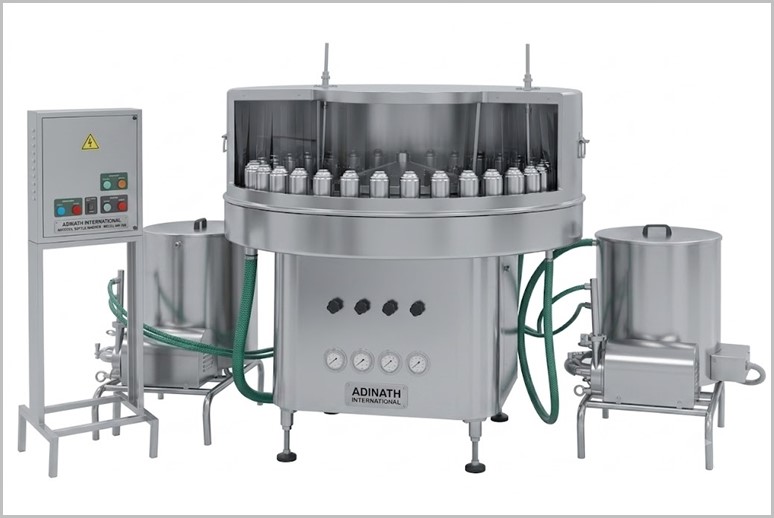
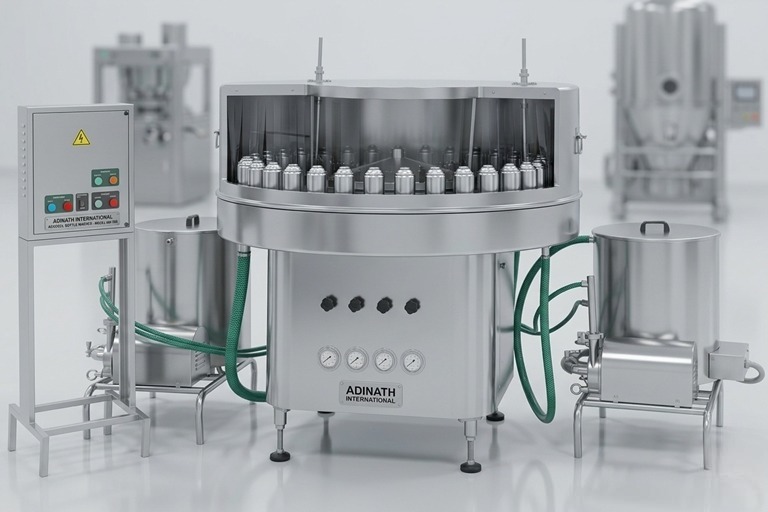
Automatic Glass Bottle Washing Machine is an industrial-grade appliance designed primarily for the beverage, dairy, food, pharmaceutical, and cosmetic industries to efficiently clean reusable or returnable glass bottles. These machines automate the cleaning process, handling high volumes of bottles while ensuring thorough removal of contaminants, labels, residues, and foils. They are built to meet hygiene standards like GMP (Good Manufacturing Practices) and are constructed from durable, corrosion-resistant materials such as stainless steel (SS 304 or higher) to withstand harsh cleaning agents and high-pressure operations.
If you need details on specific models and pricing, let me know!
The bottles are loaded on the subsequent indexing part of rotating platform and are cleared in series of operations. Specially designed bottle holders are provided to hold bottles with neck diameter. The bottles are placed in an inverted position in these cup shaped holders. Spraying showers does the external cleaning of the bottles. Solenoid valves are provided to enable the regulation of wash timings, it also spraying water when bottle are stopped means ensure saving of water and sequence of various washing media to suit specific requirement.
Automatic Glass Bottle Washing Machine follows a multi-stage cycle tailored for new, returnable, or labeled bottles:
Model No | ARBW – 64 | ARBW – 100 |
Production Output | Up to 60 Bottles / Minute (Depending on Bottle Size) | Up to 100 Bottles / Minute (Depending on Bottle Size) |
Input Specification | Diameter of the container: 25 mm to 100mm | Diameter of the container: 25 mm to 100mm |
Power Supply | Main Unit: 0.75 H.P., 380 Volt, 3 Phase, 4 Wire System, 50 Hz Optional Accessories (2 Pumps – Pumping Station) 0.75 H.P., 380 Volt, 3 Phase, 4 Wires System, 50 Hz Electric Heater Tank: 2 K.W. | Main Unit: 0.75 H.P., 380 Volt, 3 Phase, 4 Wire System, 50 Hz Optional Accessories (2 Pumps – Pumping Station) 0.75 H.P., 380 Volt, 3 Phase, 4 Wires System, 50 Hz Electric Heater Tank: 2 K.W. |
Overall Dimension | 1550 mm (L) x 1700 mm (W) x 1300 mm (H) approx. | 1800 mm (L) x 1700 mm (W) x 1300 mm (H) approx. |
Air Consumption | 30 CFM @ 5 bar | 30 CFM @ 5 bar |
Net Weight | 650 kgs. approx. | 750 kgs. approx. |
* Power voltage can be adjusted as per customer’s domestic power voltage requirements.
* Rights of technical improvements & modification reserved.
* Illustrations & dimensions are shown for information purpose only.
An Automatic Glass Bottle Washing Machine is an industrial system designed to efficiently clean, rinse, and sanitize reusable or new glass bottles. It uses multi-stage high-pressure jets, soaking, and air blowing to remove labels, residues, dirt, and contaminants, ensuring high hygiene standards for beverage, pharmaceutical, food, and cosmetic industries.
The machine supports high-speed operation with outputs of 60 to 100+ bottles per minute (e.g., ARBW-64 and ARBW-100 models). It handles a wide range of glass bottle sizes with diameters of 25–100 mm and heights up to 280 mm (with change parts).
Bottles are loaded and inverted. They pass through soaking in caustic solutions, high-pressure internal/external jets, multiple rinses, and final air blowing. The inverted position and precise nozzles ensure complete drainage and thorough cleaning without damaging the glass. The process is fully automated for consistency.
Algeria | Angola | Argentina | Australia | Austria | Bahrain | Bangladesh | Belarus | Belgium | Bolivia | Botswana | Brazil | Bulgaria | Canada | Chile | China | Colombia | Costa Rica | Cuba | Czech Republic | Denmark | Dominican Republic | Ecuador | Egypt | El Salvador | Ethiopia | Finland | France | Germany | Ghana | Greece | Guatemala | Haiti | Honduras | Hong Kong | Hungary | India | Indonesia | Iran | Ireland | Israel | Italy | Ivory Coast | Japan | Jordan | Kazakhstan | Kenya | Kuwait | Lebanon | Libya | Malaysia | Mexico | Mongolia | Morocco | Mozambique | Myanmar | Netherlands | New Zealand | Nicaragua | Nigeria | Norway | Oman | Pakistan | Panama | Paraguay | Peru | Philippines | Poland | Portugal | Qatar | Romania | Russia | Saudi Arabia | Senegal | Slovakia | Singapore | South Africa | South Korea | South Sudan | Spain | Sri Lanka | Sweden | Switzerland | Taiwan | Tanzania | Thailand | Trinidad and Tobago | Tunisia | Turkey | Uganda | Ukraine | United Arab Emirates | United Kingdom | United States | Uruguay | Uzbekistan | Venezuela | Vietnam | Zambia | Zimbabwe
Connect with our engineering team to discuss your specific production requirements. We provide customized, cGMP-compliant machinery solutions designed to optimize your manufacturing facility and maximize output.
©Adinath International | Theme Developed By Pharma Machinery Manufacturer I Website updated on: 09 October 2026
WhatsApp us
