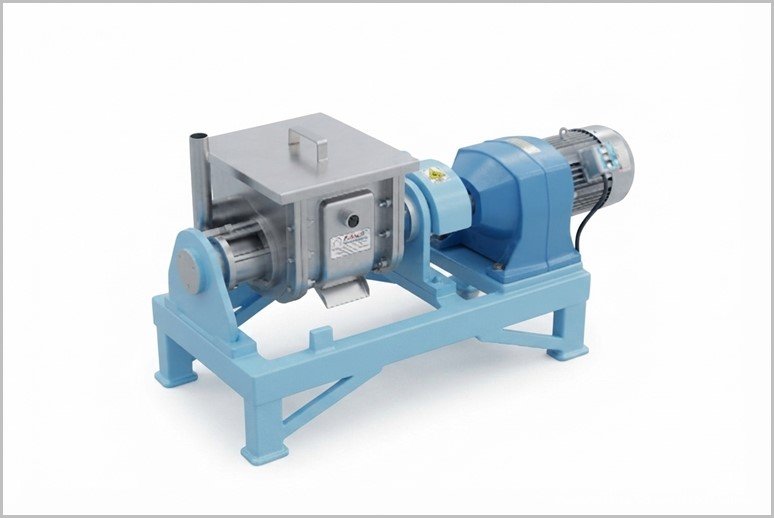
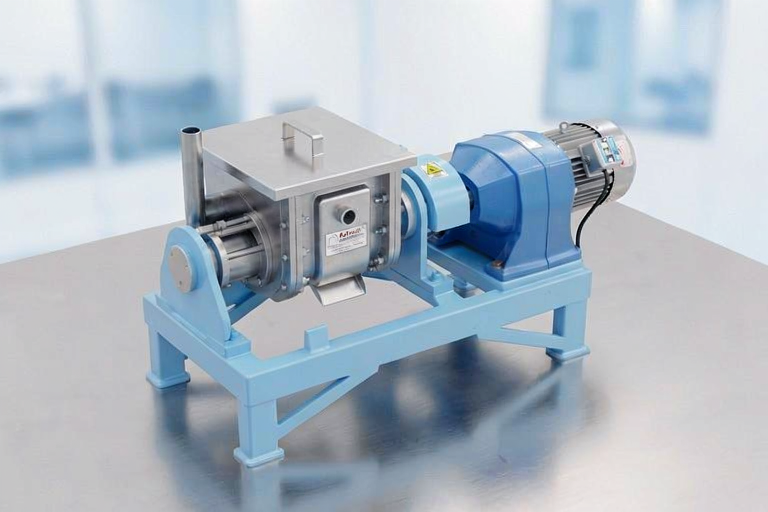
A Laboratory Sigma Blade Mixer, often called a lab sigma blade mixer, sigma kneader, Z-blade mixer, or double-arm kneader, is a small, precisely built mixing machine tailored for research and development, testing formulations, and small-scale production of highly viscous materials. This flexible piece of lab equipment is essential in industries dealing with thick, sticky, or dough-like substances where regular mixers cannot produce consistent results.
The sigma blade mixer is notable for its distinctive blade setup. It includes two heavy-duty, Z-shaped or sigma-shaped blades that spin at different speeds inside a specially shaped mixing chamber. This setup creates an efficient kneading and folding motion. The design ensures complete mixing, uniformity, and removal of air from dense materials, making it suitable for substances with viscosities ranging from several thousand to millions of centipoise.
Discharge Methods
Finished batches can be unloaded through three primary mechanisms:
Blade Configurations & Applications
Tangential Blade Design
Overlapping Blade Design
Model | Capacity – Liters | Motor (H.P.) | ||
Working Capacity approx. | Gross Capacity approx. | General | Heavy Duty | |
ASM – 5 | 5 Liters | 8 Liters | 1 H.P. | 1.5 H.P. |
ASM – 10 | 10 Liters | 15 Liters | 1 H.P. | 1.5 H.P. |
ASM – 20 | 20 Liters | 30 Liters | 1.5 H.P. | 3 H.P. |
ASM – 50 | 50 Liters | 80 Liters | 5 H.P. | 7.5 H.P. |
ASM – 75 | 75 Liters | 110 Liters | 7.5 H.P. | 10 H.P. |
ASM – 100 | 100 Liters | 150 Liters | 10 H.P. | 15 H.P. |
* Power voltage can be adjusted as per customer’s domestic power voltage requirements.
* Rights of technical improvements & modification reserved.
* Illustrations & dimensions are shown for information purpose only.
A Laboratory Blade Sigma Mixer (also known as a lab sigma blade mixer, sigma kneader, Z-blade mixer, or double-arm kneader) is a compact, precision-built machine designed for R&D, formulation testing, and small-scale production of highly viscous, sticky, or dough-like materials. It features two heavy-duty Z-shaped (sigma) blades that rotate at different speeds to provide intensive kneading, folding, and mixing action.
The laboratory models are offered in working capacities from 5 liters up to 100 liters (gross capacities 8–150 liters). Specific models include ASM-5 (5L), ASM-10 (10L), ASM-20 (20L), ASM-50 (50L), ASM-75 (75L), and ASM-100 (100L), with corresponding motor options ranging from 1 HP to 15 HP (general and heavy-duty variants).
It is ideal for high-viscosity materials (thousands to millions of centipoise) such as adhesives, rubber compounds, pigments, dyes, creams, ointments, carbon pastes, pharmaceutical formulations, nutraceuticals, herbal and Ayurvedic preparations, cosmetics, and other semi-solid or dough-like substances.
The mixer is available in Stainless Steel 316, Stainless Steel 304, or Mild Steel. Stainless Steel versions can be polished to matt or mirror finish per customer requirements. Mild Steel models come with one coat of red oxide and two coats of epoxy paint. PTFE shaft seals are provided for food-grade compatibility.
The two counter-rotating Z-shaped (sigma) blades operate tangentially or in an overlapping configuration inside a W-shaped trough. This creates intense shearing, kneading, folding, stretching, dividing, and recombining actions, transferring material efficiently from one end to the other while minimizing dead zones and removing air for homogeneous results.
Discharge can be achieved through hand-wheel operated (manual) tilting, hydraulic operated (automatic) tilting, bottom valves, or an optional extrusion screw. These options accommodate different viscosities and operational preferences.
Yes. Jacketed troughs with mineral wool insulation and cladding are available for heating or cooling applications (using steam, hot oil, or water), making it suitable for temperature-sensitive formulations.
Optional features include Liquid Spray System, Vacuum System (for de-aeration), Blades Cooling Arrangement, Screw/Extrusion System, and Automatic Valve Discharge System, allowing customization for specific lab or pilot-scale needs.
It is widely used in the Pharmaceutical, Nutraceutical, Herbal, Ayurvedic, Biotech, Cosmetic, and Chemical industries for R&D, formulation development, and small-batch processing of high-viscosity materials requiring uniform dispersion and consistency.
Algeria | Angola | Argentina | Australia | Austria | Bahrain | Bangladesh | Belarus | Belgium | Bolivia | Botswana | Brazil | Bulgaria | Canada | Chile | China | Colombia | Costa Rica | Cuba | Czech Republic | Denmark | Dominican Republic | Ecuador | Egypt | El Salvador | Ethiopia | Finland | France | Germany | Ghana | Greece | Guatemala | Haiti | Honduras | Hong Kong | Hungary | India | Indonesia | Iran | Ireland | Israel | Italy | Ivory Coast | Japan | Jordan | Kazakhstan | Kenya | Kuwait | Lebanon | Libya | Malaysia | Mexico | Mongolia | Morocco | Mozambique | Myanmar | Netherlands | New Zealand | Nicaragua | Nigeria | Norway | Oman | Pakistan | Panama | Paraguay | Peru | Philippines | Poland | Portugal | Qatar | Romania | Russia | Saudi Arabia | Senegal | Slovakia | Singapore | South Africa | South Korea | South Sudan | Spain | Sri Lanka | Sweden | Switzerland | Taiwan | Tanzania | Thailand | Trinidad and Tobago | Tunisia | Turkey | Uganda | Ukraine | United Arab Emirates | United Kingdom | United States | Uruguay | Uzbekistan | Venezuela | Vietnam | Zambia | Zimbabwe
Connect with our engineering team to discuss your specific production requirements. We provide customized, cGMP-compliant machinery solutions designed to optimize your manufacturing facility and maximize output.
©Adinath International | Theme Developed By Pharma Machinery Manufacturer I Website updated on: 15 October 2026
Request A Quick Quote
Laboratory Blade Sigma Mixer
Please drop your requirements, one of our technical expert will contact you in next 24 working hours.
WhatsApp us


