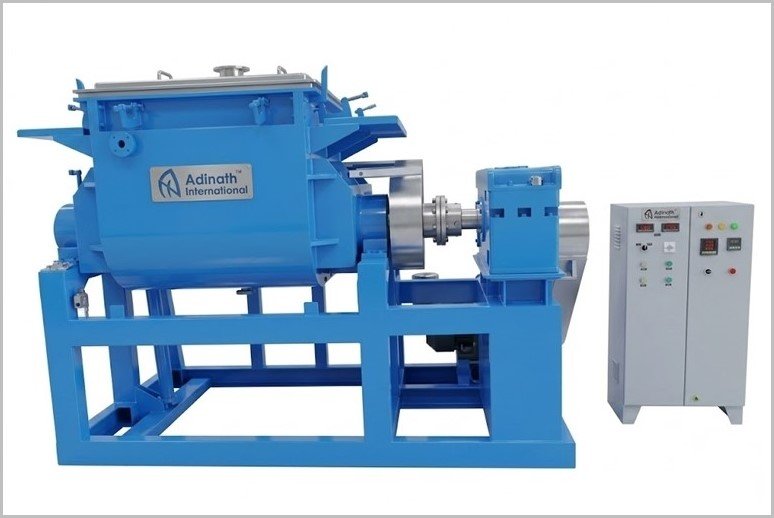
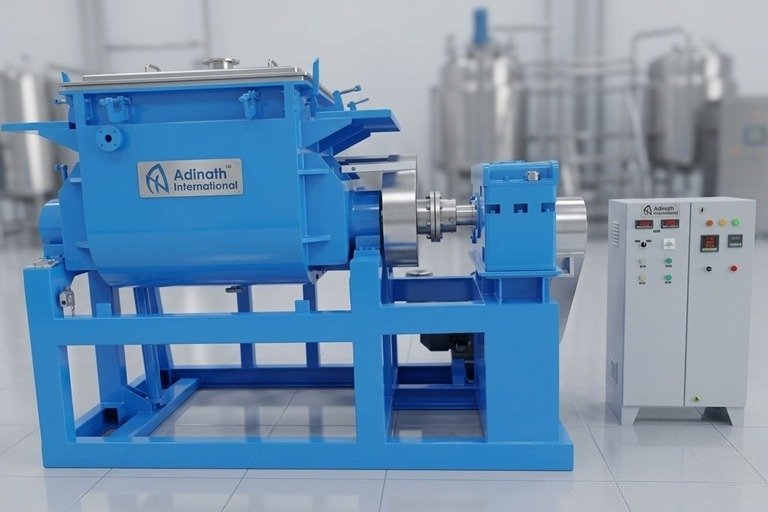
A Liquid Soap Mixer Sigma Blade Mixer, also referred to as a Sigma Double Blade Mixer, Double Arm Sigma Mixer, Z-Blade Mixer, or Sigma Kneader, is a robust industrial mixing device specifically designed for kneading, blending, and thoroughly mixing high-viscosity, sticky, and semi-solid materials. This reliable equipment is commonly used by manufacturers producing items such as liquid soap, detergents, creams, pastes, adhesives, and other thick formulations that demand strong mechanical action to maintain consistent quality. The main feature of the Sigma Blade Mixer is its two counter-rotating sigma-shaped (Σ or Z-shaped) blades, which are mounted inside a U-shaped trough.
These blades operate at different speeds, creating substantial shearing, folding, compressing, and stretching actions. This unique mechanism ensures that all ingredients are fully combined, prevents the development of lumps, and delivers a uniform texture even in very thick batches. Compared to standard mixers, the Double Arm Sigma Mixer is especially effective in processing materials that range from thick pastes to dense dough-like substances.
Many models come with additional features such as jacketed troughs for precise temperature control, vacuum systems to remove air bubbles, hydraulic tilting for easier emptying, and PLC automation for accurate and consistent recipe reproduction. These features make the Z-Blade Mixer a versatile and efficient tool suitable for a wide range of industries.
Discharge Configurations
Tangential Blade Design
Overlapping Blade Design
Model | Capacity – Liters | Motor (H.P.) | ||
Working Capacity approx. | Gross Capacity approx. | General | Heavy Duty | |
ASM – 50 | 50 Liters | 80 Liters | 5 H.P. | 7.5 H.P. |
ASM – 75 | 75 Liters | 110 Liters | 7.5 H.P. | 10 H.P. |
ASM – 100 | 100 Liters | 150 Liters | 10 H.P. | 15 H.P. |
ASM – 150 | 150 Liters | 200 Liters | 15 H.P. | 20 H.P. |
ASM – 200 | 200 Liters | 300 Liters | 20 H.P. | 25 H.P. |
ASM – 400 | 400 Liters | 550 Liters | 30 H.P. | 40 H.P. |
ASM – 500 | 500 Liters | 750 Liters | 40 H.P. | 50 H.P. |
ASM – 750 | 750 Liters | 1150 Liters | 50 H.P. | 60 H.P. |
ASM – 1000 | 1000 Liters | 1500 Liters | 60 H.P. | 70 H.P. |
ASM – 1500 | 1500 Liters | 2100 Liters | 75 H.P. | 80 H.P. |
ASM – 2000 | 2000 Liters | 2600 Liters | 80 H.P. | 90 H.P. |
ASM – 3000 | 3000 Liters | 3800 Liters | 100 H.P. | 120 H.P. |
* Power voltage can be adjusted as per customer’s domestic power voltage requirements.
* Rights of technical improvements & modification reserved.
* Illustrations & dimensions are shown for information purpose only.
It is a robust industrial kneader designed for thoroughly mixing, blending, and kneading high-viscosity, sticky, and semi-solid materials such as liquid soap, detergents, creams, pastes, and adhesives. It features two counter-rotating sigma-shaped (Σ or Z-shaped) blades mounted in a U-shaped trough that deliver strong shearing, folding, and stretching action for uniform results.
The differential-speed counter-rotating Z-blades create intensive mechanical action that eliminates lumps, ensures complete ingredient incorporation, and produces a consistent texture in thick, viscous formulations typical of liquid soaps and detergents—something standard mixers struggle to achieve.
Precisely synchronized Z-shaped blades rotate at different speeds inside the trough, continuously moving material end-to-end while applying shearing, stretching, folding, dividing, and recombining forces. This also provides natural size reduction through tearing against the blades and trough walls.
The machine is offered in Mild Steel (MS), Stainless Steel 304 (SS 304), or Stainless Steel 316 (SS 316). Finishes range from matte to high-gloss mirror polish; mild-steel versions receive a red-oxide primer plus dual epoxy coating for durability and hygiene.
Models range from ASM-50 (approx. 50 L working / 80 L gross capacity) to ASM-3000 (approx. 3000 L working / 3800 L gross). Motors are available in general or heavy-duty ratings (e.g., 5–7.5 HP up to 100–120 HP), with voltage adjustable to local power supplies.
Optional heating or cooling jackets (insulated with mineral wool and outer cladding) allow precise temperature regulation. Blade-cooling arrangements can also be added for temperature-sensitive liquid soap or cream formulations.
Tangential blades meet at the edges and typically run at a 3:2 speed ratio for high shear, ideal for very viscous materials. Overlapping blades rotate at the same speed for faster interchange and milder kneading, suited to freer-flowing or lighter pastes/creams. Choice depends on the specific viscosity of the liquid soap batch.
Finished product can be unloaded by trough tilting, bottom valves, or a side-mounted extrusion screw. Discharge may be manual (hand-wheel) or automatic (hydraulic), with optional automatic valve systems for efficient, clean emptying of sticky batches.
It serves the pharmaceutical, nutraceutical, herbal, Ayurvedic, biotech, cosmetic, and chemical industries for high-viscosity pastes, creams, adhesives, rubber compounds, dyes, pigments, and similar products requiring intensive kneading.
Available options include liquid spray systems, vacuum systems (to remove air bubbles), blade-cooling arrangements, extrusion-screw discharge, automatic valve discharge, specialized heating/cooling jackets, and PLC automation for recipe consistency and process control.
Algeria | Angola | Argentina | Australia | Austria | Bahrain | Bangladesh | Belarus | Belgium | Bolivia | Botswana | Brazil | Bulgaria | Canada | Chile | China | Colombia | Costa Rica | Cuba | Czech Republic | Denmark | Dominican Republic | Ecuador | Egypt | El Salvador | Ethiopia | Finland | France | Germany | Ghana | Greece | Guatemala | Haiti | Honduras | Hong Kong | Hungary | India | Indonesia | Iran | Ireland | Israel | Italy | Ivory Coast | Japan | Jordan | Kazakhstan | Kenya | Kuwait | Lebanon | Libya | Malaysia | Mexico | Mongolia | Morocco | Mozambique | Myanmar | Netherlands | New Zealand | Nicaragua | Nigeria | Norway | Oman | Pakistan | Panama | Paraguay | Peru | Philippines | Poland | Portugal | Qatar | Romania | Russia | Saudi Arabia | Senegal | Slovakia | Singapore | South Africa | South Korea | South Sudan | Spain | Sri Lanka | Sweden | Switzerland | Taiwan | Tanzania | Thailand | Trinidad and Tobago | Tunisia | Turkey | Uganda | Ukraine | United Arab Emirates | United Kingdom | United States | Uruguay | Uzbekistan | Venezuela | Vietnam | Zambia | Zimbabwe
Connect with our engineering team to discuss your specific production requirements. We provide customized, cGMP-compliant machinery solutions designed to optimize your manufacturing facility and maximize output.
©Adinath International | Theme Developed By Pharma Machinery Manufacturer I Website updated on: 15 October 2026
Request A Quick Quote
Liquid Soap Mixer Sigma Blade Mixer Sigma Double Blade Mixer
Please drop your requirements, one of our technical expert will contact you in next 24 working hours.
WhatsApp us


