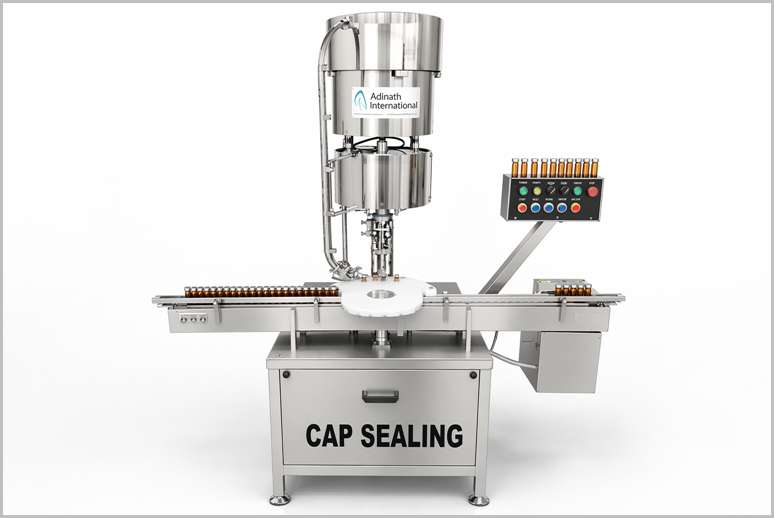
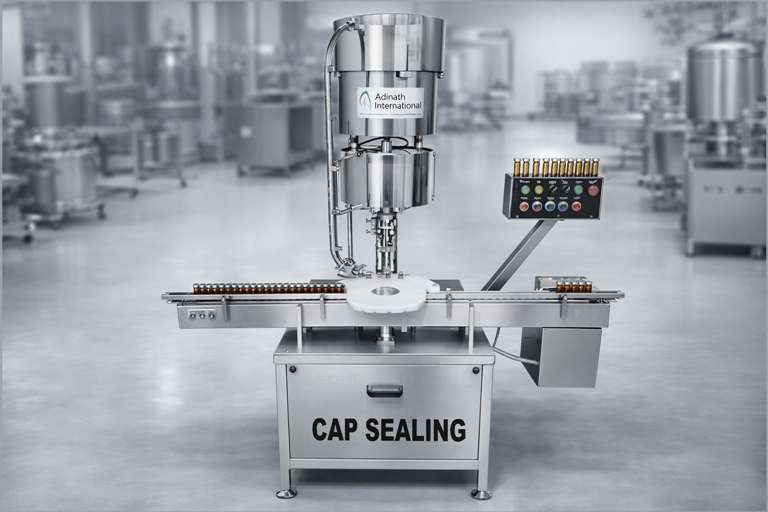
Automatic Vial Capping Machine is a specialized piece of equipment designed to automate the process of sealing vials with caps, widely used in industries such as pharmaceuticals, biotechnology, cosmetics, and chemicals. These machines enhance productivity, ensure consistent sealing quality, and maintain sterility while reducing manual labor and occupational health risks like repetitive strain injuries. This cGMP-compliant machine ensures high filling accuracy, minimal contamination risk, and seamless integration with upstream (vial washing & sterilizing) and downstream (rubber stoppering, capping & labeling) equipment to form a complete sterile production line.
Automatic Vial Capping Machines are critical for scaling production while ensuring precision, sterility, and efficiency in high-stakes industries.
If you need details on specific models, pricing, or comparisons with multi-head machines, let me know!
Duly Stoppered vials are continuously fed from the convetor of filling machine to the flat conveyor belt of sealing machine and move further through infeed worm for correct spacing and transferred to the infeed starwheel. Aluminium caps kept in vibratory bowl automatically orient caps in right direction before entering the delivery chute. Vial during its rotation movement with infeed starwheel picks up aluminum seal from the retaining finger of delivery chute and correctly position on the vial before entering sealing turret. Vial now moves on the spring loaded sealing platform, where free spinning sealing rollers moves gradually inside to complete the sealing operation during rotational movement of sealing platform turret. Now sealed vials are transferred to exit starwheel pocket and further moves out on to the flat conveyor belt. Duly sealed vials are collected on out-feed collection tray.
Model | ACS-60 | ACS-120 | ACS-200 |
No. of Sealing Head | Single | Four | Eight |
Production Rate | Up to 50 Vials/Minute | Up to 100 Vials/Minute | Up to 200 Vials/Minute |
Container Diameter: | 15mm to 80mm | 15mm to 80mm | 15mm to 80mm |
Container Height: | 20mm to 180mm | 20mm to 180mm | 20mm to 180mm |
Cap Diameter: | 13mm, 20mm, 28mm, 30mm & 33mm with the help of change parts. | 13mm, 20mm, 28mm, 30mm & 33mm with the help of change parts. | 13mm, 20mm, 28mm, 30mm & 33mm with the help of change parts. |
Power Supply | 0.5 H.P. | 1 H.P. | 2 H.P. |
Electrical characteristics | 440 Volts, 3 Phase, 50 Hertz, 4 Wire System | 440 Volts, 3 Phase, 50 Hertz, 4 Wire System | 440 Volts, 3 Phase, 50 Hertz, 4 Wire System |
Optional Accessories | Aluminum profile cabinet covering full machine | Aluminum profile cabinet covering full machine | Aluminum profile cabinet covering full machine |
Chuck for flip-off seal | Chuck for flip-off seal | Chuck for flip-off seal | |
PLC with HMI | PLC with HMI | PLC with HMI | |
Overall Dimension | 1300mm X 800mm (W) X 1800mm (H) approx. | 1500mm (L) x 850mm (W) x 1800mm (H) approx. | 2000mm (L) x 850mm (W) x 1800mm (H) approx. |
* Power voltage can be adjusted as per customer’s domestic power voltage requirements.
* Rights of technical improvements & modification reserved.
* Illustrations & dimensions are shown for information purpose only.
The machine is available in different configurations to suit varying production needs:
Yes, the machine is highly adaptable. It can accommodate vials with a diameter of 15mm to 80mm and a height of 20mm to 180mm. With specific change parts, it supports a wide range of cap diameters, including 13mm, 20mm, 28mm, 30mm, and 33mm.
The machine uses spring-loaded free-spinning sealing rollers. This mechanism allows for a precise, uniform seal while accommodating minor variations in container neck diameter without damaging the aluminum caps. Additionally, the sealing pressure is adjustable to suit different gauges and sizes of caps.
To maintain high efficiency and prevent contamination, the machine includes several intelligent interlocks:
“No Stopper on Vial Before Sealing – Machine Stop” system: Ensures every vial is properly stoppered before a cap is applied.
“No Seal in Chute – Machine Stop” system: Prevents the machine from operating if the cap supply is empty.
Optional PLC/HMI: Provides real-time fault detection and monitoring for a safer, more transparent workflow.
Yes, this is a complete cGMP-compliant model. All parts that come into contact with the vials or aluminum caps, as well as parts exposed to the atmosphere, are constructed from stainless steel (304 or 316) for superior hygiene, durability, and easy sterilization.
More Capping and Sealing Machines
 Automatic Bottle Capping Machine
 Automatic Bottle Ropp Capping Machine
 Automatic Bottle Screw Capping Machine
Automatic Ropp Screw Capping Machine
Automatic Bottle Screw Capping Machine
Automatic Ropp Screw Capping Machine
Algeria | Angola | Argentina | Australia | Austria | Bahrain | Bangladesh | Belarus | Belgium | Bolivia | Botswana | Brazil | Bulgaria | Canada | Chile | China | Colombia | Costa Rica | Cuba | Czech Republic | Denmark | Dominican Republic | Ecuador | Egypt | El Salvador | Ethiopia | Finland | France | Germany | Ghana | Greece | Guatemala | Haiti | Honduras | Hong Kong | Hungary | India | Indonesia | Iran | Ireland | Israel | Italy | Ivory Coast | Japan | Jordan | Kazakhstan | Kenya | Kuwait | Lebanon | Libya | Malaysia | Mexico | Mongolia | Morocco | Mozambique | Myanmar | Netherlands | New Zealand | Nicaragua | Nigeria | Norway | Oman | Pakistan | Panama | Paraguay | Peru | Philippines | Poland | Portugal | Qatar | Romania | Russia | Saudi Arabia | Senegal | Slovakia | Singapore | South Africa | South Korea | South Sudan | Spain | Sri Lanka | Sweden | Switzerland | Taiwan | Tanzania | Thailand | Trinidad and Tobago | Tunisia | Turkey | Uganda | Ukraine | United Arab Emirates | United Kingdom | United States | Uruguay | Uzbekistan | Venezuela | Vietnam | Zambia | Zimbabwe
Connect with our engineering team to discuss your specific production requirements. We provide customized, cGMP-compliant machinery solutions designed to optimize your manufacturing facility and maximize output.
©Adinath International | Theme Developed By Pharma Machinery Manufacturer I Website updated on: 15 October 2026
Request A Quick Quote
Automatic Vial Capping Machine
Please drop your requirements, one of our technical expert will contact you in next 24 working hours.
WhatsApp us
