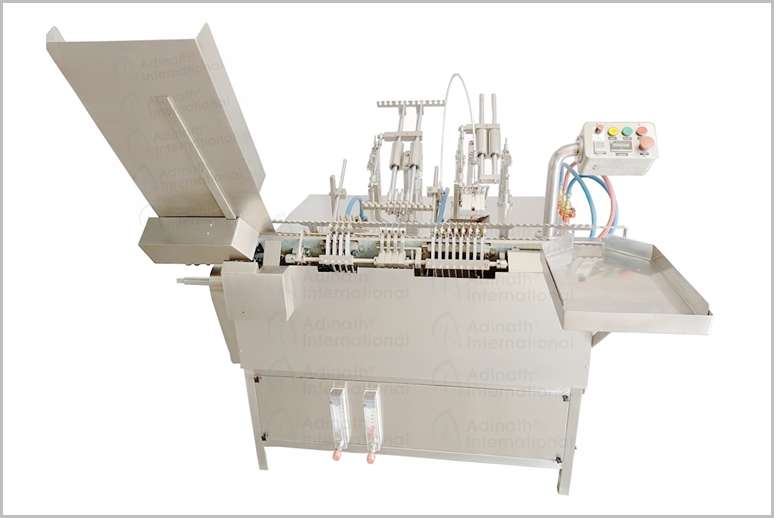
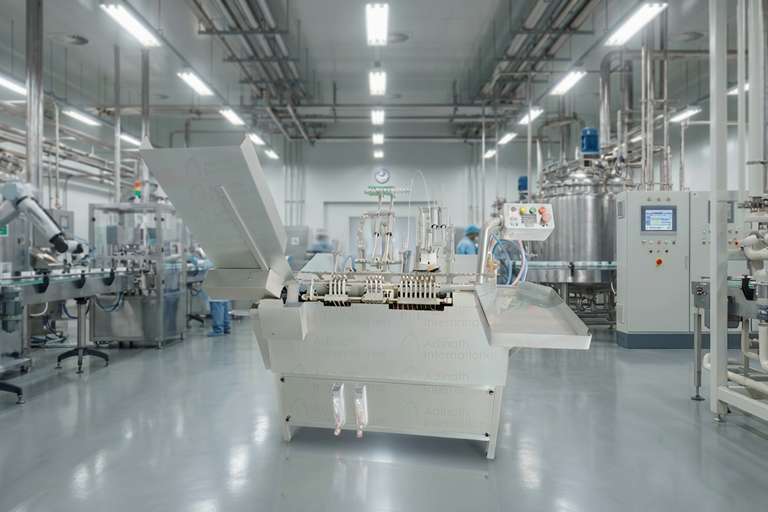
Injectable Ampoule Filling Machine is a specialized piece of pharmaceutical equipment designed for the precise, sterile, and automated filling and sealing of glass or plastic ampoules with injectable liquids, such as vaccines, antibiotics, or other pharmaceutical solutions. These machines are critical in industries like pharmaceuticals, biotechnology, and cosmetics, Their robust design, precise filling mechanisms, and integration with washing and sterilization systems ensure compliance with stringent regulatory standards while maximizing efficiency. Whether for small-scale R&D or large-scale production, these machines offer flexibility, accuracy, and reliability tailored to diverse industry needs. Below is a detailed description of the machine, its features, and its operation, based on industry standards and available information.
This advanced machine integrates multiple critical operations — pre-gassing, liquid filling, post-gassing, pre-heating, and flame sealing — in a single compact unit. Built on the principle of slant traveling of ampoules, it ensures smooth, gentle handling with minimal breakage while maintaining the highest level of sterility and product integrity.
The operation of an injectable ampoule filling machine typically follows these steps:
Model | AFS-1 | AFS-2 | AFS-4 | AFS-8 |
No. of Head | Single | Two | Four | Eight |
Syringes | One | Double | Four | Eight |
Ampoule Sizes | 1 ml to 30 ml | 1 ml to 30 ml | 1 ml to 20 ml | 1 ml to 20 ml |
Filling Speed | Up to 25 ampoules/minute | Up to 50 ampoules/minute | Up to 100 ampoules/minute | Up to 200 ampoules/minute |
Filling Precision | ± 1% | ± 1% | ± 1% | ± 1% |
Filling Pump | Piston Pump | Piston Pump | Piston Pump | Piston Pump |
Burner Gas | LPG & Oxygen (O₂) | LPG & Oxygen (O₂) | LPG & Oxygen (O₂) | LPG & Oxygen (O₂) |
Nitrogen Arrangement | Before & After Filling | Before & After Filling | Before & After Filling | Before & After Filling |
Number of Fill Nozzles | One | Two | Four | Eight |
Number of Nitrogen Nozzles | Two | Four | Eight | Sixteen |
Number of Sealing Burners | Two | Four | Eight | Sixteen |
Power Required | 0.5 H.P. | 1 H.P. | 1 H.P. | 2 H.P. |
Power Voltage | 230 Volts, Single Phase, 50 Hertz, 4 Wire System | 230 Volts, Single Phase, 50 Hertz, 4 Wire System | 230 Volts, Single Phase, 50 Hertz, 4 Wire System | 230 Volts, Single Phase, 50 Hertz, 4 Wire System |
Contact Parts | Made from Stainless Steel 316L | Made from Stainless Steel 316L | Made from Stainless Steel 316L | Made from Stainless Steel 316L |
Overall Dimension | 915mm (L) x 610mm (W) x 965mm (H) approx. | 915mm (L) x 760mm (W) x 965mm (H) approx. | 1200mm (L) x 1070mm (W) x 965mm (H) approx. | 2200mm (L) x 1400mm (W) x 1100mm (H) approx. |
* Power voltage can be adjusted as per customer’s domestic power voltage requirements.
* Rights of technical improvements & modification reserved.
* Illustrations & dimensions are shown for information purpose only.
An Injectable Ampoule Filling Machine is a high-precision, fully automatic pharmaceutical equipment designed to fill sterile injectable liquids (such as vaccines, antibiotics, and other solutions) into glass ampoules and immediately seal them using flame sealing. It integrates pre-gassing, filling, post-gassing, pre-heating, and sealing stations in a compact cGMP-compliant design. The machine ensures sterility, accuracy, and efficiency while minimizing contamination risks through features like nitrogen flushing and “No Ampoule – No Filling” safety systems.
The machine supports ampoule sizes from 1 ml to 30 ml (model dependent). We offer four main models:
All models deliver ±1% filling accuracy using volumetric piston pumps and can handle LPG + Oxygen or oxy-hydrogen for sealing. Custom power voltage options are also available.
Key features include:
These ensure high sterility, minimal product wastage, and compliance with cGMP standards.
Empty, washed, and sterilized ampoules are loaded into the infeed hopper. They move via a starwheel to a receiving rack and then to the moving rack in an inclined position. As ampoules travel left to right, the machine performs:
Filled and sealed ampoules are automatically collected upright in a tray. The slant design reduces breakage and ensures smooth, contamination-free operation.
This machine is ideal for the pharmaceutical, biotechnology, veterinary, cosmetic, and chemical industries. Main benefits include:
It is perfect for both small-scale R&D and large-scale commercial production.
Algeria | Angola | Argentina | Australia | Austria | Bahrain | Bangladesh | Belarus | Belgium | Bolivia | Botswana | Brazil | Bulgaria | Canada | Chile | China | Colombia | Costa Rica | Cuba | Czech Republic | Denmark | Dominican Republic | Ecuador | Egypt | El Salvador | Ethiopia | Finland | France | Germany | Ghana | Greece | Guatemala | Haiti | Honduras | Hong Kong | Hungary | India | Indonesia | Iran | Ireland | Israel | Italy | Ivory Coast | Japan | Jordan | Kazakhstan | Kenya | Kuwait | Lebanon | Libya | Malaysia | Mexico | Mongolia | Morocco | Mozambique | Myanmar | Netherlands | New Zealand | Nicaragua | Nigeria | Norway | Oman | Pakistan | Panama | Paraguay | Peru | Philippines | Poland | Portugal | Qatar | Romania | Russia | Saudi Arabia | Senegal | Slovakia | Singapore | South Africa | South Korea | South Sudan | Spain | Sri Lanka | Sweden | Switzerland | Taiwan | Tanzania | Thailand | Trinidad and Tobago | Tunisia | Turkey | Uganda | Ukraine | United Arab Emirates | United Kingdom | United States | Uruguay | Uzbekistan | Venezuela | Vietnam | Zambia | Zimbabwe
Connect with our engineering team to discuss your specific production requirements. We provide customized, cGMP-compliant machinery solutions designed to optimize your manufacturing facility and maximize output.
©Adinath International | Theme Developed By Pharma Machinery Manufacturer I Website updated on: 09 October 2026
WhatsApp us
