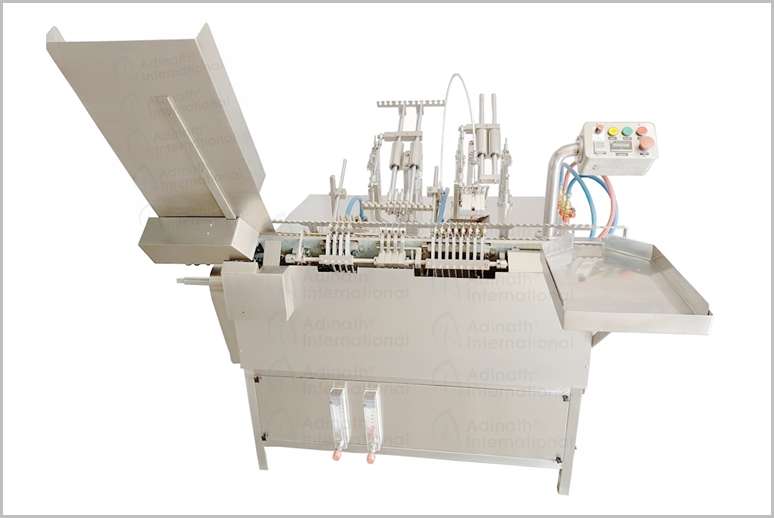
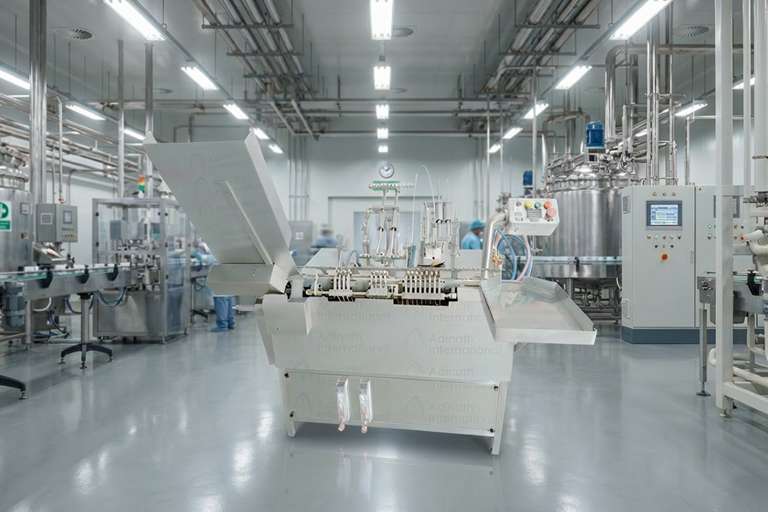
Injection Ampoule Filling Machine is a specialized piece of pharmaceutical equipment designed to fill and seal glass ampoules with injectable liquid drugs, ensuring precision, sterility, and compliance with industry standards. These machines are widely used in pharmaceutical, biotech, chemical, and cosmetic industries to handle liquids ranging from free-flowing to viscous oils, typically in ampoules of 1ml to 30ml capacity. Injection Ampoule Filling Machines are critical for high-precision, sterile, and efficient production of injectable pharmaceuticals and other sensitive liquids. Their robust design, advanced automation, and compliance with global standards make them indispensable in modern pharmaceutical manufacturing. Below is a detailed description based on the operational principles, features, and advantages of these machines:
Empty washed & sterilized ampoules loaded onto infeed hopper of the machine. From where it has been received to receiving rack through starwheel/cassette. The moving rack which moves horizontally collect one/two/four/eight ampoules from the receiving rack and transfer the ampoule to the machine in left to right in an inclined position. During ampoule movement Pre-gassing, Filling, Post Gassing, Pre-heating & Sealing Station perform filling and sealing operations. At the end duly filled and sealed ampoules get collected automatically onto collection tray of the machine. For detailed working process please explore Automatic Ampoule Filler Video in top right section of this page.
Model | AFS-1 | AFS-2 | AFS-4 | AFS-8 |
No. of Head | Single | Two | Four | Eight |
Syringes | One | Double | Four | Eight |
Ampoule Sizes | 1 ml to 30 ml | 1 ml to 30 ml | 1 ml to 20 ml | 1 ml to 20 ml |
Filling Speed | Up to 25 ampoules/minute | Up to 50 ampoules/minute | Up to 100 ampoules/minute | Up to 200 ampoules/minute |
Filling Precision | ± 1% | ± 1% | ± 1% | ± 1% |
Filling Pump | Piston Pump | Piston Pump | Piston Pump | Piston Pump |
Burner Gas | LPG & Oxygen (O₂) | LPG & Oxygen (O₂) | LPG & Oxygen (O₂) | LPG & Oxygen (O₂) |
Nitrogen Arrangement | Before & After Filling | Before & After Filling | Before & After Filling | Before & After Filling |
Number of Fill Nozzles | One | Two | Four | Eight |
Number of Nitrogen Nozzles | Two | Four | Eight | Sixteen |
Number of Sealing Burners | Two | Four | Eight | Sixteen |
Power Required | 0.5 H.P. | 1 H.P. | 1 H.P. | 2 H.P. |
Power Voltage | 230 Volts, Single Phase, 50 Hertz, 4 Wire System | 230 Volts, Single Phase, 50 Hertz, 4 Wire System | 230 Volts, Single Phase, 50 Hertz, 4 Wire System | 230 Volts, Single Phase, 50 Hertz, 4 Wire System |
Contact Parts | Made from Stainless Steel 316L | Made from Stainless Steel 316L | Made from Stainless Steel 316L | Made from Stainless Steel 316L |
Overall Dimension | 915mm (L) x 610mm (W) x 965mm (H) approx. | 915mm (L) x 760mm (W) x 965mm (H) approx. | 1200mm (L) x 1070mm (W) x 965mm (H) approx. | 2200mm (L) x 1400mm (W) x 1100mm (H) approx. |
* Power voltage can be adjusted as per customer’s domestic power voltage requirements.
* Rights of technical improvements & modification reserved.
* Illustrations & dimensions are shown for information purpose only.
The Injection Ampoule Filling Machine is a fully automatic monobloc system designed for high-precision filling and flame sealing of sterile liquid injectables into glass ampoules. It handles free-flowing to viscous liquids in ampoules ranging from 1ml to 30ml. The machine integrates nitrogen flushing (before, during, and after filling), precise piston pump filling, neck pre-heating, and LPG + Oxygen flame sealing in one compact unit. It is built as per cGMP, USFDA, WHO, and ISO 9187-1:2010 standards, making it ideal for pharmaceutical parenteral production.
We offer four standard models:
Custom high-speed models are available up to 36,000 ampoules per hour. Filling range is 0.5ml to 25ml with ±1% accuracy. Ampoule size compatibility: 1ml–30ml (AFS-1) and 1ml–20ml (higher models).
The machine operates on the slant traveling principle, which gently handles ampoules and reduces glass breakage and particle contamination. The process includes:
It features a “No Ampoule – No Filling” system and automatic collection of sealed ampoules. The slant design and automated steps ensure high sterility and minimal human intervention.
Key features include:
It is widely used in:
Main benefits:
Yes — Adinath International Injection Ampoule Filling Machine complies to cGMP, MHRA, FDA and WHO-GMP standards, with optional CE marked equipments and 21 CFR Part 11 software compliance for the HMI/PLC. Machine contact parts having Stainless Steel 316L grade materials with validation documents having IQ, OQ, DQ validation protocols as optional. Organization is ISO 9001:2015 certified.
Manufacturing lead time is generally 7 to 14 weeks from order confirmation. Further it takes 2 to 8 weeks for international shipping depending upon destination. Order can be expediate sooner or later as per specific buying requirements. Destination specific certifications like US FDA, EU, ANVISA, SFDA. CE can add 3 to 6 weeks additionally.
Yes, Adinath International Injection Ampoule Filling Machine export this machine to more than 48 countries of this world including America, Europe, Asia, Middle East, Africa, CIS and Australia sub continents. Please visit our clientele page for complete list of our customers worldwide. Located at Ahmedabad, India having world class infrastructure.
Service of skilled engineers and technicians provided for technical support of supplied equipments. Installations, commissioning, training and IQ, OQ, DQ validations performed by qualified engineers. Remote support through video call, phone, email and other modes provided for international installations. Spare parts of Injection Ampoule Filling Machine stocked at our premises in Ahmedabad and shipped immediately after ordering. Standard 12 months manufacturing warranty included with supplied equipment.
Algeria | Angola | Argentina | Australia | Austria | Bahrain | Bangladesh | Belarus | Belgium | Bolivia | Botswana | Brazil | Bulgaria | Canada | Chile | China | Colombia | Costa Rica | Cuba | Czech Republic | Denmark | Dominican Republic | Ecuador | Egypt | El Salvador | Ethiopia | Finland | France | Germany | Ghana | Greece | Guatemala | Haiti | Honduras | Hong Kong | Hungary | India | Indonesia | Iran | Ireland | Israel | Italy | Ivory Coast | Japan | Jordan | Kazakhstan | Kenya | Kuwait | Lebanon | Libya | Malaysia | Mexico | Mongolia | Morocco | Mozambique | Myanmar | Netherlands | New Zealand | Nicaragua | Nigeria | Norway | Oman | Pakistan | Panama | Paraguay | Peru | Philippines | Poland | Portugal | Qatar | Romania | Russia | Saudi Arabia | Senegal | Slovakia | Singapore | South Africa | South Korea | South Sudan | Spain | Sri Lanka | Sweden | Switzerland | Taiwan | Tanzania | Thailand | Trinidad and Tobago | Tunisia | Turkey | Uganda | Ukraine | United Arab Emirates | United Kingdom | United States | Uruguay | Uzbekistan | Venezuela | Vietnam | Zambia | Zimbabwe
Connect with our engineering team to discuss your specific production requirements. We provide customized, cGMP-compliant machinery solutions designed to optimize your manufacturing facility and maximize output.
©Adinath International | Theme Developed By Pharma Machinery Manufacturer I Website updated on: 09 October 2026
WhatsApp us
