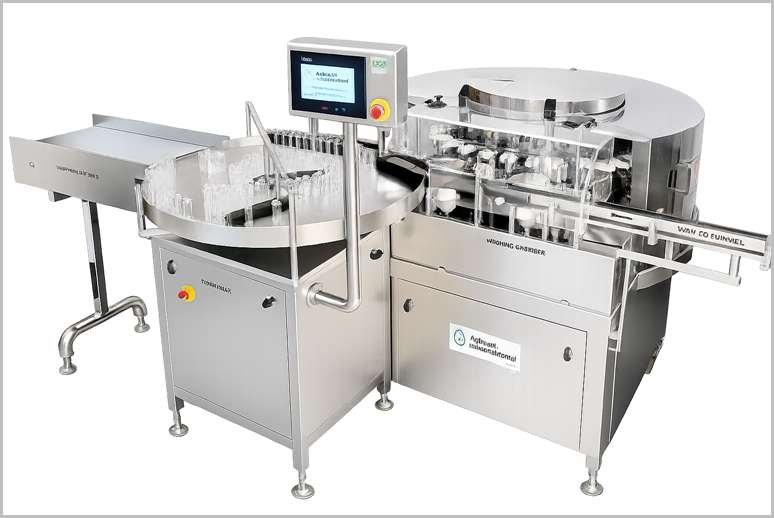
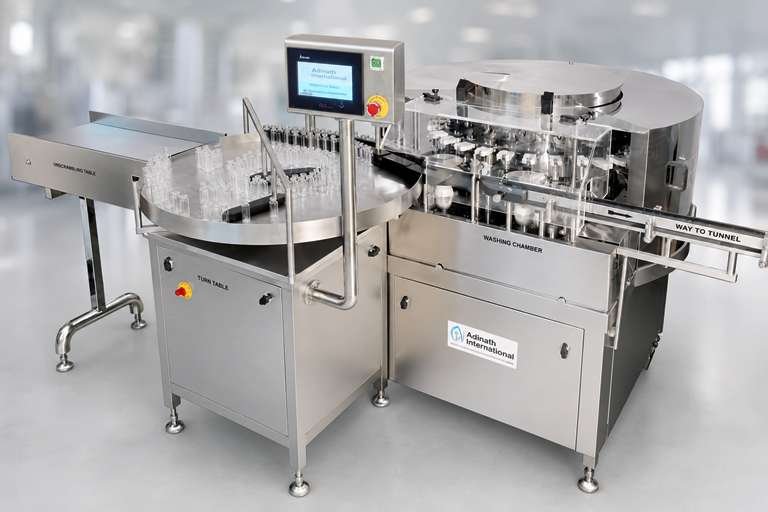
A Glass Ampoule Washer is a specialized machine used primarily in the pharmaceutical, veterinary, and biotech industries to clean glass ampoules (and sometimes vials) before filling them with injectable or sensitive substances. These machines ensure that ampoules are sterile, free from contaminants, and comply with Good Manufacturing Practice (cGMP) standards. Glass Ampoule Washers are designed to thoroughly clean and sterilize glass ampoules (typically ranging from 1ml to 25ml) to remove contaminants such as dust, particles, fibers, or residues. This ensures a sterile environment for filling pharmaceuticals, chemicals, or other sensitive liquids, maintaining product integrity and patient safety.
Ampoules feed from the Infeed tray are received on an Infeed Feed worm then moves on Infeed starwheel. The Grippers picks up the Ampoule from Infeed Star Wheel and invert it in neck down position over washing needles and move along with the needle bar for Washing. Ampoules traveling in neck down position above washing needles and moves along with the Needle bar ensures maximum time for washing once the needle enter in the Ampoule neck. Machine having six different washing stations each of 6 needles for optimum Washing and the sequence can be adjusted as per requirements. Washer also having external wash for optimum washing of ampoules.
On completion of a cycle, washed Ampoules are again inverted to neck upward position and feed to output star wheel. Washed Ampoules received from output starwheel can be collected on Output Tray or can be pushed to tunnel. A separate pumping station (optional) gives the right quantum of water at the desired pressure. In the absent of separate pumping station, we can provide the re-circulation & siliconization system on request.
INTERNAL CLEANING:
The AVRW is equipped with 6 internal cleaning stations and each station has 6 cleaning needles making up a total of 36 cleaning needles. Each cleaning station is supplied via a pipe connected to the cleaning media-making washing area. This not only reduces the risk of particle generation, but also simplifies maintenance and cleaning efforts while saving time.
EXTERNAL CLEANING
The 3 external cleaning stations mounted in a stationary position above the ampoule can be easily adjusted for a specific height, angle and lateral position. Each cleaning station receives cleaning media-making through a pipe connected to the cleaning media-making washing area.
CLEANING MEDIA PRINCIPAL:
WFI, Purified water and air cleaning station are synchronized with the ampoule by reciprocating motion. Design is such that these media are put to use only when needles motion in forward direction. WFI consumption is further reduced by collecting the WFI in re-circulating water tank to be used later on in the pre-washing station.
Model | AVRW 120 | AVRW 240 |
Production Output | Up to 100 per minute | Up to 200 per minute |
Ampoule Diameter | 9mm to 21.5mm | 9mm to 21.5mm |
Ampoule Height | 60mm to 140mm | 60mm to 140mm |
Power Load | 4 H.P. | 5.5 H.P. |
Power Voltage | 440 Volts, 3 Phase 50 Hertz, 4 wire system | 440 Volts, 3 Phase 50 Hertz, 4 wire system. |
Optional Accessories |
|
|
Utility |
|
|
Water Tank & Pump | 3 nos. each with 25 liters Capacity & Centrifugal pump | 3 nos. each with 25 liters Capacity & Centrifugal pump |
Overall Dimension: | 2050mm (L) X 2000mm (W) X 1210mm (H) approx. | 2450mm (L) X 2000mm (W) X 1300mm (H) approx. |
Net Weight | 700 kgs. approx. | 900 kgs. approx. |
Gross Weight | 1000 kgs. approx. | 1300 kgs. approx. |
* Power voltage can be adjusted as per customer’s domestic power voltage requirements.
* Rights of technical improvements & modification reserved.
* Illustrations & dimensions are shown for information purpose only.
1st wash | Recycled Water (WFI) |
2nd wash | Compressed Air |
3rd wash | DM Water |
4th wash | Compressed Air |
5th wash | Water for Injection (WFI) |
6th wash | Compressed Air |
A Glass Ampoule Washer is an automatic rotary washing machine designed to thoroughly clean glass ampoules internally and externally before they are filled with injectable liquids, vaccines, or other sterile products. It removes dust, particles, fibers, and residues to ensure high cleanliness and sterility. It is widely used in the pharmaceutical, veterinary, biotech, cosmetic, and chemical industries.
Key features include a complete cGMP-compliant design with AISI 316L stainless steel contact parts, 3 water washes + 3 air washes with independent circuits to prevent cross-contamination, 18 jets across 6 internal washing zones (total 36 needles), neck-gripping system that inverts ampoules for minimal contact, adjustable washing sequence, PLC with HMI (optional), digital speed indicator, container counter, and water recycling to reduce WFI consumption. It can be used as a standalone machine or inline with other equipment.
We offer two models:
It handles glass ampoules from 1ml to 10ml (diameter 9mm to 21.5mm and height 60mm to 140mm). Quick-change parts allow easy changeover for different sizes.
Ampoules are loaded from an infeed tray onto a feed worm and starwheel. Grippers pick them up, invert them neck-down, and move them over washing needles. They pass through 6 internal washing stations (reciprocating needles) and 3 external spray stations using a typical sequence: Recycled WFI → Air → DM Water → Air → Fresh WFI → Air. After washing, ampoules are re-inverted neck-up and discharged automatically. Independent circuits and synchronized media flow ensure thorough cleaning with minimal contamination risk.
Utilities required:
Yes, the machine is fully cGMP compliant with polished SS 316L contact parts, IQ/OQ/DQ validation documentation, and optional 21 CFR Part 11 compliant controls. It meets pharmaceutical standards for sterile injectable production.
Yes — Adinath International Glass Ampoule Washer complies to cGMP, MHRA, FDA and WHO-GMP standards, with optional CE marked equipments and 21 CFR Part 11 software compliance for the HMI/PLC. Machine contact parts having Stainless Steel 316L grade materials with validation documents having IQ, OQ, DQ validation protocols as optional. Organization is ISO 9001:2015 certified.
Manufacturing lead time is generally 7 to 14 weeks from order confirmation. Further it takes 2 to 8 weeks for international shipping depending upon destination. Order can be expediate sooner or later as per specific buying requirements. Destination specific certifications like US FDA, EU, ANVISA, SFDA. CE can add 3 to 6 weeks additionally.
Yes, Adinath International Glass Ampoule Washer export this machine to more than 48 countries of this world including America, Europe, Asia, Middle East, Africa, CIS and Australia sub continents. Please visit our clientele page for complete list of our customers worldwide. Located at Ahmedabad, India having world class infrastructure.
Service of skilled engineers and technicians provided for technical support of supplied equipments. Installations, commissioning, training and IQ, OQ, DQ validations performed by qualified engineers. Remote support through video call, phone, email and other modes provided for international installations. Spare parts of Glass Ampoule Washer stocked at our premises in Ahmedabad and shipped immediately after ordering. Standard 12 months manufacturing warranty included with supplied equipment.
Algeria | Angola | Argentina | Australia | Austria | Bahrain | Bangladesh | Belarus | Belgium | Bolivia | Botswana | Brazil | Bulgaria | Canada | Chile | China | Colombia | Costa Rica | Cuba | Czech Republic | Denmark | Dominican Republic | Ecuador | Egypt | El Salvador | Ethiopia | Finland | France | Germany | Ghana | Greece | Guatemala | Haiti | Honduras | Hong Kong | Hungary | India | Indonesia | Iran | Ireland | Israel | Italy | Ivory Coast | Japan | Jordan | Kazakhstan | Kenya | Kuwait | Lebanon | Libya | Malaysia | Mexico | Mongolia | Morocco | Mozambique | Myanmar | Netherlands | New Zealand | Nicaragua | Nigeria | Norway | Oman | Pakistan | Panama | Paraguay | Peru | Philippines | Poland | Portugal | Qatar | Romania | Russia | Saudi Arabia | Senegal | Slovakia | Singapore | South Africa | South Korea | South Sudan | Spain | Sri Lanka | Sweden | Switzerland | Taiwan | Tanzania | Thailand | Trinidad and Tobago | Tunisia | Turkey | Uganda | Ukraine | United Arab Emirates | United Kingdom | United States | Uruguay | Uzbekistan | Venezuela | Vietnam | Zambia | Zimbabwe
Connect with our engineering team to discuss your specific production requirements. We provide customized, cGMP-compliant machinery solutions designed to optimize your manufacturing facility and maximize output.
©Adinath International | Theme Developed By Pharma Machinery Manufacturer I Website updated on: 09 October 2026
WhatsApp us
