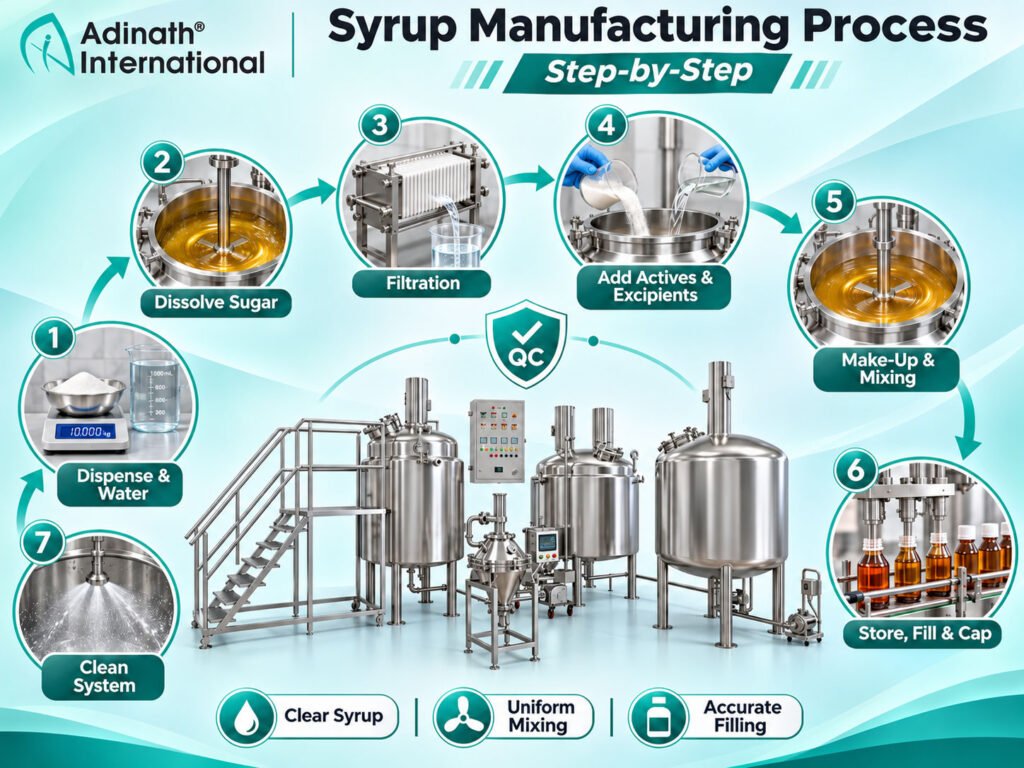
The syrup manufacturing process turns purified water, sugar and a set of active ingredients and excipients into a clear, uniform liquid that can be filled into bottles. Each step builds on the one before: if the sugar is not fully dissolved, filtration struggles; if ingredients are added in the wrong order or at the wrong temperature, the batch may not be uniform. Getting the sequence right is what makes one batch match the next.
This guide follows a typical batch from dispensing to capped bottles. It is written for production engineers, supervisors and buyers who want a practical, step-by-step view of what happens and why. Exact quantities, temperatures and times always come from the product’s approved batch record; the steps below describe the general pattern. If you are looking at equipment for the process, you can browse all manufacturing plants for oral liquids.
The syrup manufacturing process at a glance
The flowchart shows the main steps in order. Some steps, such as cooling before additions, depend on the product and are shown with a dashed outline.
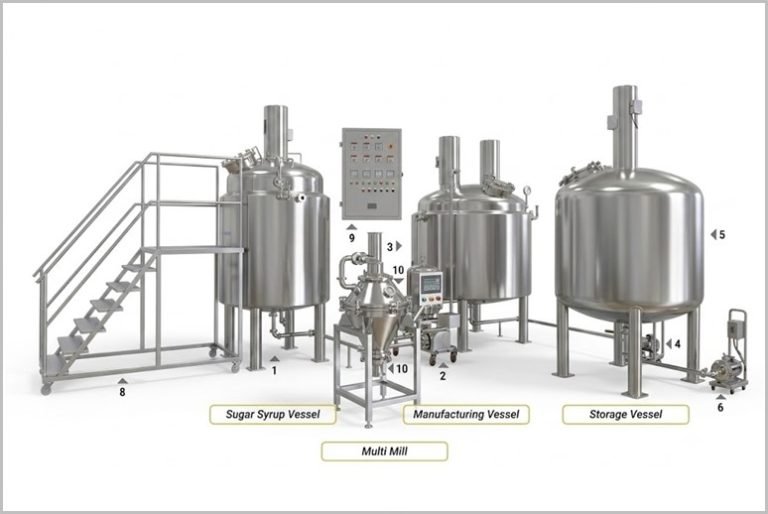
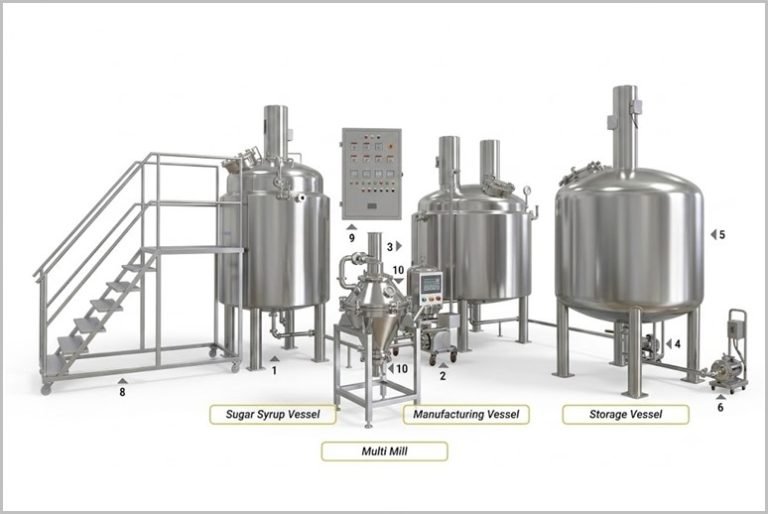
The process runs through a connected set of vessels: a sugar melting vessel, a filter press, a manufacturing vessel and a storage vessel, linked by pumps and pipework. This guide concentrates on the process steps that run through that equipment.
Step 1: Dispensing and water
Every batch starts with dispensing: weighing or measuring each raw material against the batch record. Sugar, actives, preservatives, buffers, colours and flavours are weighed separately, labelled and checked by a second person or by a weighing system that records the result. Dispensing errors cannot be corrected later without risk to the batch, so this step is treated with the same care as any other critical operation.
Water is the largest ingredient in most syrups. Pharmaceutical syrups are made with purified water, supplied from the site’s water system to a point of use at the vessel. Before use, operators normally confirm that the water system is in a released state. The quantity charged at this step is less than the final batch volume, because space is left for the sugar and other ingredients and for the final make-up.
Checks before starting
- Vessels, pipes and filter press are clean and labelled with their cleaning status.
- Dispensed materials match the batch record by name, quantity and batch number.
- Utilities such as steam, cooling water and compressed air are available.
- Filter media of the correct grade is fitted and the press is assembled.
Step 2: Dissolving sugar
Purified water is charged into the sugar melting vessel and heated. The sugar is then added while the high-speed stirrer runs. Adding sugar steadily, rather than in one dump, helps prevent lumps forming and stops undissolved sugar settling on the heated bottom.
Heat speeds up dissolving considerably, so the batch is held at the temperature specified in the batch record, with stirring, until all sugar has dissolved. The operator usually confirms this visually through the sight glass. Over-heating is avoided because sucrose can partly break down into glucose and fructose (inversion) and darken (caramelise) when held hot for too long, especially in acidic conditions.
The concentration of the sugar solution depends on the formula. As a reference point, the classic pharmacopoeial simple syrup is a highly concentrated sucrose solution; the exact strength is defined in the pharmacopoeia your product follows. Many medicated syrups use less sugar, or use other sweeteners such as sorbitol solution, but the dissolving step follows the same pattern.
Step 3: Filtration
Once the sugar has dissolved, the hot syrup is pumped through a filter press. Filtration removes insoluble matter from the sugar, such as fibres and dust, and any remaining undissolved crystals. Filtering while the syrup is still hot keeps its viscosity low, so it passes through the filter media at a reasonable rate.
The first portion of filtrate is often recirculated back to the vessel until it runs clear, because the media may let a little haze through until it settles. The operator watches the pressure gauge: a rising pressure means the media is loading with solids.
The filtered syrup is transferred to the manufacturing vessel by pump or vacuum. In a closed plant, such as our Syrup Manufacturing Plant models, this transfer happens through fixed pipework rather than in open containers.
Step 4: Adding actives and excipients
In the manufacturing vessel, the syrup base becomes the finished product. The order of addition is part of the formula and is usually chosen to make each ingredient dissolve or disperse completely without harming the others.
Cooling before additions
Many ingredients are sensitive to heat. Flavours can evaporate, some actives degrade, and colours may change. The syrup is therefore cooled, usually by passing cooling water through the vessel jacket, to the temperature stated in the batch record before these ingredients are added.
Pre-dissolving
Ingredients added in small amounts are often dissolved first in a portion of purified water, or in a co-solvent such as propylene glycol or glycerin where the formula specifies it. Adding a solution rather than a powder spreads the ingredient through the batch faster and avoids undissolved particles. Insoluble ingredients in a suspension are usually dispersed with a high-shear mixer or homogeniser so that particles are evenly distributed.
| Ingredient type | Typical approach | Reason |
|---|---|---|
| Preservatives | Dissolved first, often in warm water or a co-solvent | Some dissolve slowly in cold syrup |
| Active ingredient | Pre-dissolved or dispersed, then added with stirring | Uniform content in every bottle |
| Buffers and pH adjusters | Added and pH checked | Stability of the active and preservative |
| Colours | Pre-dissolved in water | Even colour without specks |
| Flavours | Added after cooling | Limits loss of volatile components |
Additions are made through a charging port while the agitator runs, and each addition is recorded. Vessels for this stage are also available as standalone units as jacketed mixing tanks.
Step 5: Volume make-up and mixing
After all ingredients have been added, purified water is added to bring the batch to its final volume or weight. Volume make-up is done at the temperature stated in the batch record, because liquids expand when warm: a batch made up while hot will be slightly short of volume when it cools. Some sites make up by weight, using load cells on the vessel, which avoids this effect.
The batch is then mixed for the specified time so that the make-up water is fully blended in. Dense sugar syrup and lighter water do not mix instantly, and incomplete mixing can leave layers with different concentrations. Where an in-line homogeniser is installed, the batch may be recirculated through it during this stage.
At the end of mixing, samples are taken for in-process tests named in the specification, such as appearance, pH, density or specific gravity, and assay. The batch moves on only when the results are within limits.
Step 6: Storage, filling and capping
The finished bulk is pumped to a storage vessel, where it waits for quality release. Storage frees the manufacturing vessel for the next batch. If the product is a suspension, the storage vessel’s stirrer runs to stop solids settling.
After release, the bulk is transferred to the filling machine, either by moving a mobile storage vessel to the filling room or by pumping through pipework to a buffer tank at the filler. A syrup preparation plant is an example of a plant arranged to feed bulk directly to a filling line.
Filling
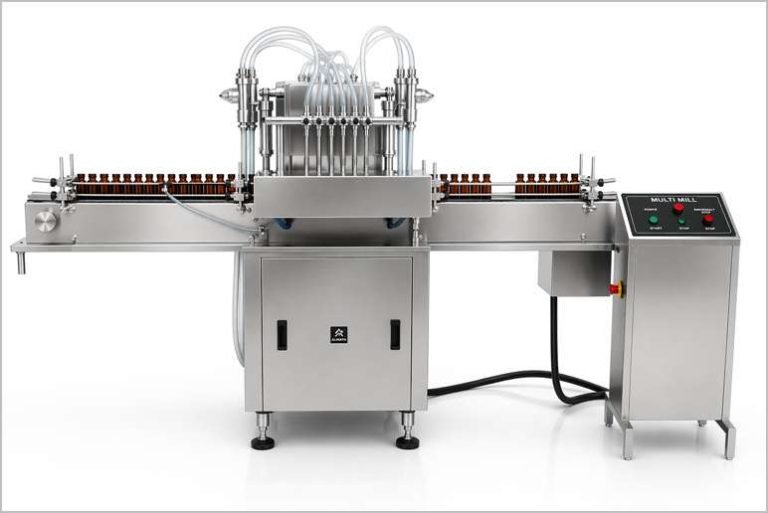
Bottles are rinsed or air-cleaned, filled to the set volume, and moved to capping. Volumetric piston filling is widely used for syrups because it handles a range of viscosities. A multi-head automatic liquid bottle filling machine is typical for this duty, with the number of heads chosen for the bottle size and output.
Capping and labelling
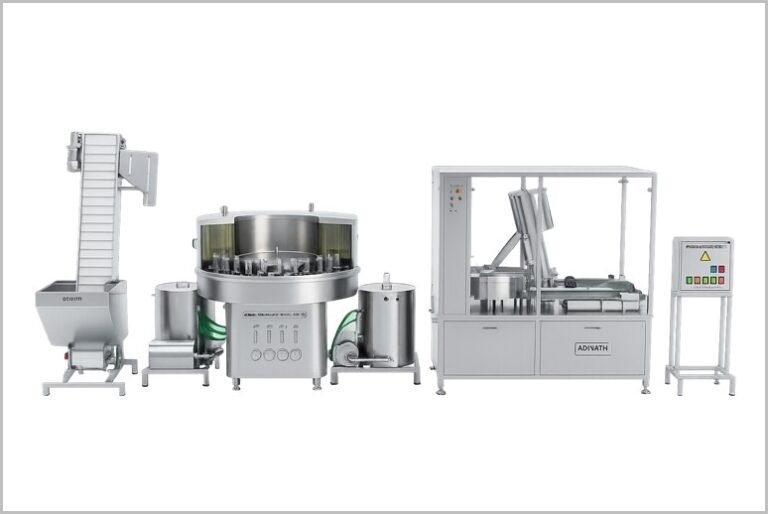
Filled bottles are capped, commonly with screw caps or ROPP (roll-on pilfer-proof) aluminium caps, then labelled and packed. On an integrated oral liquid filling line, washing, filling, capping and labelling machines are linked by conveyors so bottles move from one machine to the next without manual handling.
In-process checks and records
A syrup batch is only as reliable as its records. Each step in the syrup manufacturing process produces information that the batch record captures, so that anyone reviewing the batch can see what was done, when and by whom. The table below shows the kind of check usually linked to each step; the exact tests and limits always come from the product specification and site procedures.
| Step | Typical check or record |
|---|---|
| Dispensing | Material identity, quantity, batch number, second-person or system verification |
| Dissolving sugar | Temperature, stirring time, visual confirmation of complete dissolving |
| Filtration | Filter media grade, inlet pressure, clarity of filtrate |
| Additions | Order of addition, temperature at each addition, time |
| Make-up and mixing | Final volume or weight, mixing time, in-process test results |
| Storage | Vessel identity, status label, hold time before filling |
Cleaning between batches
Sugar-rich residues are a good growth medium for micro-organisms, so vessels, pumps, pipework and the filter press are cleaned after each batch or campaign as the site’s cleaning procedure requires. Warm purified water dissolves sugar residues readily, which is why a hot rinse is normally the first stage of cleaning. Where the plant has CIP (clean-in-place) connections, cleaning solutions are circulated through spray balls in the vessels and through the lines; otherwise parts are dismantled and cleaned manually.
The filter press needs particular attention. Used media is discarded, the plates and shell are washed, and the press is reassembled with fresh media before the next batch. Lines are drained at their low points so no rinse water is left standing. Cleaning status labels on each item tell the next shift which equipment is ready for use.
Common process problems
| Symptom | Likely cause | What to check |
|---|---|---|
| Crystals form in stored syrup | Sugar concentration too high or incomplete dissolving | Dispensed quantity, dissolving time and temperature |
| Hazy product | Filtration bypass or insoluble ingredient | Filter media seating, ingredient solubility |
| Off-colour batch | Overheating of sugar syrup | Heating time and temperature records |
| Assay out of limits | Dispensing error or incomplete mixing | Dispensing records, mixing time, sample point |
| Volume variation in bottles | Unsteady supply or air in filler | Buffer tank level, filler settings |
Conclusion
The syrup manufacturing process follows a clear order: dispense and check materials, dissolve sugar in heated purified water, filter the hot syrup, cool where needed, add actives and excipients in a defined order, make up to volume, mix, sample and store, and finally fill, cap and label. Each step protects the next, and most quality problems trace back to dispensing, heating, filtration or mixing.
If you are setting up or upgrading an oral liquid facility, our team can help match the plant and filling equipment to your product range. Send us an enquiry about a syrup manufacturing plant and share your batch sizes, product types and bottle formats.
 Summarize this article with: