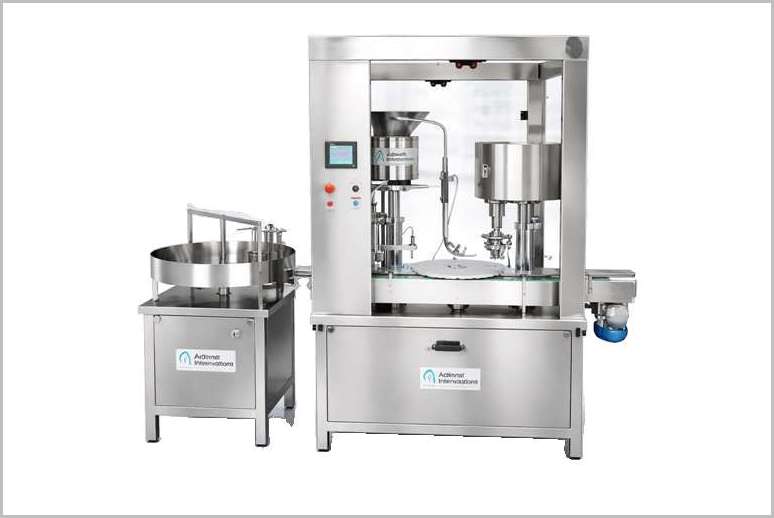
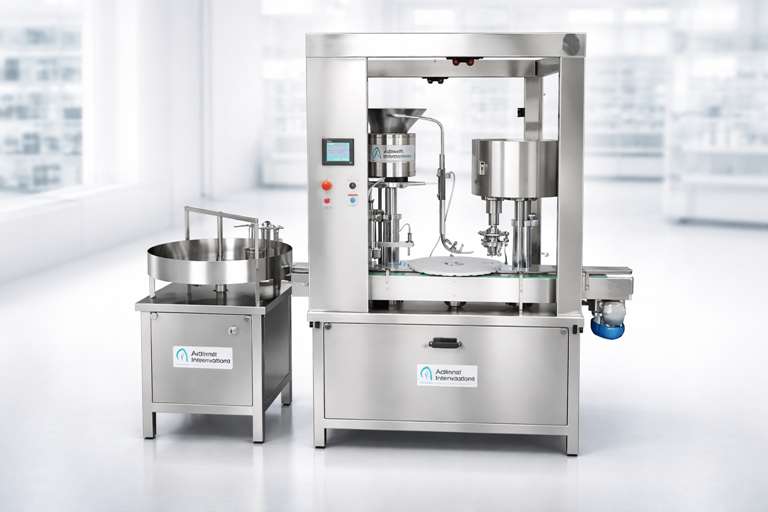
Sterile Liquid Filling Machine is specialized equipment designed to fill containers such as vials, bottles, syringes, or cartridges with liquid products under strict aseptic conditions to prevent contamination, primarily used in the pharmaceutical, biotechnology, and cosmetics industries. These machines ensure precision, hygiene, and compliance with stringent regulatory standards like cGMP and FDA requirements.
If you need details on specific models and pricing, let me know!
Bottles are feed on to in-built Infeed turn table, from where it delivered to SS conveyor belt. Conveyor belt transport bottles to filling station. Filling station has Pneumatic bottle stopper for exact bottle neck centering of bottles during filling operation.
Nozzle goes upwards slowly from the bottom level of bottle towards neck during filling to minimize forming adjustable nozzle is reciprocating according to filling dose.
The dosing block with a hexagonal bolt, this means different fill size can be set easily within minimum use of time.
After liquid filling bottles are delivered to capping/labeling machine conveyor for further operations.
Model | ALVF-40 | ALVF-80 | ALVF-120 | ALVF – 250 |
Filling Heads | Two | Four | Eight | Twelve |
Production Rate | Up to 40 Vials/Minute | Up to 80 Vials/Minute | Up to 150 Vials/Minute | Up to 250 Vials/Minute |
Vial Diameter | 15mm to 70mm | 15mm to 70mm | 15mm to 70mm | 15mm to 70mm |
Vial Height | 25mm to 140mm | 25mm to 140mm | 25mm to 140mm | 25mm to 140mm |
Filling Precision | ±1% | ±1% | ±1% | ±1% |
Power Required | 1 H.P. | 1.5 H.P. | 2 H.P. | 2 H.P. |
Electrical Characteristics | 440 Volts, 3 Phase, 50 Hertz | 440 Volts, 3 Phase, 50 Hertz | 440 Volts, 3 Phase, 50 Hertz | 440 Volts, 3 Phase, 50 Hertz |
Overall Dimension | 2050mm (L) x 850mm (W) x 1700mm (H) | 2200mm (L) x 850mm (W) x 1700mm (H) | 3000mm (L) x 945mm (W) x 1700mm (H) | 3500mm (L) x 945mm (W) x 1700mm (H) |
* Power voltage can be adjusted as per customer’s domestic power voltage requirements.
* Rights of technical improvements & modification reserved.
* Illustrations & dimensions are shown for information purpose only.
A Sterile Liquid Filling Machine is specialized equipment designed to fill vials, bottles, syringes, or cartridges with liquid products under strict aseptic/sterile conditions. It prevents microbial contamination during the filling and stoppering process, making it essential for pharmaceuticals (injectables, vaccines), biotechnology, and high-end cosmetics. The machine operates in a sterile area under laminar flow protection and complies with cGMP and FDA standards.
The machine is available in four main models:
Filling range: 2 ml to 250 ml with ±1% filling accuracy. It handles vial diameters of 15–70 mm and heights of 25–140 mm.
Key features include:
Vials are fed via an infeed turntable onto the SS conveyor belt. A pneumatic stopper centers each vial under the filling nozzles. The nozzles descend and move upward during filling (reciprocating motion) to minimize foaming. Precise dosing is achieved via the adjustable dosing block. After filling, vials proceed to the stoppering unit (often with pre- and post-gassing) and then to capping or labeling. The entire process maintains sterility under laminar airflow.
It is primarily used in the Pharmaceutical, Biotechnology, Cosmetic, and Veterinary industries. Main benefits include:
United States | Canada | Mexico | Brazil | Argentina | Chile | Colombia | Peru | Germany | United Kingdom | France | Italy | Spain | Netherlands | Belgium | Switzerland | Sweden | Austria | Denmark | Norway | Poland | Finland | Czech Republic | Hungary | Portugal | Ireland | Greece | Slovakia | Romania | Bulgaria | China | Japan | India | South Korea | Indonesia | Vietnam | Thailand | Malaysia | Philippines | Singapore | Bangladesh | Pakistan | Saudi Arabia | United Arab Emirates | Israel | Turkey | Iran | Qatar | Kuwait | South Africa | Nigeria | Egypt | Algeria | Morocco | Kenya | Ghana | Tunisia | Australia | New Zealand | Russia | Ukraine | Belarus | Kazakhstan | Taiwan | Hong Kong | South Sudan | Uzbekistan | Oman | Jordan | Bahrain | Sri Lanka | Myanmar | Lebanon | Mongolia | Ethiopia | Libya | Angola | Zambia | Zimbabwe | Mozambique | Ivory Coast | Senegal | Uganda | Tanzania | Botswana | Ecuador | Venezuela | Bolivia | Paraguay | Uruguay | Trinidad and Tobago | Panama | Guatemala | Costa Rica | Honduras | El Salvador | Nicaragua | Dominican Republic | Haiti | Cuba
Connect with our engineering team to discuss your specific production requirements. We provide customized, cGMP-compliant machinery solutions designed to optimize your manufacturing facility and maximize output.
Algeria | Angola | Argentina | Australia | Austria | Bahrain | Bangladesh | Belarus | Belgium | Bolivia | Botswana | Brazil | Bulgaria | Canada | Chile | China | Colombia | Costa Rica | Cuba | Czech Republic | Denmark | Dominican Republic | Ecuador | Egypt | El Salvador | Ethiopia | Finland | France | Germany | Ghana | Greece | Guatemala | Haiti | Honduras | Hong Kong | Hungary | India | Indonesia | Iran | Ireland | Israel | Italy | Ivory Coast | Japan | Jordan | Kazakhstan | Kenya | Kuwait | Lebanon | Libya | Malaysia | Mexico | Mongolia | Morocco | Mozambique | Myanmar | Netherlands | New Zealand | Nicaragua | Nigeria | Norway | Oman | Pakistan | Panama | Paraguay | Peru | Philippines | Poland | Portugal | Qatar | Romania | Russia | Saudi Arabia | Senegal | Slovakia | Singapore | South Africa | South Korea | South Sudan | Spain | Sri Lanka | Sweden | Switzerland | Taiwan | Tanzania | Thailand | Trinidad and Tobago | Tunisia | Turkey | Uganda | Ukraine | United Arab Emirates | United Kingdom | United States | Uruguay | Uzbekistan | Venezuela | Vietnam | Zambia | Zimbabwe
Connect with our engineering team to discuss your specific production requirements. We provide customized, cGMP-compliant machinery solutions designed to optimize your manufacturing facility and maximize output.
©Adinath International | Theme Developed By Pharma Machinery Manufacturer I Website updated on: 18 September 2026
WhatsApp us
