
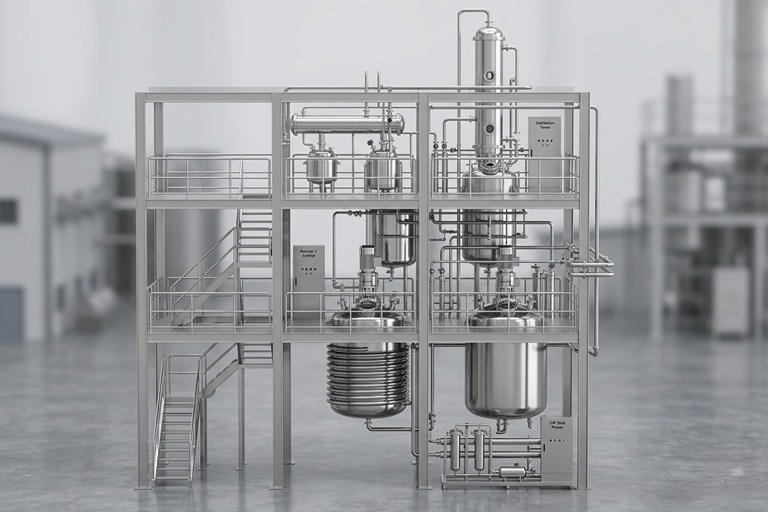
Alkyd Resin Manufacturing Plant is a specialized chemical processing facility designed for the esterification and polymerization of raw materials into alkyd resins. These plants typically operate on a batch or semi-continuous basis, with capacities ranging from 5-50 tons per batch, depending on reactor size. They emphasize safety, precision temperature control, and efficient water removal to ensure high-quality, consistent resin output. Modern plants incorporate automation for monitoring acid value, viscosity, and color, while adhering to VOC emission standards.
If you need details on specific models and pricing, let me know!
The solvent process is the most common commercial method, conducted in a single- or two-stage batch cycle lasting 8-16 hours. It uses 5-10% solvent as a reflux medium to facilitate water removal via azeotropic distillation.
Alternative processes include:
Component | Purpose | Typical Specifications |
Reactor | Esterification/polymerization | 200-260°C, 5-10 bar pressure, jacketed for steam/thermal fluid |
Distillation Unit | Water azeotrope removal | Xylene reflux, 5-10% solvent charge |
Product clarification | Removes particulates >10 microns | |
Blender | Thinning & mixing | Adjustable for 40-70% solids content |
* Power voltage can be adjusted as per customer’s domestic power voltage requirements.
* Rights of technical improvements & modification reserved.
* Illustrations & dimensions are shown for information purpose only.
A typical alkyd resin plant includes:
Heating sources vary: natural gas, diesel, coal, or electric, with exhaust systems for fumes. Plants often integrate wastewater treatment and solvent recovery units for sustainability.
An Alkyd Resin Manufacturing Plant is a complete industrial system designed to produce Short Oil, Medium Oil, and Long Oil Alkyd Resins. These synthetic resins are widely used in the paint, coating, and varnish industries. Adinath International offers turnkey plants with all necessary equipment for efficient resin production.
The plant can manufacture Short, Medium, and Long Oil Alkyd Resins. Long oil variants are particularly suitable for enamel paints. Multipurpose plants can operate using both solvent and fusion processes.
Plants are available in capacities from 20 kgs to 40 MT per batch (on solid base). Common models range from 1 Ton to 10 Ton. The typical batch cycle time is approximately 16 hours from charging to filtration.
The complete plant includes a Resin Reactor, Blender, Column, Condenser, Vent Condenser, Receiver, Reflux Line, Cooling Tower, Thermic Fluid Heater/Boiler, Vacuum Ejector, Exhaust Blower, Resin Filter, Pipelines, Valves, and Platform.
Key benefits include high production efficiency, versatility across resin types, robust and durable design, low maintenance, optimized power consumption, consistent high-quality output, and full support from Adinath as a leading Indian manufacturer. It is ideal for scaling paint and coating production.
More Manufacturing Plants
 1 Ton Alkyd Resin Plant
 Higher Capacity Alkyd Resin Plant
 Stainless Steel Alkyd Resin Plant
 Cosmetic Manufacturing Plant
Algeria | Angola | Argentina | Australia | Austria | Bahrain | Bangladesh | Belarus | Belgium | Bolivia | Botswana | Brazil | Bulgaria | Canada | Chile | China | Colombia | Costa Rica | Cuba | Czech Republic | Denmark | Dominican Republic | Ecuador | Egypt | El Salvador | Ethiopia | Finland | France | Germany | Ghana | Greece | Guatemala | Haiti | Honduras | Hong Kong | Hungary | India | Indonesia | Iran | Ireland | Israel | Italy | Ivory Coast | Japan | Jordan | Kazakhstan | Kenya | Kuwait | Lebanon | Libya | Malaysia | Mexico | Mongolia | Morocco | Mozambique | Myanmar | Netherlands | New Zealand | Nicaragua | Nigeria | Norway | Oman | Pakistan | Panama | Paraguay | Peru | Philippines | Poland | Portugal | Qatar | Romania | Russia | Saudi Arabia | Senegal | Slovakia | Singapore | South Africa | South Korea | South Sudan | Spain | Sri Lanka | Sweden | Switzerland | Taiwan | Tanzania | Thailand | Trinidad and Tobago | Tunisia | Turkey | Uganda | Ukraine | United Arab Emirates | United Kingdom | United States | Uruguay | Uzbekistan | Venezuela | Vietnam | Zambia | Zimbabwe
Connect with our engineering team to discuss your specific production requirements. We provide customized, cGMP-compliant machinery solutions designed to optimize your manufacturing facility and maximize output.
©Adinath International | Theme Developed By Pharma Machinery Manufacturer I Website updated on: 15 October 2026
Request A Quick Quote
Alkyd Resin Manufacturing Plant
Please drop your requirements, one of our technical expert will contact you in next 24 working hours.
WhatsApp us
