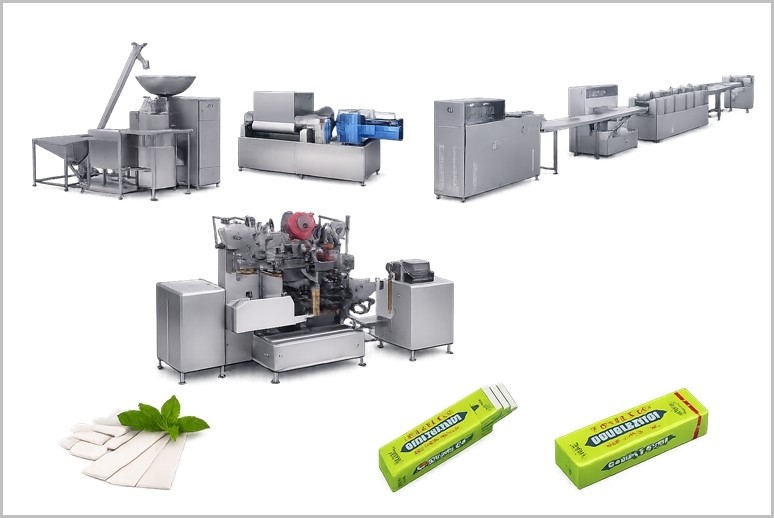
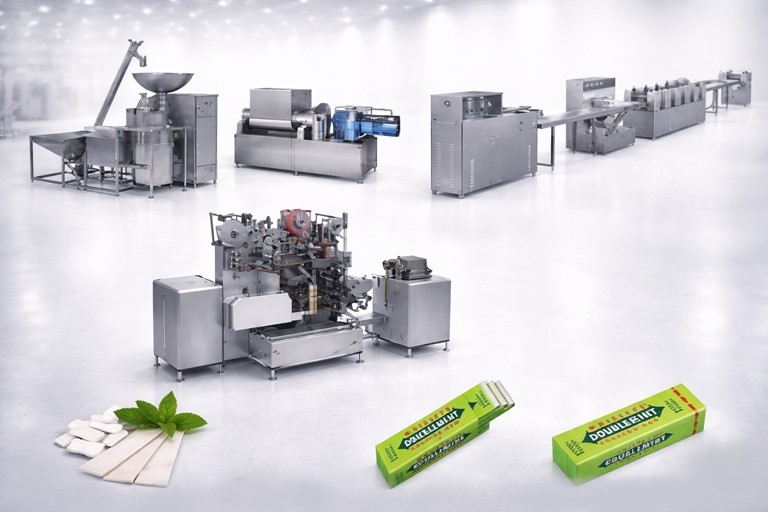
Bubble Gum Production Plant is a specialized industrial facility designed for the large-scale manufacturing of bubble gum, a type of chewing gum formulated to allow consumers to blow bubbles. Bubble Gum Production Plant is a highly automated, food-grade manufacturing facility that produces bubble gum in various forms and flavors. The plant integrates advanced machinery, quality control systems, and hygiene standards to ensure consistent production of safe, high-quality gum products that meet consumer demand and regulatory requirements.
If you need details on specific models and pricing, let me know!
* Power voltage can be adjusted as per customer’s domestic power voltage requirements.
* Rights of technical improvements & modification reserved.
* Illustrations & dimensions are shown for information purpose only.
A Bubble Gum Production Plant is a specialized industrial facility designed for large-scale manufacturing of bubble gum. It integrates advanced machinery for mixing high-viscosity gum base with sweeteners, flavors, and colors, followed by extrusion, forming, cooling, coating (optional), and packaging to produce high-quality, bubble-blowing gum in various shapes and flavors.
Key features include heavy-duty design for viscous materials, stainless steel 304/316 construction (hygienic and durable), tangential ‘Z’ sigma blades for uniform mixing, jacketed bowls for temperature control, manual/hydraulic discharge, and options like vacuum systems and automation. It ensures food-grade hygiene and consistent output.
The process starts with raw material preparation and precise mixing of gum base with additives. The mass is then extruded, formed into shapes, cooled to set structure, optionally coated, and finally packaged. Quality checks at each stage ensure consistency, safety, and desired elasticity for bubble blowing.
Essential equipment includes Sigma Mixers/Kneaders for compounding, extruders, forming/cutting machines, cooling tunnels, coating pans (for gumballs), polishing drums, high-speed packaging machines, and quality control systems. Supporting utilities like HVAC and CIP ensure hygiene.
Benefits include high automation for efficiency, scalability from small to large production, customization of flavors/shapes, consistent product quality, compliance with food safety standards, flexibility for market trends, and strong ROI due to global demand for confectionery products.
More Manufacturing Plants
 Cosmetic Cream Production Plant
 Ointment Production Plant
 1 Ton Alkyd Resin Plant
 Alkyd Resin Manufacturing Plant
Algeria | Angola | Argentina | Australia | Austria | Bahrain | Bangladesh | Belarus | Belgium | Bolivia | Botswana | Brazil | Bulgaria | Canada | Chile | China | Colombia | Costa Rica | Cuba | Czech Republic | Denmark | Dominican Republic | Ecuador | Egypt | El Salvador | Ethiopia | Finland | France | Germany | Ghana | Greece | Guatemala | Haiti | Honduras | Hong Kong | Hungary | India | Indonesia | Iran | Ireland | Israel | Italy | Ivory Coast | Japan | Jordan | Kazakhstan | Kenya | Kuwait | Lebanon | Libya | Malaysia | Mexico | Mongolia | Morocco | Mozambique | Myanmar | Netherlands | New Zealand | Nicaragua | Nigeria | Norway | Oman | Pakistan | Panama | Paraguay | Peru | Philippines | Poland | Portugal | Qatar | Romania | Russia | Saudi Arabia | Senegal | Slovakia | Singapore | South Africa | South Korea | South Sudan | Spain | Sri Lanka | Sweden | Switzerland | Taiwan | Tanzania | Thailand | Trinidad and Tobago | Tunisia | Turkey | Uganda | Ukraine | United Arab Emirates | United Kingdom | United States | Uruguay | Uzbekistan | Venezuela | Vietnam | Zambia | Zimbabwe
Connect with our engineering team to discuss your specific production requirements. We provide customized, cGMP-compliant machinery solutions designed to optimize your manufacturing facility and maximize output.
©Adinath International | Theme Developed By Pharma Machinery Manufacturer I Website updated on: 24 October 2026
Request A Quick Quote
Bubble Gum Production Plant
Please drop your requirements, one of our technical expert will contact you in next 24 working hours.
WhatsApp us
