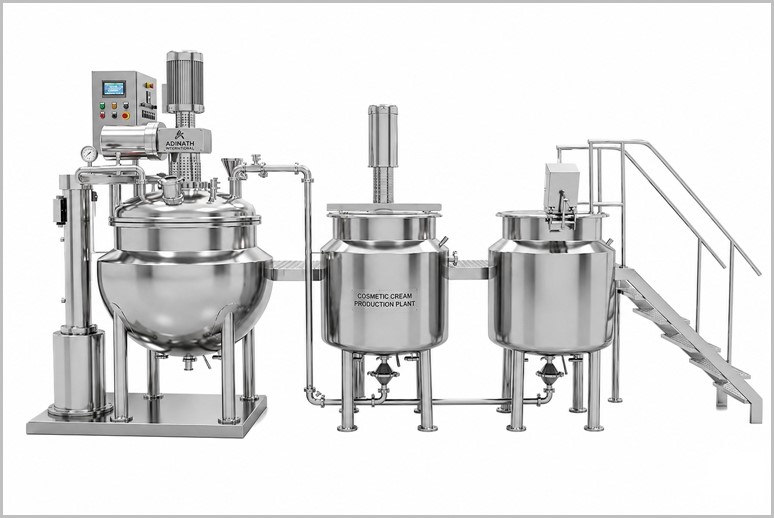
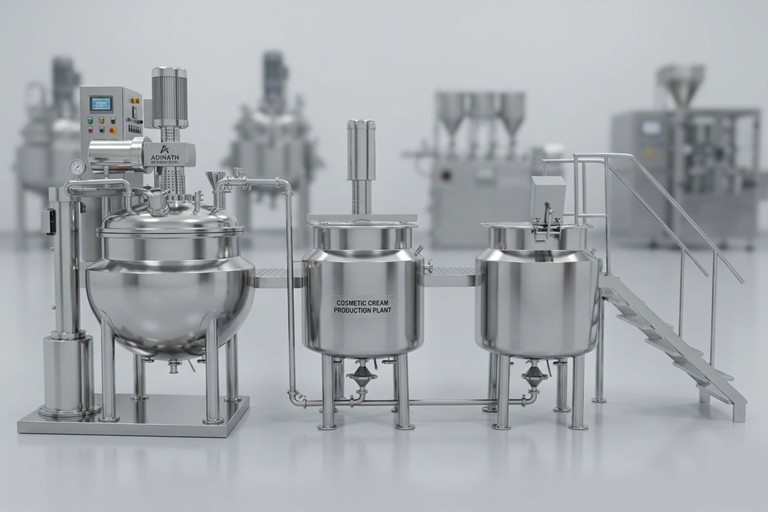
Cosmetic Cream Production Plant is a specialized industrial facility designed for the large-scale manufacturing of semi-solid cosmetic products such as moisturizers, face creams, lotions, body butters, and emulsions. These plants are engineered to handle oil-in-water (o/w) or water-in-oil (w/o) formulations, ensuring high-quality, homogeneous blends with minimal contamination and efficient processing. They are commonly used in the cosmetics, personal care, and sometimes pharmaceutical industries, with batch capacities ranging from 20 kg to over 2,000 kg. Key features include automated mixing, emulsification, homogenization, and filling systems that comply with standards like cGMP for hygiene and safety. The plant typically operates as a closed-circuit system to reduce human handling, maintain vacuum integrity during blending, and optimize manpower utilization. It incorporates stainless steel vessels for durability and corrosion resistance, along with features like recirculation pumps, temperature controls, and centralized PLC/HMI panels for automation.
If you need details on specific models and pricing, let me know!
The production of cosmetic creams follows a structured, temperature-controlled process to ensure stability, efficacy, and consistency. Here’s a typical 9-step workflow:

* Power voltage can be adjusted as per customer’s domestic power voltage requirements.
* Rights of technical improvements & modification reserved.
* Illustrations & dimensions are shown for information purpose only.
A Cosmetic Cream Production Plant is a specialized manufacturing facility designed for the production of semi-solid cosmetic formulations such as creams, lotions, gels, and emulsions. It ensures high-quality, stable, and homogeneous products through precise emulsification, homogenization, and temperature control while complying with GMP standards for the cosmetic and personal care industries.
Key features include low manpower operation (one operator + one helper), SS 304/SS 316 contact parts with mirror finish and tri-clover joints, cGMP-compliant vessels, integrated vacuum system for deaeration, high-speed emulsifiers/homogenizers, jacketed vessels for heating/cooling, CIP/SIP capability, and digital/PLC controls. Batch sizes range from lab to industrial scale.
The process involves separate preparation of oil phase and aqueous phase, followed by vacuum emulsification in the main vessel with high-shear mixing and homogenization. Active ingredients are incorporated, the mixture is cooled while stirring, and then transferred to storage for filling. This ensures smooth texture and long-term stability.
It is ideal for the Cosmetic, Pharmaceutical, Ayurvedic, Herbal, Nutraceutical, and Biotech industries. It supports production of moisturizers, anti-aging creams, sunscreens, medicated creams, gels, and other topical skincare and personal care formulations.
Benefits include high efficiency with minimal labor, excellent product uniformity and stability, reduced contamination risk through closed systems, easy cleaning and validation (CIP/SIP), scalability, and customizable options for different viscosities and formulations while meeting regulatory requirements.
More Manufacturing Plants
 Bubble Gum Production Plant
 Cosmetic Manufacturing Plant
 Cream Manufacturing Plant
 Cream Preparation Plant
Algeria | Angola | Argentina | Australia | Austria | Bahrain | Bangladesh | Belarus | Belgium | Bolivia | Botswana | Brazil | Bulgaria | Canada | Chile | China | Colombia | Costa Rica | Cuba | Czech Republic | Denmark | Dominican Republic | Ecuador | Egypt | El Salvador | Ethiopia | Finland | France | Germany | Ghana | Greece | Guatemala | Haiti | Honduras | Hong Kong | Hungary | India | Indonesia | Iran | Ireland | Israel | Italy | Ivory Coast | Japan | Jordan | Kazakhstan | Kenya | Kuwait | Lebanon | Libya | Malaysia | Mexico | Mongolia | Morocco | Mozambique | Myanmar | Netherlands | New Zealand | Nicaragua | Nigeria | Norway | Oman | Pakistan | Panama | Paraguay | Peru | Philippines | Poland | Portugal | Qatar | Romania | Russia | Saudi Arabia | Senegal | Slovakia | Singapore | South Africa | South Korea | South Sudan | Spain | Sri Lanka | Sweden | Switzerland | Taiwan | Tanzania | Thailand | Trinidad and Tobago | Tunisia | Turkey | Uganda | Ukraine | United Arab Emirates | United Kingdom | United States | Uruguay | Uzbekistan | Venezuela | Vietnam | Zambia | Zimbabwe
Connect with our engineering team to discuss your specific production requirements. We provide customized, cGMP-compliant machinery solutions designed to optimize your manufacturing facility and maximize output.
©Adinath International | Theme Developed By Pharma Machinery Manufacturer I Website updated on: 15 October 2026
Request A Quick Quote
Cosmetic Cream Production Plant
Please drop your requirements, one of our technical expert will contact you in next 24 working hours.
WhatsApp us
