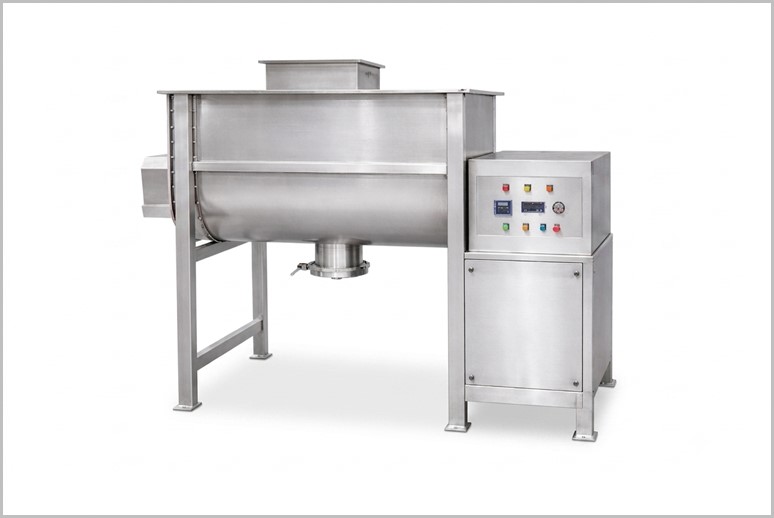
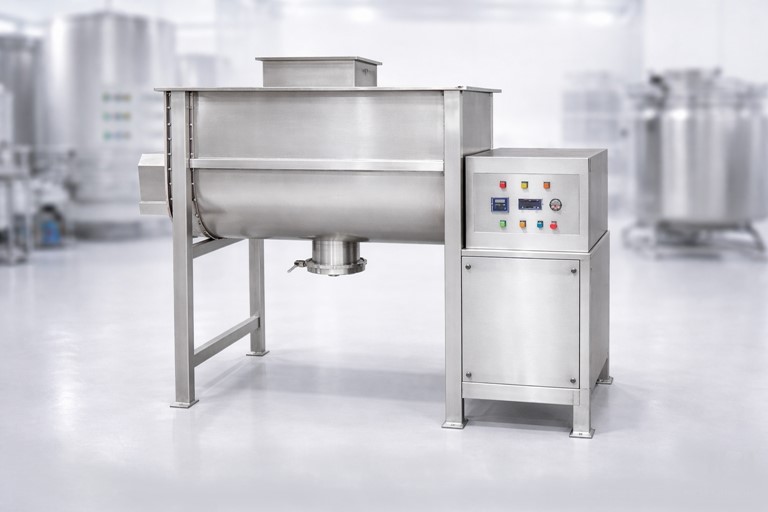
Food Grade Ribbon Blender is an industrial mixing machine designed for safe handling of edible or sanitary materials, typically featuring contact parts made from high-quality stainless steel to meet hygiene standards like GMP or FDA requirements. It consists of a U-shaped horizontal trough with a central agitator shaft supporting inner and outer helical ribbon blades that create a triple mixing action: outer ribbons move materials toward the center, while inner ones push them outward, ensuring efficient, homogeneous blending without dead spots. This gentle, low-shear process operates at speeds up to about 300 feet per minute, making it ideal for powders, granules, and light pastes while minimizing damage to fragile ingredients.
These blenders are widely used in the food industry for applications like mixing seasonings, beverage powders, spices, dry food products, nutraceuticals, and additives such as emulsifiers or sweeteners. They also support heating, cooling, vacuum drying, or coating solids with liquids, and can integrate features like screw conveyors for discharge or CIP (clean-in-place) systems for sanitation. Capacities range from small lab units to large production models up to 1000 cubic feet, with options for customization like adjustable speeds, jackets for temperature control, or sanitary valves.
Key manufacturers include Ross, AIM Blending Technologies, Stricklin Company, and Ability Fabricators. Used options are available from resellers like Federal Equipment or Aaron Equipment.
If you need details on specific models and pricing, let me know!
Material is charged in the blender through nozzles or feed-hoppers mounted on the top cover of the blender. Suppose if screw feeder is opted with mixer, then material to be load onto screw feeder and it will feed powder into blender. Filling to be done about 70 percent of the total volume of the container. This is generally up to the level of the outer ribbon’s tip. After feeding completes then please close the top cover of the blender and tighten the latches. Now start the machine form the control panel.
During the blending operation, the outer ribbons of the agitator interchange the material from the ends to the center while the inner ribbons transfer the material from the center to ends. Radial movement is achieved because of the rotational motion of the ribbons. The difference in the peripheral speeds of the outer and inner ribbons results in axial movement of the material along the horizontal axis of the blender. As a result of the radial and the counter-current axial movement, homogenous blending is achieved in short time. Blending is generally performed in 15 to 20 minutes cycle time. Mixing efficiency of ribbon blender depends upon particle size and its bulk density. Generally, ribbon mixer blender with 95% efficiency in most of the cases. Ingredients with similar particle size and bulk densities tend to mix faster as compared to ingredients with variation in these attributes.
After mixing, material is discharged from a discharge valve located at center bottom of container. The discharge can be fitted with any of these valves like slide-gate, butterfly, flush bottom, spherical and other types depending on the application. The operation of the valves can be manual or pneumatically actuated as per requirements. Sifter can be installed at discharge of the blender for sieving the output materials. Ribbon blenders can be designed for multiple discharge ports. Unlike tumbling blenders where 100% discharge of material is achieved by gravity, in a ribbon blender the material is discharged by rotation of the ribbon agitator. Finished powder can be collected directly on mobile container or can discharge onto conveyor for further operations.
Model | Gross Volume approx. | Working Volume approx. | Power |
RM-10 | 10 Liters | 5 Liters | 0.5 H.P. |
RM-50 | 50 Liters | 20 Liters | 1 H.P. |
RM-75 | 75 Liters | 50 Liters | 1 H.P. |
RM-150 | 150 Liters | 100 Liters | 2 H.P. |
RM-250 | 250 Liters | 150 Liters | 3 H.P. |
RM-450 | 450 Liters | 300 Liters | 5 H.P. |
RM-600 | 600 Liters | 450 Liters | 7.5 H.P. |
RM-1100 | 1100 Liters | 750 Liters | 10 H.P. |
RM-1500 | 1500 Liters | 1000 Liters | 12.5 H.P. |
RM-2000 | 2000 Liters | 1250 Liters | 15 H.P. |
RM-3000 | 3000 Liters | 1875 Liters | 20 H.P. |
RM-5000 | 5000 Liters | 3000 Liters | 25 H.P. |
RM-10000 | 10000 Liters | 6000 Liters | 40 H.P. |
* Power voltage can be adjusted as per customer’s domestic power voltage requirements.
* Rights of technical improvements & modification reserved.
* Illustrations & dimensions are shown for information purpose only.
Industrial Ribbon Blender Mixer is an efficient and versatile blending machine for mixing of dry granules & powders homogeneously. Approximately two third of the volume of the container of Ribbon Blender is filled to ensure proper mixing. The Ribbon Blender gives best result for mixing of dry powder & granules due to the design and shape of the mixing ribbon and product container. The outer ribbon displaces the material from the ends to the centre while the inner ribbon moves the material from the center to the ends. This counter-current action results in homogenous blending. The ribbons rotate at approximately 70 – 100 meters per minute and move the material both radially and laterally to ensure thorough blends in short cycle times.
A Food Grade Ribbon Blender is built with strict hygiene and safety standards in mind. All product-contact parts are typically made from high-quality SS304 or SS316L stainless steel, with mirror-polished surfaces (Ra < 0.4 μm), seamless welds, and radiused corners to eliminate bacterial harborage points. It features FDA-compliant seals/gaskets, easy-to-clean design (often with CIP options), and complies with GMP, cGMP, and other food safety regulations. This prevents contamination, cross-contact with allergens, and ensures suitability for food, nutraceutical, and spice blending applications.
For best results, load the blender to 40–70% of its gross volume (typically around 60–65% is ideal). Overfilling reduces mixing efficiency and can strain the motor, while underfilling may lead to poor material movement. Our models are designed for working capacities from 5 liters to 25,000 liters, allowing flexible batch sizes while achieving high homogeneity (up to 95%) in 5–20 minutes.
Yes. Many models support optional jackets for heating or cooling (using steam, hot water, or chilled fluids) to control temperature during mixing. Liquid addition is possible via spray nozzles or atomizers for coating powders or creating light pastes. Vacuum or inert gas options are also available for sensitive ingredients. These features make it versatile for spices, beverage mixes, protein powders, and more.
The design prioritizes sanitation with polished stainless steel surfaces, quick-release components, wide access lids, and a flush bottom discharge valve that minimizes residue. Stuffing boxes with Teflon gland packing or mechanical seals simplify disassembly. Many units support Clean-in-Place (CIP) systems. Routine maintenance involves checking lubrication, gearbox oil, and seals—ensuring low downtime and compliance with food safety audits.
Ribbon Blenders excel at gentle yet thorough mixing of dry powders and granules with their counter-current helical ribbons, delivering fast homogeneity with low shear. They are more versatile for cohesive materials and large volumes than V-Blenders (better for free-flowing fragile items) and often more efficient than paddle mixers for uniform distribution of minor ingredients. Ribbon blenders are preferred in food and pharma for their balance of speed, gentleness, and ease of cleaning.
Algeria | Angola | Argentina | Australia | Austria | Bahrain | Bangladesh | Belarus | Belgium | Bolivia | Botswana | Brazil | Bulgaria | Canada | Chile | China | Colombia | Costa Rica | Cuba | Czech Republic | Denmark | Dominican Republic | Ecuador | Egypt | El Salvador | Ethiopia | Finland | France | Germany | Ghana | Greece | Guatemala | Haiti | Honduras | Hong Kong | Hungary | India | Indonesia | Iran | Ireland | Israel | Italy | Ivory Coast | Japan | Jordan | Kazakhstan | Kenya | Kuwait | Lebanon | Libya | Malaysia | Mexico | Mongolia | Morocco | Mozambique | Myanmar | Netherlands | New Zealand | Nicaragua | Nigeria | Norway | Oman | Pakistan | Panama | Paraguay | Peru | Philippines | Poland | Portugal | Qatar | Romania | Russia | Saudi Arabia | Senegal | Slovakia | Singapore | South Africa | South Korea | South Sudan | Spain | Sri Lanka | Sweden | Switzerland | Taiwan | Tanzania | Thailand | Trinidad and Tobago | Tunisia | Turkey | Uganda | Ukraine | United Arab Emirates | United Kingdom | United States | Uruguay | Uzbekistan | Venezuela | Vietnam | Zambia | Zimbabwe
Connect with our engineering team to discuss your specific production requirements. We provide customized, cGMP-compliant machinery solutions designed to optimize your manufacturing facility and maximize output.
©Adinath International | Theme Developed By Pharma Machinery Manufacturer I Website updated on: 09 October 2026
WhatsApp us
