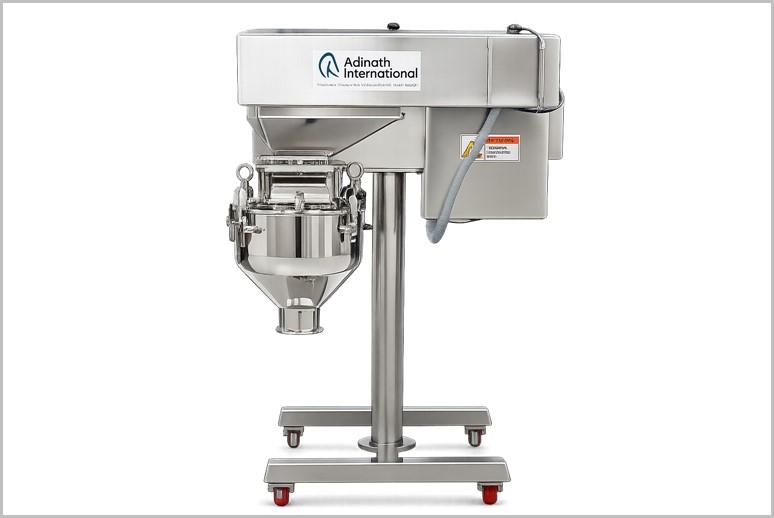
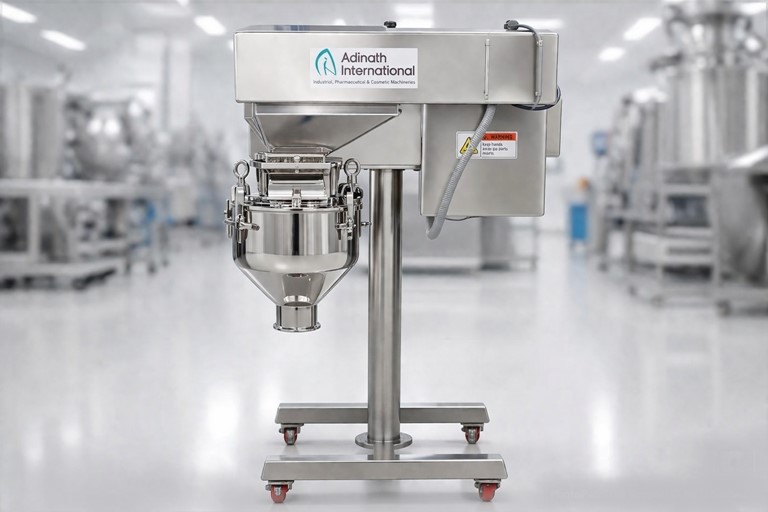
Sieving Multi Mill operates on the principle of impact, shear, and attrition for size reduction, combined with mechanical sieving for classification. Material is fed into the chamber where high-speed rotating blades strike and propel it against the chamber walls and screens. This “top-down” approach disintegrates coarse particles into finer ones via mechanical energy. Particles smaller than the screen aperture pass through radially or tangentially for discharge, while larger ones recirculate for further milling. The process ensures a narrow particle size distribution (PSD) by controlling rotor speed, screen size, and feed rate.
If you need details on specific models and pricing, let me know!
Unit consists of S.S 316 AISI quality material rotor fitted with 8 Nos. SS blades knife/impact edge having swing action and 2 Nos. scrapper blades. Rotor assembly fitted on SS shaft with suitable bearing. Other end of the shaft directly coupled with suitable H.P./3 PHASE/415V/60CS/2800 RPM flange mounting type motor through love jaw coupling. The speed variation will be achieved through A.C. Frequency drive unit with selected 4 speeds of i.e., 2800RPM/2200RPM/1600RPM/800RPM.
S.S Charging hopper with slide plate arrangement to control the material feed rate. S.S Screen with hold plate is provided to get desired size of granules. S.S discharge hopper with necessary holding arrangement. Drive unit supported on S.S column with S.S base plate fitted with PU castor wheels to achieve portability.
Model | MM-100 | MM 200 | MM-500 |
Production Output | Up to 100 Kgs. / Hour. | Up to 200 kgs./hour | Up to 500 Kgs. / Hour. |
Rotor assembly diameter | 150 mm Approx. | 250 mm (approx.) | 350 mm Approx. |
Rotor Speed | 750 / 1500 / 2300 / 3000 RPM | 750 / 1500 / 2300 / 3000 RPM | 750 / 1500 / 2100 / 3000 RPM |
Beaters | 12 knife & impact edges & 2 scrapper blades | 12 knife & impact edges & 2 scrapper blades | 12 knife & impact edges & 2 scrapper blades |
Screen dimensions approx. | Inner Diameter 160 mm | Inner diameter – 260 mm | Inner diameter – 350 mm |
Height 135 mm | Height – 135 mm | Height – 200 mm | |
Motor | 1 H. P., 1440 RPM, 440 Volts, 3 Phase, 50 Hz. | 3 H. P., 1440 RPM, 440 Volts, 3 Phase, 50 Hz. | 5 H. P., 1440 RPM, 440 Volts, 3 Phase, 50 Hz. |
Starter | DOL Starter with reversible switch | DOL Starter with reversible switch | VFD Panel |
Material Charging Height | 1250mm | 1445 mm approx. | |
Net Weight | 80 Kgs. approx. | 250 Kgs. approx. | Variable as required by client |
Gross weight | 150 Kgs. approx. | 400 kgs. approx. | 300 Kgs. approx. |
Overall Dimensions approx. (LXWXH) | 850mm x 950mm x 1630mm | 870mm x 965mm x 1630mm | 450 Kgs. approx. |
Case Dimensions approx. (LXWXH) | 1200mm x 1500mm x 1860mm | 1200mm x 1550mm x 1860mm |
* Power voltage can be adjusted as per customer’s domestic power voltage requirements.
* Rights of technical improvements & modification reserved.
* Illustrations & dimensions are shown for information purpose only.
The Sieving Multi Mill is a versatile, high-speed size reduction and sieving machine that combines milling with mechanical sieving for precise particle size control. It is designed for granulating, pulverizing, shredding, and classifying both wet and dry materials. It is widely used in Pharmaceutical, Ayurvedic, Herbal, Nutraceutical, Biotech, and Cosmetic industries to achieve narrow particle size distribution (PSD) for APIs, excipients, granules, and herbal powders while meeting cGMP standards.
Material is fed through the SS hopper into the milling chamber. A high-speed rotor with swing-type beaters (knife & impact edges) and scrapper blades subjects the material to impact, shear, and attrition forces. Particles are thrown against the perforated screen; those smaller than the screen aperture pass through, while larger particles continue to be milled until they achieve the desired size. The reversible rotor direction and variable speed ensure optimal performance.
We offer three main models:
Rotor speeds range from 750 to 3000 RPM. Lab-scale to production-scale models are available with customizable options.
The machine is designed for fast and thorough cleaning. All contact parts (hopper, screen, beaters, and discharge) can be easily dismantled without tools. Mirror-polished stainless steel surfaces and the absence of dead corners minimize residue. This enables quick product changeovers and supports strict GMP cleaning validation requirements.
Algeria | Angola | Argentina | Australia | Austria | Bahrain | Bangladesh | Belarus | Belgium | Bolivia | Botswana | Brazil | Bulgaria | Canada | Chile | China | Colombia | Costa Rica | Cuba | Czech Republic | Denmark | Dominican Republic | Ecuador | Egypt | El Salvador | Ethiopia | Finland | France | Germany | Ghana | Greece | Guatemala | Haiti | Honduras | Hong Kong | Hungary | India | Indonesia | Iran | Ireland | Israel | Italy | Ivory Coast | Japan | Jordan | Kazakhstan | Kenya | Kuwait | Lebanon | Libya | Malaysia | Mexico | Mongolia | Morocco | Mozambique | Myanmar | Netherlands | New Zealand | Nicaragua | Nigeria | Norway | Oman | Pakistan | Panama | Paraguay | Peru | Philippines | Poland | Portugal | Qatar | Romania | Russia | Saudi Arabia | Senegal | Slovakia | Singapore | South Africa | South Korea | South Sudan | Spain | Sri Lanka | Sweden | Switzerland | Taiwan | Tanzania | Thailand | Trinidad and Tobago | Tunisia | Turkey | Uganda | Ukraine | United Arab Emirates | United Kingdom | United States | Uruguay | Uzbekistan | Venezuela | Vietnam | Zambia | Zimbabwe
Connect with our engineering team to discuss your specific production requirements. We provide customized, cGMP-compliant machinery solutions designed to optimize your manufacturing facility and maximize output.
©Adinath International | Theme Developed By Pharma Machinery Manufacturer I Website updated on: 09 October 2026
WhatsApp us
