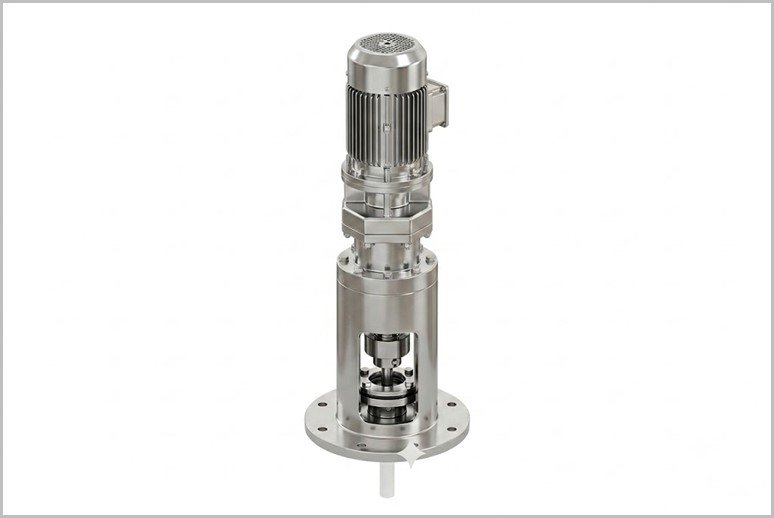
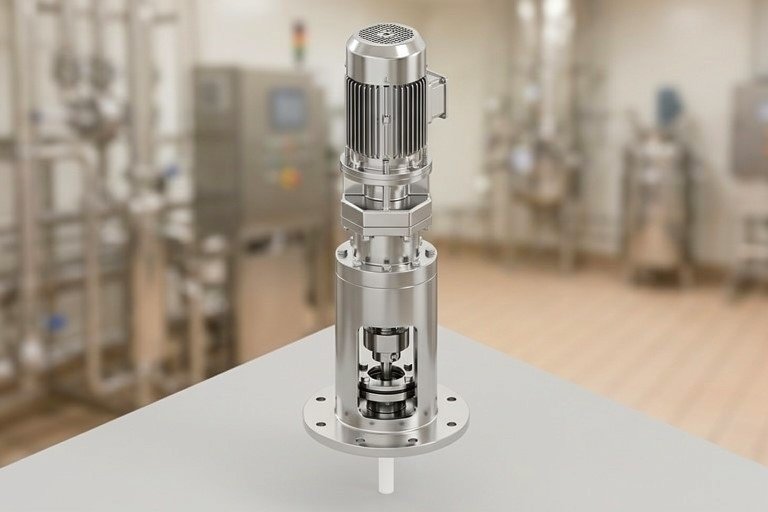
Industrial manufacturing, chemical processing, pharmaceuticals, and wastewater treatment rely on precise and efficient fluid dynamics. At the heart of many process vessels lies a critical mechanical device: the vertical agitator. Also referred to as a top-mounted mixer or vertical mixer, this essential industrial equipment is engineered to mix, agitate, homogenize, or disperse liquids, solid suspensions, and highly viscous materials inside tanks or closed vessels.
For engineers, plant managers, and procurement specialists seeking optimal fluid processing solutions, understanding the engineering principles, structural components, and operational advantages of a top-mounted industrial mixer is vital for optimizing facility performance and product quality.
Expert Engineering and Reliable Solutions from Adinath International
The motor rotates the shaft, which drives the impellers to create flow patterns:
A vertical agitator (also called a top-mounted mixer or vertical mixer) is industrial equipment designed to mix, agitate, homogenize, or disperse liquids, solid suspensions, and highly viscous materials inside tanks or closed vessels. It features a vertical shaft extending downward into the liquid and is commonly used in chemical processing, pharmaceuticals, and wastewater treatment.
An electric motor rotates a vertical shaft fitted with one or more impellers. This creates primarily axial (top-to-bottom) flow patterns that circulate the fluid, ensuring uniform mixing, preventing settling or stratification, promoting heat transfer, and supporting chemical reactions. Some designs also generate radial flow for higher shear.
Key features include top-mounted (overhead) installation on open or closed tanks, a vertical shaft driven by an electric motor (direct drive or with gearbox/reducer), various sealing options (lip/V-ring to single/double mechanical seals), multiple impeller types, axial flow for thorough circulation, stainless-steel construction, compact design, and easy maintenance access.
Common impeller options include marine propellers, pitched-blade turbines, hydrofoils, paddles, anchors, and Cowles discs. The choice depends on the required flow pattern (axial or radial), fluid viscosity, and process goals such as gentle blending or high-shear dispersion.
Vertical agitators are commonly built from AISI 304, 316, or 316L stainless steel for corrosion resistance and hygiene. Special alloys or coatings can be specified for highly corrosive or abrasive applications.
They are widely applied in the pharmaceutical, nutraceutical, herbal, Ayurvedic, biotech, cosmetic, and chemical industries, as well as in general industrial manufacturing and wastewater treatment processes requiring precise fluid dynamics.
Sealing ranges from simple lip or V-ring seals for less demanding duties to single or double mechanical seals for higher containment, hygiene, or pressure requirements in closed vessels.
The top-mounted design offers compact installation, relatively easy access for maintenance, suitability for a wide range of tank volumes and fluid viscosities, effective prevention of dead zones and settling through top-to-bottom circulation, and reliable long-term process performance.
Yes. They are engineered to mix, homogenize, and disperse liquids as well as solid suspensions and highly viscous materials by generating strong axial flow loops that keep solids suspended and ensure uniform consistency throughout the vessel.
Experienced manufacturers provide robust, standards-compliant equipment engineered for maximum uptime, consistent product quality, and process reliability. Custom solutions can be tailored for scaling chemical synthesis lines or upgrading pharmaceutical mixing infrastructure while meeting international quality requirements.
Algeria | Angola | Argentina | Australia | Austria | Bahrain | Bangladesh | Belarus | Belgium | Bolivia | Botswana | Brazil | Bulgaria | Canada | Chile | China | Colombia | Costa Rica | Cuba | Czech Republic | Denmark | Dominican Republic | Ecuador | Egypt | El Salvador | Ethiopia | Finland | France | Germany | Ghana | Greece | Guatemala | Haiti | Honduras | Hong Kong | Hungary | India | Indonesia | Iran | Ireland | Israel | Italy | Ivory Coast | Japan | Jordan | Kazakhstan | Kenya | Kuwait | Lebanon | Libya | Malaysia | Mexico | Mongolia | Morocco | Mozambique | Myanmar | Netherlands | New Zealand | Nicaragua | Nigeria | Norway | Oman | Pakistan | Panama | Paraguay | Peru | Philippines | Poland | Portugal | Qatar | Romania | Russia | Saudi Arabia | Senegal | Slovakia | Singapore | South Africa | South Korea | South Sudan | Spain | Sri Lanka | Sweden | Switzerland | Taiwan | Tanzania | Thailand | Trinidad and Tobago | Tunisia | Turkey | Uganda | Ukraine | United Arab Emirates | United Kingdom | United States | Uruguay | Uzbekistan | Venezuela | Vietnam | Zambia | Zimbabwe
Connect with our engineering team to discuss your specific production requirements. We provide customized, cGMP-compliant machinery solutions designed to optimize your manufacturing facility and maximize output.
©Adinath International | Theme Developed By Pharma Machinery Manufacturer I Website updated on: 15 October 2026
Request A Quick Quote
Vertical Agitator
Please drop your requirements, one of our technical expert will contact you in next 24 working hours.
WhatsApp us


