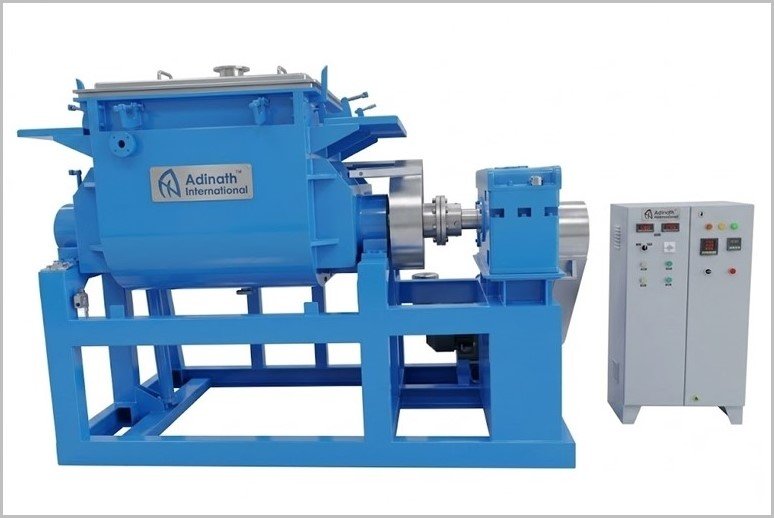
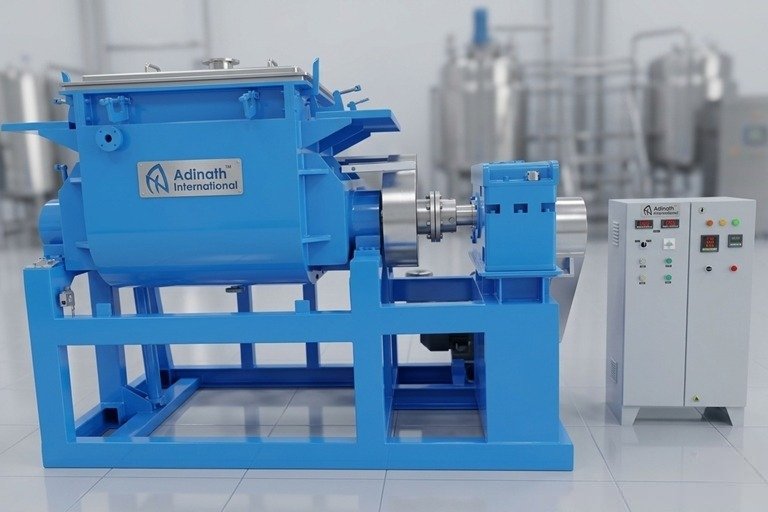
The 1000 Liter Sigma Mixer, also widely known as a Sigma Blade Kneader or Z-Blade Mixer, is a powerful, heavy-duty industrial mixing machine designed specifically for handling high-viscosity, semi-solid, and elastic-plastic materials. This robust equipment delivers intensive kneading, shearing, stretching, folding, and homogenization, making it an essential asset for manufacturers who demand consistent, high-quality results in demanding production environments.
Whether you’re in the chemical, pharmaceutical, food processing, rubber, plastics, adhesives, or cosmetics industry, the 1000-liter capacity Sigma Mixer offers the perfect balance of volume and performance for medium-to-large scale operations.
The core of the 1000L Sigma Mixer is a horizontal, W-shaped or U-shaped trough (mixing chamber) constructed from durable materials like mild steel, stainless steel 304, or 316L for corrosion resistance and hygiene compliance. The trough measures approximately 2-3 meters in length and 1-1.5 meters in width, with a depth optimized for optimal material flow. Inside the trough, two counter-rotating Z-shaped (Sigma) blades are mounted horizontally—one typically rotating at a faster speed (e.g., 0-42 RPM) than the other (e.g., 0-35 RPM)—creating tangential shear forces against the trough walls and each other. The blades are precisely machined with minimal clearance (often 2-5 mm) to the walls, ensuring maximum kneading efficiency and preventing material buildup.
Kneading Dynamics & Flow Mechanics
Product Extraction Methods
Tangential Blade Arrangement
Overlapping Blade Arrangement
Description | Specification |
Model | ASM – 1000 |
Working Capacity | 1000 Liters approx |
Gross Capacity | 1500 Liters approx |
Motor (General) | 60 H.P. |
Motor (Heavy Duty) | 70 H.P. |
* Power voltage can be adjusted as per customer’s domestic power voltage requirements.
* Rights of technical improvements & modification reserved.
* Illustrations & dimensions are shown for information purpose only.
The mixer’s footprint is compact for its capacity, typically 4-5 meters long, 2-3 meters wide, and 2.5-3 meters tall, mounted on a vibration-dampening steel frame for noise-free operation.
The 1000 Liters Sigma Mixer (also known as a Sigma Blade Kneader or Z-Blade Mixer) is a heavy-duty industrial mixing machine built for high-viscosity, semi-solid, and elastic-plastic materials. It delivers intensive kneading, shearing, stretching, folding, and homogenization, making it ideal for chemical, pharmaceutical, food processing, rubber, plastics, adhesives, and cosmetics applications.
The ASM-1000 model has a working capacity of approximately 1000 liters and a gross capacity of approximately 1500 liters.
It is offered with a general-duty motor of 60 H.P. or a heavy-duty motor of 70 H.P. Power voltage can be customized to match the customer’s local requirements.
The mixer is fabricated from Mild Steel (MS), SS 304, or SS 316. Surface finishes can be customized from a matte texture to a high-reflectivity mirror polish. Mild steel versions receive an anti-corrosive red oxide primer followed by a dual-layer epoxy paint coat.
It uses highly synchronized, counter-rotating ‘Z’-profile (Sigma) blades that produce a tangential kneading effect. This creates bulk mass movement, stretching, folding, splitting, and re-amalgamation while applying intensive shear forces between the blades and the trough walls for thorough homogenization and particle breakdown.
Tangential blades meet tangentially and typically run at different speeds (often a 3:2 ratio); they are optimized for high-viscosity materials such as adhesives, rubber compounds, and pigments. Overlapping blades rotate at the same speed, suit lower-viscosity materials (e.g., creams, ointments, carbon pastes), and provide faster material interchange with gentler shearing.
Emptying can be performed via manual hand-wheel control or automated hydraulic actuation. Additional methods include vessel tilting, bottom-mounted discharge valves, or a lateral extrusion screw for controlled product removal.
Yes. It features adaptable temperature-control jackets for external heating (steam or hot oil) or cooling (water or chilled fluids), typically up to 200°C. The jackets are insulated with high-density mineral wool and protected by external metal cladding; optional blade cooling is also available.
The mixer has an ultra-close clearance between the trough wall and agitators to eliminate product accumulation, PTFE shaft seals for safe and food-grade compatible operation, and precision-crafted tangential Z-profile blades for streak-free homogenization.
It is used across pharmaceutical, nutraceutical, herbal, Ayurvedic, biotech, cosmetic, and chemical industries. Key benefits include reduced labor costs, improved product quality, real-time monitoring and data logging capabilities, support for GMP compliance, and long-term reliability as a capital investment.
Algeria | Angola | Argentina | Australia | Austria | Bahrain | Bangladesh | Belarus | Belgium | Bolivia | Botswana | Brazil | Bulgaria | Canada | Chile | China | Colombia | Costa Rica | Cuba | Czech Republic | Denmark | Dominican Republic | Ecuador | Egypt | El Salvador | Ethiopia | Finland | France | Germany | Ghana | Greece | Guatemala | Haiti | Honduras | Hong Kong | Hungary | India | Indonesia | Iran | Ireland | Israel | Italy | Ivory Coast | Japan | Jordan | Kazakhstan | Kenya | Kuwait | Lebanon | Libya | Malaysia | Mexico | Mongolia | Morocco | Mozambique | Myanmar | Netherlands | New Zealand | Nicaragua | Nigeria | Norway | Oman | Pakistan | Panama | Paraguay | Peru | Philippines | Poland | Portugal | Qatar | Romania | Russia | Saudi Arabia | Senegal | Slovakia | Singapore | South Africa | South Korea | South Sudan | Spain | Sri Lanka | Sweden | Switzerland | Taiwan | Tanzania | Thailand | Trinidad and Tobago | Tunisia | Turkey | Uganda | Ukraine | United Arab Emirates | United Kingdom | United States | Uruguay | Uzbekistan | Venezuela | Vietnam | Zambia | Zimbabwe
Connect with our engineering team to discuss your specific production requirements. We provide customized, cGMP-compliant machinery solutions designed to optimize your manufacturing facility and maximize output.
©Adinath International | Theme Developed By Pharma Machinery Manufacturer I Website updated on: 15 October 2026
Request A Quick Quote
1000 Liters Sigma Mixer
Please drop your requirements, one of our technical expert will contact you in next 24 working hours.
WhatsApp us


