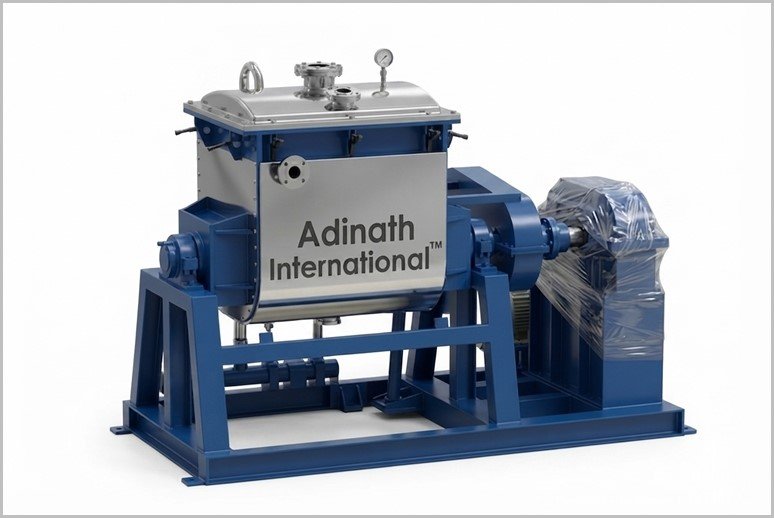
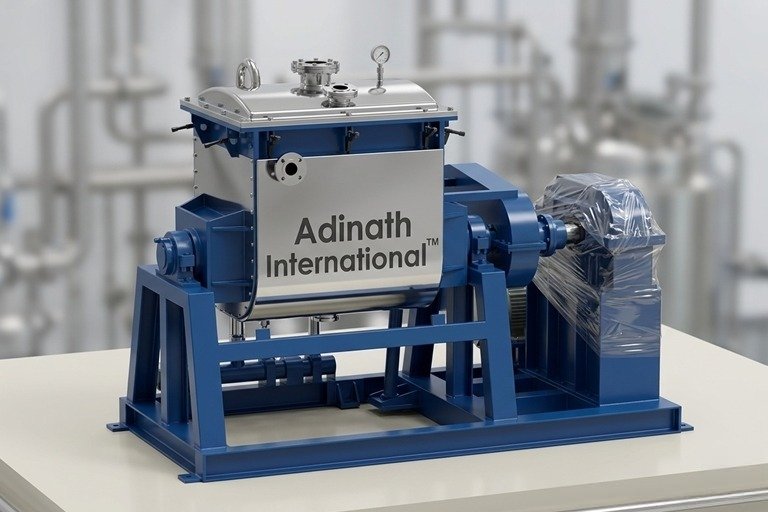
The 500 liter Sigma Mixer, also widely known as a Sigma Blade Kneader or Z-Blade Mixer, is a powerful, heavy-duty industrial mixing machine specifically engineered for intensive kneading, blending, and homogenization of highly viscous and sticky materials. This robust equipment has become an essential asset across multiple manufacturing sectors due to its superior ability to achieve uniform dispersion and thorough mixing that standard mixers simply cannot handle.
Whether you are searching for a reliable 500L sigma mixer, sigma kneader machine, or Z blade mixer for viscous materials, this equipment stands out for its durability, efficiency, and consistent performance in demanding production environments.
Operation is semi-automatic or fully automated via PLC controls, with intuitive panels for speed adjustment, timer settings, and temperature monitoring. Blades rotate at differential speeds (typically 30-40 RPM for one blade and 20-25 RPM for the other) to create a cascading effect that folds, kneads, and shears materials against the trough walls. This design is particularly effective for non-free-flowing substances like silicone rubber, sealants, putty, electrode pastes, and carbon compounds, ensuring bubble-free, streak-free results.
Discharge options include:
Heating/cooling jackets cover the sides and bottom, with circulation ports for uniform heat transfer. Vacuum integration is available for moisture removal or volatile extraction, and the system complies with CE, ISO 9001, SGS, and GOST standards for global safety and quality assurance.
Agitation Kinematics & Kneading Mechanics
Product Extraction Methods
Tangential Impeller Configuration
Overlapping Impeller Configuration
Description | Specification |
Model | ASM – 500 |
Working Capacity | 500 Liters approx |
Gross Capacity | 750 Liters approx |
Motor (General) | 40 H.P. |
Motor (Heavy Duty) | 50 H.P. |
* Power voltage can be adjusted as per customer’s domestic power voltage requirements.
* Rights of technical improvements & modification reserved.
* Illustrations & dimensions are shown for information purpose only.
At the heart of the 500L Sigma Mixer is its durable, heavy-gauge construction, typically fabricated from mild steel or high-grade stainless steel to withstand rigorous operation and corrosive environments. The mixing trough measures approximately 38″ x 39″ x 39″ (about 965mm x 990mm x 990mm), providing a total vessel capacity of 500 liters. The trough is often jacketed with carbon steel for precise temperature control, supporting electric heating, steam heating, hot oil circulation, or water cooling to maintain process temperatures from ambient to elevated levels.
The mixer’s core components include:
The ASM-500 model has an approximate working capacity of 500 liters and a gross capacity of about 750 liters, making it suitable for medium-to-large batch production of viscous materials.
It is offered with a 40 H.P. motor for general duty and a 50 H.P. motor for heavy-duty applications. Voltage can be customized to match the customer’s local power supply requirements.
The mixer is built from heavy-duty Mild Steel, Stainless Steel 304, or Stainless Steel 316. Surface finishes range from matte to mirror polish, and Mild Steel versions receive a red-oxide primer plus dual-layer epoxy paint for protection.
It uses two counter-rotating precision-crafted tangential Z-profile (sigma) blades that create differential-velocity longitudinal displacement, intense shearing, folding, stretching, and kneading action against the trough walls, ensuring uniform homogenization with minimal product retention.
Discharge can be performed via manual hand-wheel tipping, automated hydraulic actuation, bottom-mounted drainage valves, or a lateral extrusion screw positioned beside the mixing container for controlled unloading.
Yes. The mixer can be fitted with adaptable thermal jackets for external heating or cooling (steam, hot oil, electric, or water), high-density mineral wool insulation, and protective metal cladding. Optional blade cooling is also available.
Tangential blades meet at the edges and typically run at a 3:2 speed ratio; they are preferred for high-viscosity materials (adhesives, rubber compounds, pigments). Overlapping blades rotate at the same speed and suit lower-viscosity free-flowing or creeping products (creams, pastes, ointments), providing gentler shearing and faster inter-compartment transfer.
It is widely applied in the pharmaceutical, nutraceutical, herbal, Ayurvedic, biotech, cosmetic, and chemical industries for intensive kneading and homogenization of sticky, high-viscosity formulations.
Ultra-close clearance between the trough wall and agitators, resilient PTFE shaft seals (food-grade compatible), heavy-gauge construction, and optional vacuum or liquid-spray systems help eliminate retention, ensure hygiene, and handle abrasive or sticky media effectively.
It delivers homogeneous blends faster than conventional mixers, significantly reduces batch-to-batch variation, handles large volumes while maintaining quality, withstands continuous heavy-duty use with low maintenance, optimizes power consumption through efficient blade and drive design, and features a tilting bowl plus accessible layout for easy cleaning between batches.
Algeria | Angola | Argentina | Australia | Austria | Bahrain | Bangladesh | Belarus | Belgium | Bolivia | Botswana | Brazil | Bulgaria | Canada | Chile | China | Colombia | Costa Rica | Cuba | Czech Republic | Denmark | Dominican Republic | Ecuador | Egypt | El Salvador | Ethiopia | Finland | France | Germany | Ghana | Greece | Guatemala | Haiti | Honduras | Hong Kong | Hungary | India | Indonesia | Iran | Ireland | Israel | Italy | Ivory Coast | Japan | Jordan | Kazakhstan | Kenya | Kuwait | Lebanon | Libya | Malaysia | Mexico | Mongolia | Morocco | Mozambique | Myanmar | Netherlands | New Zealand | Nicaragua | Nigeria | Norway | Oman | Pakistan | Panama | Paraguay | Peru | Philippines | Poland | Portugal | Qatar | Romania | Russia | Saudi Arabia | Senegal | Slovakia | Singapore | South Africa | South Korea | South Sudan | Spain | Sri Lanka | Sweden | Switzerland | Taiwan | Tanzania | Thailand | Trinidad and Tobago | Tunisia | Turkey | Uganda | Ukraine | United Arab Emirates | United Kingdom | United States | Uruguay | Uzbekistan | Venezuela | Vietnam | Zambia | Zimbabwe
Connect with our engineering team to discuss your specific production requirements. We provide customized, cGMP-compliant machinery solutions designed to optimize your manufacturing facility and maximize output.
©Adinath International | Theme Developed By Pharma Machinery Manufacturer I Website updated on: 15 October 2026
Request A Quick Quote
500 Liters Sigma Mixer
Please drop your requirements, one of our technical expert will contact you in next 24 working hours.
WhatsApp us


