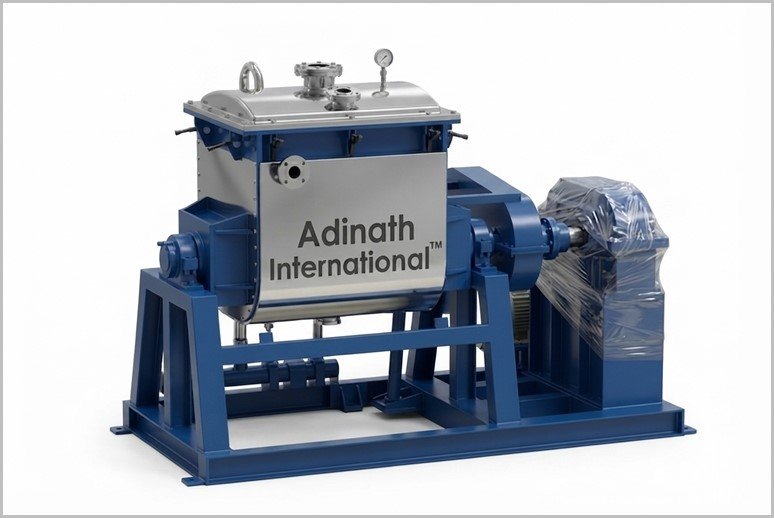
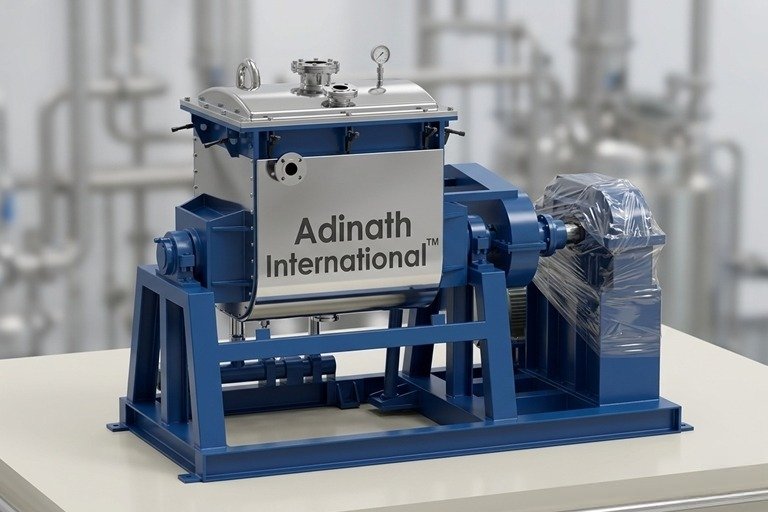
The Crayons Production Sigma Mixer, also known as a Sigma Blade Mixer, Z-Blade Mixer, or Kneader, is a specialized industrial machine designed for thorough mixing and kneading of high-viscosity, semi-solid, and paste-like materials. This heavy-duty equipment features a U- or W-shaped trough with two counter-rotating Z-shaped (sigma) blades that operate at different speeds — one faster and one slower — creating powerful shear forces essential for uniform blending and dispersion.
In crayon manufacturing, achieving perfect homogeneity is critical. The Crayons Production Sigma Mixer excels at dispersing pigments, binders, waxes, paraffin, stearic acid, and other additives into a smooth, consistent mass without introducing unwanted air bubbles. This results in vibrant colors, smooth writing performance, and reliable structural integrity in the final crayon products.
Blending Dynamics & Thermal Transitions
Product Evacuation Pathways
Completed batches can be unloaded through three distinct ejection methods:
Rotor Geometries & Viscosity Matrix
Tangential Blade Layout
Overlapping Blade Layout
Model | Capacity – Liters | Motor (H.P.) | ||
Working Capacity approx. | Gross Capacity approx. | General | Heavy Duty | |
ASM – 50 | 50 Liters | 80 Liters | 5 H.P. | 7.5 H.P. |
ASM – 75 | 75 Liters | 110 Liters | 7.5 H.P. | 10 H.P. |
ASM – 100 | 100 Liters | 150 Liters | 10 H.P. | 15 H.P. |
ASM – 150 | 150 Liters | 200 Liters | 15 H.P. | 20 H.P. |
ASM – 200 | 200 Liters | 300 Liters | 20 H.P. | 25 H.P. |
ASM – 400 | 400 Liters | 550 Liters | 30 H.P. | 40 H.P. |
ASM – 500 | 500 Liters | 750 Liters | 40 H.P. | 50 H.P. |
ASM – 750 | 750 Liters | 1150 Liters | 50 H.P. | 60 H.P. |
ASM – 1000 | 1000 Liters | 1500 Liters | 60 H.P. | 70 H.P. |
ASM – 1500 | 1500 Liters | 2100 Liters | 75 H.P. | 80 H.P. |
ASM – 2000 | 2000 Liters | 2600 Liters | 80 H.P. | 90 H.P. |
ASM – 3000 | 3000 Liters | 3800 Liters | 100 H.P. | 120 H.P. |
* Power voltage can be adjusted as per customer’s domestic power voltage requirements.
* Rights of technical improvements & modification reserved.
* Illustrations & dimensions are shown for information purpose only.
Crayons are typically made from a mixture of paraffin wax (or other waxes), pigments, fillers (like talc or clay), and stabilizers, melted and blended into a homogeneous, viscous mass before molding. Sigma mixers excel here because:
This process is common in small- to medium-scale production, especially for artisanal or specialty crayons. For large-scale manufacturing, sigma mixers are often used in pilot or batch testing before scaling to continuous extruders.
It is a heavy-duty industrial kneader (also called a Sigma Blade or Z-Blade Mixer) designed for high-viscosity, semi-solid, and paste-like materials used in crayon manufacturing. Two counter-rotating Z-shaped blades operate at different speeds inside a U- or W-shaped trough, creating intense shear, folding, stretching, and recombining action that thoroughly disperses pigments, binders, waxes, paraffin, stearic acid, and additives into a smooth, uniform mass without introducing air bubbles.
Perfect homogeneity is essential for vibrant colors, smooth writing performance, and structural integrity of crayons. The mixer’s powerful shear forces ensure even pigment dispersion and consistent blending of high-viscosity ingredients, delivering reliable batch quality that manual or less intensive methods cannot match.
The mixer is fabricated from premium grades including Stainless Steel 304, high-grade Stainless Steel 316, or carbon-based Mild Steel. Stainless-steel exteriors can be finished in brushed satin or mirror polish. Mild-steel parts receive a red-oxide primer coat followed by two layers of epoxy paint for corrosion resistance.
Models range from ASM-50 (approx. 50 L working / 80 L gross capacity) to ASM-3000 (approx. 3000 L working / 3800 L gross). Motor power is available in general and heavy-duty ratings (e.g., 5–7.5 HP for the smallest model up to 100–120 HP for the largest). Voltage can be customized to local requirements.
Optional temperature-regulation jackets allow external heating or chilling. The jackets are insulated with mineral wool and protected by metal cladding. This helps manage thermal transitions needed for wax and binder processing while maintaining product quality.
Completed batches can be unloaded by tilting the entire mixing trough, draining through bottom dump valves, or extruding via a lateral side-mounted screw mechanism. These options reduce manual scraping of sticky residues and improve efficiency.
Tangential blades (non-intersecting, typically running at a 3:2 speed ratio) deliver intensive shear ideal for heavy, high-viscosity formulations such as dense pigments and wax compounds used in crayons. Overlapping blades rotate at matching speeds, provide faster material interchange, and produce milder kneading suited to lower-viscosity materials.
Micro-gaps between the blades and trough walls eliminate dead zones and residue buildup. PTFE shaft packings provide sanitary, food-grade sealing. Enclosed construction minimizes dust and pigment exposure, supporting compliance with standards for child-safe products.
Available add-ons include liquid atomization spray systems, hermetically sealed vacuum chambers for deaeration, heating/cooling jackets with insulation, blade-cooling arrangements, and automated hydraulic or valve discharge systems, allowing customization to specific crayon production needs.
Mixing time is reduced to 10–30 minutes per batch, color or formulation changes are quick with efficient cleaning, the enclosed design enhances operator safety and product hygiene, and the machine supports consistent, high-quality output. It is optimized for batch production of high-viscosity pastes rather than very low-viscosity liquids.
More Sigma Mixers
 1000 Liters Sigma Mixer
 500 Liters Sigma Mixer
 Acrylic Latex Sealant Sigma Mixer
 Adhesives Sigma Mixer
Algeria | Angola | Argentina | Australia | Austria | Bahrain | Bangladesh | Belarus | Belgium | Bolivia | Botswana | Brazil | Bulgaria | Canada | Chile | China | Colombia | Costa Rica | Cuba | Czech Republic | Denmark | Dominican Republic | Ecuador | Egypt | El Salvador | Ethiopia | Finland | France | Germany | Ghana | Greece | Guatemala | Haiti | Honduras | Hong Kong | Hungary | India | Indonesia | Iran | Ireland | Israel | Italy | Ivory Coast | Japan | Jordan | Kazakhstan | Kenya | Kuwait | Lebanon | Libya | Malaysia | Mexico | Mongolia | Morocco | Mozambique | Myanmar | Netherlands | New Zealand | Nicaragua | Nigeria | Norway | Oman | Pakistan | Panama | Paraguay | Peru | Philippines | Poland | Portugal | Qatar | Romania | Russia | Saudi Arabia | Senegal | Slovakia | Singapore | South Africa | South Korea | South Sudan | Spain | Sri Lanka | Sweden | Switzerland | Taiwan | Tanzania | Thailand | Trinidad and Tobago | Tunisia | Turkey | Uganda | Ukraine | United Arab Emirates | United Kingdom | United States | Uruguay | Uzbekistan | Venezuela | Vietnam | Zambia | Zimbabwe
Connect with our engineering team to discuss your specific production requirements. We provide customized, cGMP-compliant machinery solutions designed to optimize your manufacturing facility and maximize output.
©Adinath International | Theme Developed By Pharma Machinery Manufacturer I Website updated on: 15 October 2026
Request A Quick Quote
Crayons Production Sigma Mixer
Please drop your requirements, one of our technical expert will contact you in next 24 working hours.
WhatsApp us
