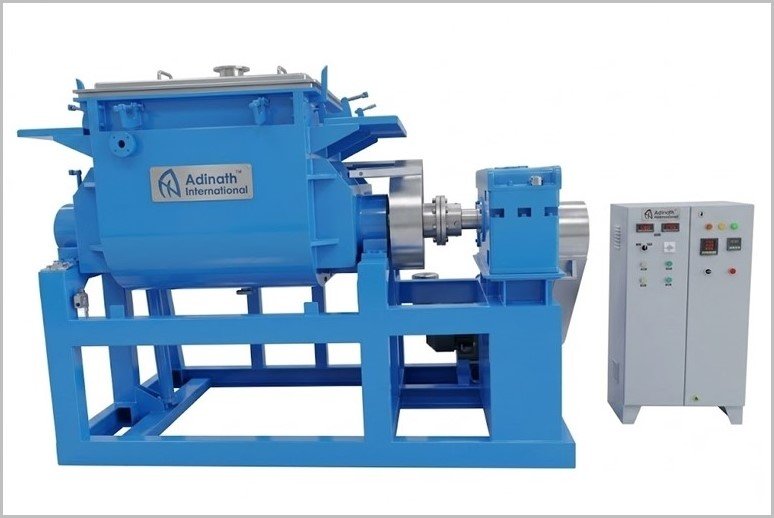
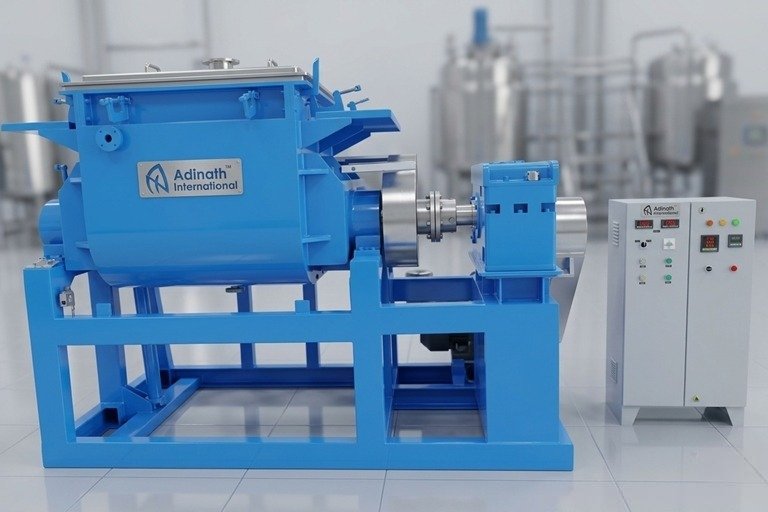
A Sigma Mixer For Dough Material, also known as a sigma blade mixer, Z-blade mixer, or double-arm kneader, is a heavy-duty industrial machine specifically designed for mixing and kneading highly viscous, sticky, and dough-like materials. It is widely used in food production, confectionery, bakery, and other industries where uniform consistency of heavy doughs is essential.
This robust equipment features two counter-rotating “Z”- or sigma-shaped blades mounted in a horizontal trough, often W-shaped or U-shaped. The unique blade geometry creates intense shearing, folding, and kneading actions that thoroughly blend ingredients, develop gluten structure, and achieve perfect homogeneity in even the stickiest formulations.
Blending Mechanics & Agitation Dynamics
Product Extraction Methods
Tangential Blade Architecture
Overlapping Blade Architecture
Model | Capacity – Liters | Motor (H.P.) | ||
Working Capacity approx. | Gross Capacity approx. | General | Heavy Duty | |
ASM – 50 | 50 Liters | 80 Liters | 5 H.P. | 7.5 H.P. |
ASM – 75 | 75 Liters | 110 Liters | 7.5 H.P. | 10 H.P. |
ASM – 100 | 100 Liters | 150 Liters | 10 H.P. | 15 H.P. |
ASM – 150 | 150 Liters | 200 Liters | 15 H.P. | 20 H.P. |
ASM – 200 | 200 Liters | 300 Liters | 20 H.P. | 25 H.P. |
ASM – 400 | 400 Liters | 550 Liters | 30 H.P. | 40 H.P. |
ASM – 500 | 500 Liters | 750 Liters | 40 H.P. | 50 H.P. |
ASM – 750 | 750 Liters | 1150 Liters | 50 H.P. | 60 H.P. |
ASM – 1000 | 1000 Liters | 1500 Liters | 60 H.P. | 70 H.P. |
ASM – 1500 | 1500 Liters | 2100 Liters | 75 H.P. | 80 H.P. |
ASM – 2000 | 2000 Liters | 2600 Liters | 80 H.P. | 90 H.P. |
ASM – 3000 | 3000 Liters | 3800 Liters | 100 H.P. | 120 H.P. |
* Power voltage can be adjusted as per customer’s domestic power voltage requirements.
* Rights of technical improvements & modification reserved.
* Illustrations & dimensions are shown for information purpose only.
A Sigma Mixer for Dough Material (also called a sigma blade mixer, Z-blade mixer, or double-arm kneader) is a heavy-duty industrial machine designed for mixing and kneading highly viscous, sticky, and dough-like materials. It is commonly used in food, confectionery, bakery, and related industries where uniform consistency of heavy doughs is required.
The mixer uses two counter-rotating “Z”- or sigma-shaped blades mounted in a horizontal trough (often W-shaped or U-shaped). These blades create intense shearing, folding, stretching, and kneading actions that thoroughly blend ingredients, develop gluten structure, and deliver homogeneous results even with the stickiest formulations.
The mixer is offered in Mild Steel (MS), Stainless Steel 304 (SS 304), and Stainless Steel 316 (SS 316). Finishes range from matte to high-reflectivity mirror polish as per customer requirements. Mild Steel models receive a red oxide primer followed by a dual-layer epoxy paint finish. PTFE shaft seals are provided for sanitary, food-grade operations.
Discharge can be performed via vessel tilting (manual hand-wheel or fully automated hydraulic), bottom-mounted outlet valves, or a lateral extrusion screw positioned beside the main mixing chamber. These options suit different viscosities and operational needs.
Yes. It can be fitted with integrated temperature control jackets for external heating or cooling. The jackets are insulated with high-density mineral wool and protected by external cladding, making the machine suitable for temperature-sensitive formulations.
Models range from ASM-50 (50 L working / 80 L gross) up to ASM-3000 (3000 L working / 3800 L gross). Motor options include general and heavy-duty variants (e.g., 5–7.5 HP for the smallest model up to 100–120 HP for the largest). Power voltage can be customized to the customer’s requirements.
Optional accessories include a Liquid Spray System, Vacuum System (for de-aeration), Blades Cooling Arrangement, Screw/Extrusion System, and Automatic Valve Discharge System. These allow customization for specific process needs.
It is widely applied in the Pharmaceutical, Nutraceutical, Herbal, Ayurvedic, Biotech, Cosmetic, and Chemical industries for processing high-viscosity, dough-like, or semi-solid materials that require thorough kneading and uniform dispersion.
The design features ultra-close clearance between the blades and the inner trough shell, which prevents product accumulation. The counter-rotating sigma blades continuously transfer material from one side of the vessel to the other, ensuring complete homogenization with minimal dead zones.
United States | Canada | Mexico | Brazil | Argentina | Chile | Colombia | Peru | Germany | United Kingdom | France | Italy | Spain | Netherlands | Belgium | Switzerland | Sweden | Austria | Denmark | Norway | Poland | Finland | Czech Republic | Hungary | Portugal | Ireland | Greece | Slovakia | Romania | Bulgaria | China | Japan | India | South Korea | Indonesia | Vietnam | Thailand | Malaysia | Philippines | Singapore | Bangladesh | Pakistan | Saudi Arabia | United Arab Emirates | Israel | Turkey | Iran | Qatar | Kuwait | South Africa | Nigeria | Egypt | Algeria | Morocco | Kenya | Ghana | Tunisia | Australia | New Zealand | Russia | Ukraine | Belarus | Kazakhstan | Taiwan | Hong Kong | South Sudan | Uzbekistan | Oman | Jordan | Bahrain | Sri Lanka | Myanmar | Lebanon | Mongolia | Ethiopia | Libya | Angola | Zambia | Zimbabwe | Mozambique | Ivory Coast | Senegal | Uganda | Tanzania | Botswana | Ecuador | Venezuela | Bolivia | Paraguay | Uruguay | Trinidad and Tobago | Panama | Guatemala | Costa Rica | Honduras | El Salvador | Nicaragua | Dominican Republic | Haiti | Cuba
Connect with our engineering team to discuss your specific production requirements. We provide customized, cGMP-compliant machinery solutions designed to optimize your manufacturing facility and maximize output.
Algeria | Angola | Argentina | Australia | Austria | Bahrain | Bangladesh | Belarus | Belgium | Bolivia | Botswana | Brazil | Bulgaria | Canada | Chile | China | Colombia | Costa Rica | Cuba | Czech Republic | Denmark | Dominican Republic | Ecuador | Egypt | El Salvador | Ethiopia | Finland | France | Germany | Ghana | Greece | Guatemala | Haiti | Honduras | Hong Kong | Hungary | India | Indonesia | Iran | Ireland | Israel | Italy | Ivory Coast | Japan | Jordan | Kazakhstan | Kenya | Kuwait | Lebanon | Libya | Malaysia | Mexico | Mongolia | Morocco | Mozambique | Myanmar | Netherlands | New Zealand | Nicaragua | Nigeria | Norway | Oman | Pakistan | Panama | Paraguay | Peru | Philippines | Poland | Portugal | Qatar | Romania | Russia | Saudi Arabia | Senegal | Slovakia | Singapore | South Africa | South Korea | South Sudan | Spain | Sri Lanka | Sweden | Switzerland | Taiwan | Tanzania | Thailand | Trinidad and Tobago | Tunisia | Turkey | Uganda | Ukraine | United Arab Emirates | United Kingdom | United States | Uruguay | Uzbekistan | Venezuela | Vietnam | Zambia | Zimbabwe
Connect with our engineering team to discuss your specific production requirements. We provide customized, cGMP-compliant machinery solutions designed to optimize your manufacturing facility and maximize output.
©Adinath International | Theme Developed By Pharma Machinery Manufacturer I Website updated on: 01 September 2026
WhatsApp us
