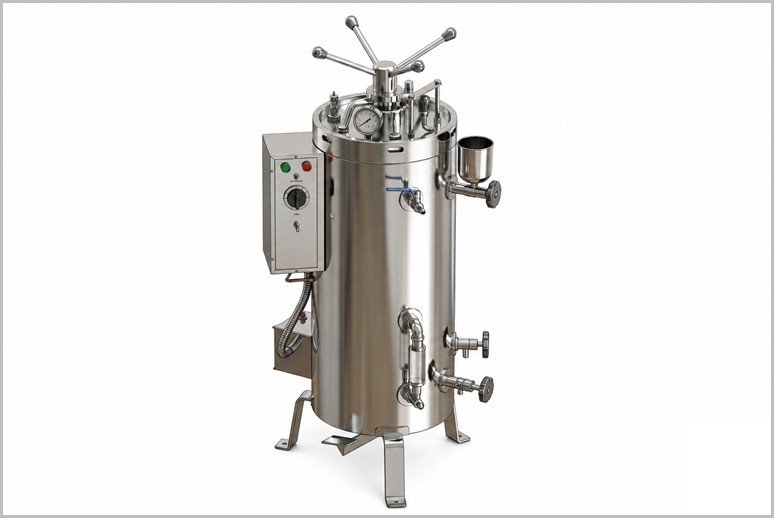
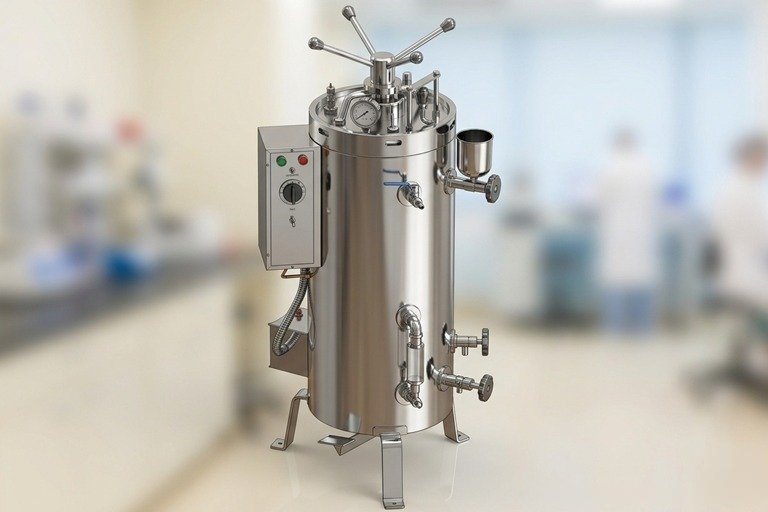
A vertical autoclave is a highly efficient sterilization device widely used across laboratories, hospitals, pharmaceutical industries, research facilities, and medical centers. Designed to eliminate harmful microorganisms, bacteria, viruses, and spores, it employs high-pressure saturated steam to ensure complete sterilization of laboratory equipment, culture media, surgical instruments, glassware, and other heat-resistant materials. As demand for reliable infection control and contamination-free environments grows, vertical autoclaves have become essential equipment in modern healthcare and scientific settings.
Unlike traditional horizontal autoclaves, which feature a cylindrical chamber positioned sideways, vertical autoclaves have an upright chamber orientation. This vertical design offers a significantly smaller footprint, making it ideal for space-constrained environments such as small laboratories, clinics, and research labs with limited floor space. Loading and unloading materials becomes much easier from the top lid, reducing physical strain and improving workflow efficiency.
Process Operation of Autoclave
A vertical autoclave is a highly efficient sterilization device used in laboratories, hospitals, pharmaceutical industries, research facilities, and medical centers. It uses high-pressure saturated steam to eliminate harmful microorganisms, bacteria, viruses, and spores, ensuring complete sterilization of laboratory equipment, culture media, surgical instruments, glassware, and other heat-resistant materials.
Unlike horizontal autoclaves with a sideways cylindrical chamber, vertical autoclaves feature an upright chamber orientation. This design provides a significantly smaller footprint, making it ideal for space-constrained environments like small laboratories, clinics, and research labs. It also allows easier top-loading and unloading, reducing physical strain and improving workflow efficiency.
Vertical autoclaves typically operate at 15–30 psi (1–2 bar) pressure and temperatures of 121–134°C (250–273°F) for standard sterilization cycles, with options for higher parameters. Many models support temperatures up to 121°C as a core range.
Key features include a stainless steel interior, digital temperature indicator and controller, ISI-marked flange/immersion heating elements, silicone rubber gasket, automatic pressure control switch, stainless steel basket, reliable steam pressure gauges, double or triple-walled construction, pedal for lid opening, and water level indicator with inlet & outlet valves.
The process involves placing the unit and materials, filling approximately 1 liter of water in the base chamber, loading the basket/dressing drum, securing the lid (clockwise until fully closed with handles parallel), generating steam to 15±2 lb psi, running the cycle for about 15 minutes, safely releasing steam, ensuring zero pressure, then unloading and draining the chamber.
It is designed for laboratory equipment, culture media, surgical instruments, glassware, and other heat-resistant materials that require complete sterilization against bacteria, viruses, spores, and microorganisms.
Core components include a cylindrical stainless steel chamber with a vertical axis for durability and corrosion resistance; capacities ranging from small benchtop to larger floor-standing units; digital PID controllers or microprocessors for cycle programming; top-loading screw-type or bolted lid with safety valve; and safety features such as pressure locks, overheat protection, and automatic exhaust.
It is widely applied in the pharmaceutical, nutraceutical, herbal, Ayurvedic, biotech, cosmetic, and chemical industries, as well as in laboratories, hospitals, research facilities, and medical centers for infection control and contamination-free environments.
It features double or triple-walled construction, silicone rubber gasket, automatic pressure control switch, reliable steam pressure gauges, safety valve on the lid to prevent over-pressurization, water level indicator, and pressure locks with overheat protection for safe operation.
The upright chamber offers a compact footprint suited to limited floor space, while top-loading simplifies material handling, reduces physical strain, and enhances workflow efficiency compared to horizontal models—making it especially practical for small labs, clinics, and research settings.
More Sterilization Equipments
 Vertical Laboratory Autoclave
 Cement Autoclave
 Cylindrical Autoclave
 Horizontal Autoclave Rectangular
Algeria | Angola | Argentina | Australia | Austria | Bahrain | Bangladesh | Belarus | Belgium | Bolivia | Botswana | Brazil | Bulgaria | Canada | Chile | China | Colombia | Costa Rica | Cuba | Czech Republic | Denmark | Dominican Republic | Ecuador | Egypt | El Salvador | Ethiopia | Finland | France | Germany | Ghana | Greece | Guatemala | Haiti | Honduras | Hong Kong | Hungary | India | Indonesia | Iran | Ireland | Israel | Italy | Ivory Coast | Japan | Jordan | Kazakhstan | Kenya | Kuwait | Lebanon | Libya | Malaysia | Mexico | Mongolia | Morocco | Mozambique | Myanmar | Netherlands | New Zealand | Nicaragua | Nigeria | Norway | Oman | Pakistan | Panama | Paraguay | Peru | Philippines | Poland | Portugal | Qatar | Romania | Russia | Saudi Arabia | Senegal | Slovakia | Singapore | South Africa | South Korea | South Sudan | Spain | Sri Lanka | Sweden | Switzerland | Taiwan | Tanzania | Thailand | Trinidad and Tobago | Tunisia | Turkey | Uganda | Ukraine | United Arab Emirates | United Kingdom | United States | Uruguay | Uzbekistan | Venezuela | Vietnam | Zambia | Zimbabwe
Connect with our engineering team to discuss your specific production requirements. We provide customized, cGMP-compliant machinery solutions designed to optimize your manufacturing facility and maximize output.
©Adinath International | Theme Developed By Pharma Machinery Manufacturer I Website updated on: 15 October 2026
Request A Quick Quote
Vertical Autoclave
Please drop your requirements, one of our technical expert will contact you in next 24 working hours.
WhatsApp us
