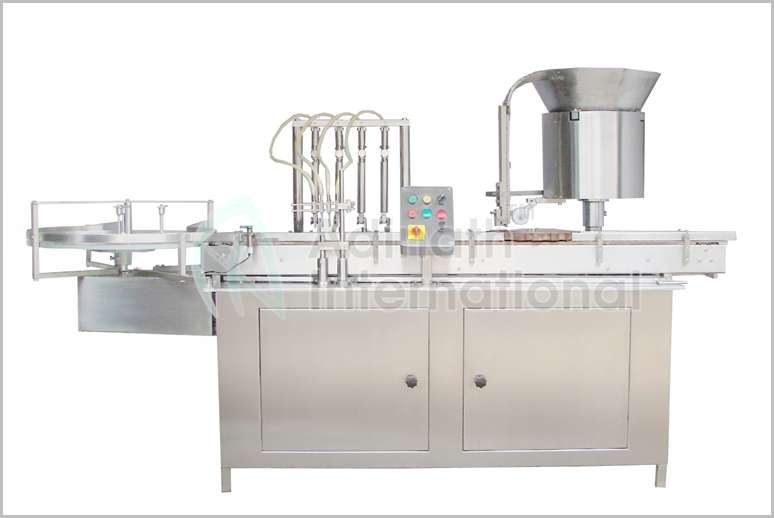
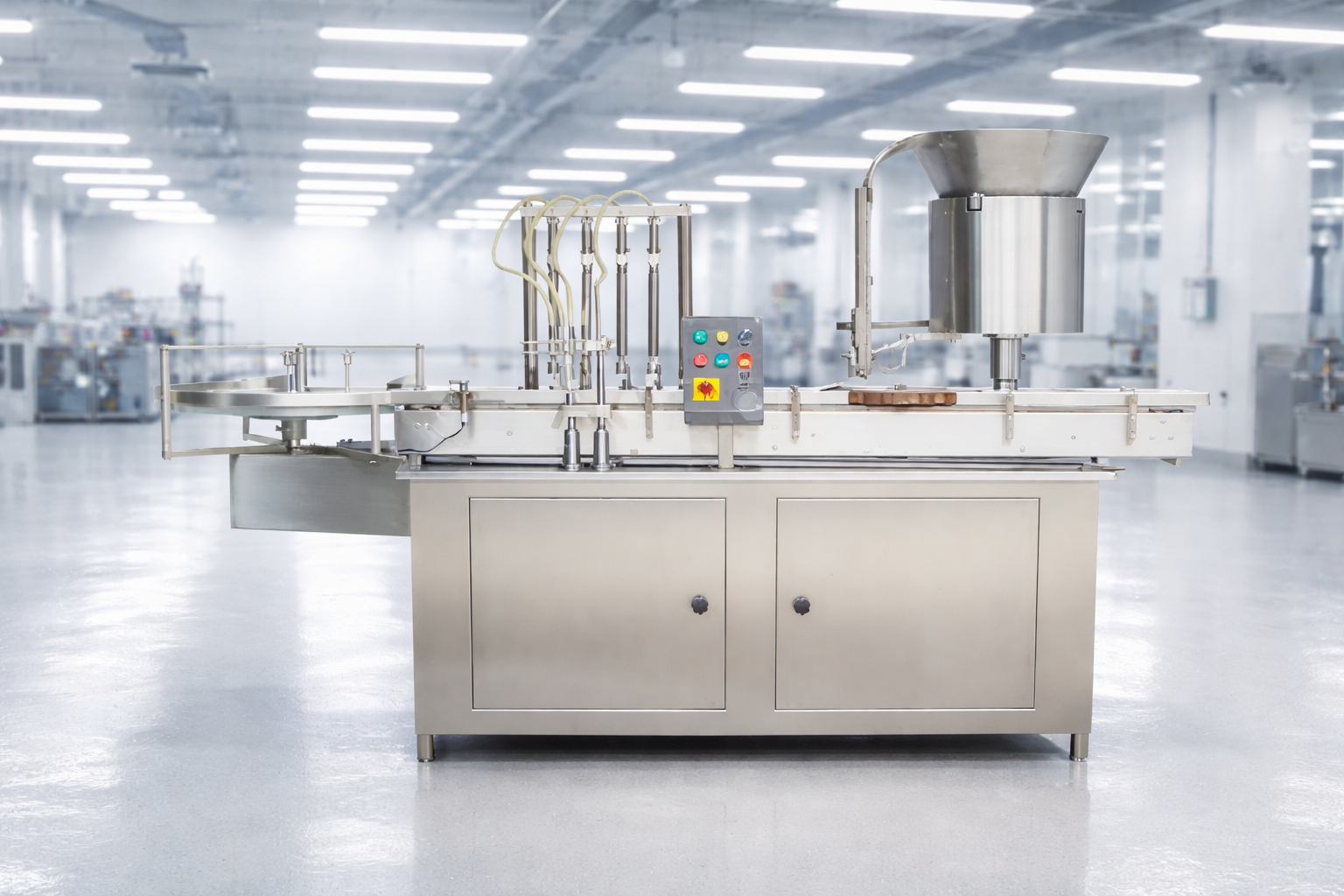
Vial Filling and Rubber Stoppering Machine is an automated pharmaceutical packaging equipment designed for the precise filling of injectable liquids into glass vials and subsequent sealing with rubber stoppers. This machine ensures sterility, prevents contamination, and maintains product integrity by accurately dosing liquids and securely applying stoppers, making it essential for high-volume production in the pharmaceutical, biotechnology, and healthcare industries. It operates on a volumetric principle, using pumps like piston or peristaltic types to achieve filling accuracy of ±1%, and is compliant with standards such as cGMP.
The incoming dry vials (sterilized and siliconised) are fed through the in-feed turn table and suitably guided on the moving Stainless Steel slat conveyor belt at the required speed of the correct placement below filling unit.
The filling unit consists syringes & nozzles. Syringes are made of Stainless Steel 316L material for cGMP compliance. Vials stop below filling unit with centering of filling nozzles, during stoppage nozzles discharge pre determined liquid into vials. Duly filled vials delivered on stoppering unit which is mounted on same platform.
Stoppering Unit consist Bowl and Chute designed for desired stopper / bung size. Stoppers are stored in vibratory bowl and delivered to the vial through delivery chute. Vibratory bowl is equipped with special vibrator motor. Stoppers travel in vibratory bowl support guide through vibration. There is arrangement in the bowl in which wrong position stopper get rejected in travelling and only correct position of stopper get into chute. Further stoppers hold at delivery point of chute through spring which collected one by one by vial in traveling below the chute. Further there is one Stainless Steel 304 roller installed to press the stoppers. Vial transfer below the wheel in which get stoppered.
Duly stoppered vials further move on conveyor & collected on out feed turn table (optional) or on to conveyor of vial aluminum cap sealing machine for cap sealing operations.
Model | ALVF-40 | ALVF-80 | ALVF-120 | ALVF – 250 |
Filling Heads | Two | Four | Eight | Twelve |
Production Rate | Up to 40 Vials/Minute | Up to 80 Vials/Minute | Up to 150 Vials/Minute | Up to 250 Vials/Minute |
Input Specification | ||||
Vial Diameter | 15mm to 70mm | 15mm to 70mm | 15mm to 70mm | 15mm to 70mm |
Vial Height | 25mm to 140mm | 25mm to 140mm | 25mm to 140mm | 25mm to 140mm |
Filling Precision | ±1% | ±1% | ±1% | ±1% |
Power Required | 1 H.P. | 1.5 H.P. | 2 H.P. | 2 H.P. |
Electrical Characteristics | 440 Volts, 3 Phase, 50 Hertz | 440 Volts, 3 Phase, 50 Hertz | 440 Volts, 3 Phase, 50 Hertz | 440 Volts, 3 Phase, 50 Hertz |
Overall Dimension | 2050mm (L) x 850mm (W) x 1700mm (H) | 2200mm (L) x 850mm (W) x 1700mm (H) | 3000mm (L) x 945mm (W) x 1700mm (H) | 3500mm (L) x 945mm (W) x 1700mm (H) |
* Power voltage can be adjusted as per customer’s domestic power voltage requirements.
* Rights of technical improvements & modification reserved.
* Illustrations & dimensions are shown for information purpose only.
The Vial Filling and Rubber Stoppering Machine is a fully automatic monoblock system designed to fill sterilized vials with liquid injectables and immediately apply rubber stoppers (bungs) in a single continuous operation. It uses a volumetric piston or peristaltic pump for precise filling, followed by an automatic stoppering unit with a vibratory bowl, chute, and pressing rollers. The machine ensures high sterility, minimal contamination, and compliance with cGMP standards, making it ideal for pharmaceutical and biotech production of vaccines, serums, antibiotics, and other sterile liquids.
Our Vial Filling and Rubber Stoppering Machine is available in four models with the following outputs:
The actual speed depends on vial size, fill volume (2ml to 250ml), and liquid viscosity. All models deliver consistent filling accuracy of ±1%.
The machine handles a wide range of vial sizes:
It supports fill volumes from 2ml to 250ml. Changeover for different vial sizes and heights is easy with adjustable assembly and minimum or no change parts required in many cases. The “No Vial – No Filling” and “No Vial – Machine Stop” systems prevent wastage and ensure smooth operation.
Sterility and quality are maintained through:
Additional safety features include acrylic covers, safety clutch to avoid vial breakage, and PLC alarms, ensuring compliance with USFDA, cGMP, and WHO guidelines.
Power requirements are model-specific and energy-efficient:
(All models operate on 440 Volts, 3 Phase, 50 Hz – customizable as per your country’s voltage.)
Key features include variable AC frequency drive for speed control, digital vial counter, touch screen HMI (optional), PRIME feature for line cleaning, independent filling heads, password-protected counters, and seamless integration with vial washing, sterilizing, capping, and labeling machines for a complete production line.
United States | Canada | Mexico | Brazil | Argentina | Chile | Colombia | Peru | Germany | United Kingdom | France | Italy | Spain | Netherlands | Belgium | Switzerland | Sweden | Austria | Denmark | Norway | Poland | Finland | Czech Republic | Hungary | Portugal | Ireland | Greece | Slovakia | Romania | Bulgaria | China | Japan | India | South Korea | Indonesia | Vietnam | Thailand | Malaysia | Philippines | Singapore | Bangladesh | Pakistan | Saudi Arabia | United Arab Emirates | Israel | Turkey | Iran | Qatar | Kuwait | South Africa | Nigeria | Egypt | Algeria | Morocco | Kenya | Ghana | Tunisia | Australia | New Zealand | Russia | Ukraine | Belarus | Kazakhstan | Taiwan | Hong Kong | South Sudan | Uzbekistan | Oman | Jordan | Bahrain | Sri Lanka | Myanmar | Lebanon | Mongolia | Ethiopia | Libya | Angola | Zambia | Zimbabwe | Mozambique | Ivory Coast | Senegal | Uganda | Tanzania | Botswana | Ecuador | Venezuela | Bolivia | Paraguay | Uruguay | Trinidad and Tobago | Panama | Guatemala | Costa Rica | Honduras | El Salvador | Nicaragua | Dominican Republic | Haiti | Cuba
Connect with our engineering team to discuss your specific production requirements. We provide customized, cGMP-compliant machinery solutions designed to optimize your manufacturing facility and maximize output.
Algeria | Angola | Argentina | Australia | Austria | Bahrain | Bangladesh | Belarus | Belgium | Bolivia | Botswana | Brazil | Bulgaria | Canada | Chile | China | Colombia | Costa Rica | Cuba | Czech Republic | Denmark | Dominican Republic | Ecuador | Egypt | El Salvador | Ethiopia | Finland | France | Germany | Ghana | Greece | Guatemala | Haiti | Honduras | Hong Kong | Hungary | India | Indonesia | Iran | Ireland | Israel | Italy | Ivory Coast | Japan | Jordan | Kazakhstan | Kenya | Kuwait | Lebanon | Libya | Malaysia | Mexico | Mongolia | Morocco | Mozambique | Myanmar | Netherlands | New Zealand | Nicaragua | Nigeria | Norway | Oman | Pakistan | Panama | Paraguay | Peru | Philippines | Poland | Portugal | Qatar | Romania | Russia | Saudi Arabia | Senegal | Slovakia | Singapore | South Africa | South Korea | South Sudan | Spain | Sri Lanka | Sweden | Switzerland | Taiwan | Tanzania | Thailand | Trinidad and Tobago | Tunisia | Turkey | Uganda | Ukraine | United Arab Emirates | United Kingdom | United States | Uruguay | Uzbekistan | Venezuela | Vietnam | Zambia | Zimbabwe
Connect with our engineering team to discuss your specific production requirements. We provide customized, cGMP-compliant machinery solutions designed to optimize your manufacturing facility and maximize output.
©Adinath International | Theme Developed By Pharma Machinery Manufacturer I Website updated on: 02 October 2026
WhatsApp us
