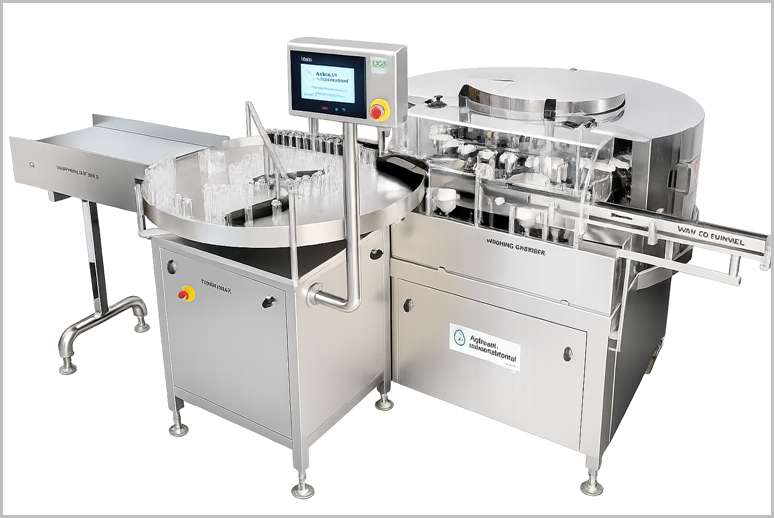
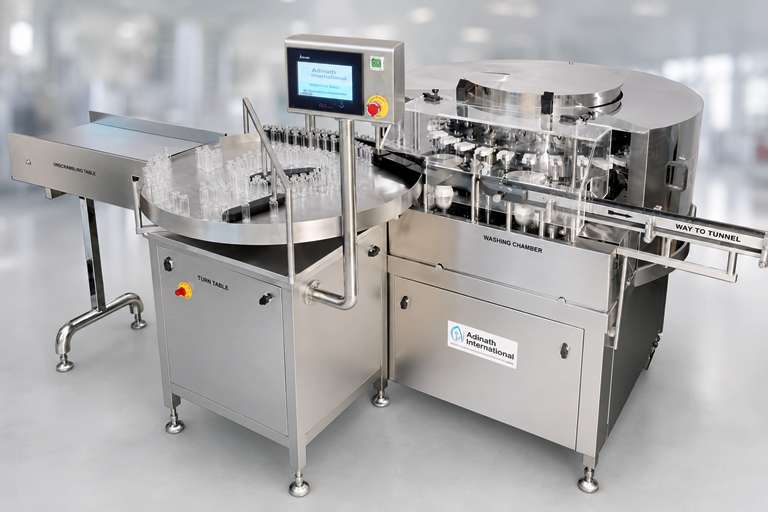
Injectable Glass Vial Washing Machine is a specialized piece of pharmaceutical equipment designed to clean glass vials used for injectable drugs, ensuring sterility and compliance with standards like cGMP (Current Good Manufacturing Practice) and FDA regulations. These machines are essential in the production of parenteral (injectable) medications, where even microscopic contaminants can pose serious health risks. They typically handle vials ranging from 2ml to 100ml in size and are integrated into larger filling lines that include sterilization, filling, sealing, and labeling processes. These washers remove particulates, residues, and pyrogens from both the interior and exterior of vials using high-pressure jets of purified water (e.g., Water for Injection or WFI), air, or filtered solutions. Common configurations include multi-jet systems for thorough internal cleaning and linear or rotary setups for high-volume production.
This process ensures vials meet USP <797> standards for sterile injectables, with validation protocols for particle counts and endotoxin levels.
If you need details on specific models and pricing. let me know!
Vials pushed from in feed tray and then move on wire woven conveyor belt, which align the vial in correct position, to enter in to the carrier pocket with help of oscillating guide rails. Oscillating arm deliver the vial inside pocket in mouth down position over spraying nozzles. Multijet sprayers fixed at the top cause the total external and internal surface to be washed. To avoid any possible cross contamination between two different waters, each washing station is provided with an independent circuit. Carrier pocket is moving with indexing motion. When the baskets have completed their motion the needles are lifted. They penetrate the vials, spraying jets of water or compressed air then return down. The baskets movement then advances by one station. Each station of vials passes through the washing cycles selected. The duly washed vials then delivered to the out feed tray with neck opening upward and then automatically re ordered to sterilizing tunnel with back pressure.
|
Model |
AVRW 120 |
AVRW 240 |
|
Production Output |
Up to 100 per minute |
Up to 200 per minute |
|
Vial Sizes |
2ml to 100ml |
2ml to 100ml |
|
Type of Vials |
Glass & Plastic Vials |
Glass & Plastic Vials |
|
Power Load |
4 H.P. |
5.5 H.P. |
|
Power Voltage |
440 Volts, 3 Phase 50 Hertz, 4 wire system |
440 Volts, 3 Phase 50 Hertz, 4 wire system. |
|
Optional Accessories |
|
|
|
Utility |
|
|
|
Water Tank & Pump |
3 nos. each with 25 liters Capacity & Centrifugal pump |
3 nos. each with 25 liters Capacity & Centrifugal pump |
|
Overall Dimension: |
2050mm (L) X 2000mm (W) X 1210mm (H) approx. |
2450mm (L) X 2000mm (W) X 1300mm (H) approx. |
|
Net Weight |
700 kgs. approx. |
900 kgs. approx. |
|
Gross Weight |
1000 kgs. approx. |
1300 kgs. approx. |
* Power voltage can be adjusted as per customer’s domestic power voltage requirements.
* Rights of technical improvements & modification reserved.
* Illustrations & dimensions are shown for information purpose only.
These features make the machine essential for ensuring sterility assurance, particulate control, and regulatory compliance in injectable manufacturing (e.g., vaccines, antibiotics, biologics).
Note: Features can vary between linear vs. rotary and manufacturer-specific models. Linear types are often preferred for flexibility, while rotary suits very high-speed needs.
1st wash | Recycled Water (WFI) |
2nd wash | Compressed Air |
3rd wash | DM Water |
4th wash | Compressed Air |
5th wash | Water for Injection (WFI) |
6th wash | Compressed Air |
An Injectable Glass Vial Washing Machine is a fully automatic, high-speed washing system designed to clean glass (and plastic) vials used for injectable drugs. It performs both internal and external washing using high-pressure jets to remove particles, residues, and pyrogens, ensuring the vials meet cGMP and FDA standards before sterilization and filling.
We offer two standard models:
These models are ideal for medium to high-volume injectable production lines.
The machine can efficiently wash 2ml to 100ml glass and plastic vials. It features a special pocket system and requires no change parts for different vial sizes, allowing quick and easy changeover.
It performs 6 washing cycles as standard:
Both internal and external surfaces are thoroughly cleaned using multijet spraying nozzles.
Algeria | Angola | Argentina | Australia | Austria | Bahrain | Bangladesh | Belarus | Belgium | Bolivia | Botswana | Brazil | Bulgaria | Canada | Chile | China | Colombia | Costa Rica | Cuba | Czech Republic | Denmark | Dominican Republic | Ecuador | Egypt | El Salvador | Ethiopia | Finland | France | Germany | Ghana | Greece | Guatemala | Haiti | Honduras | Hong Kong | Hungary | India | Indonesia | Iran | Ireland | Israel | Italy | Ivory Coast | Japan | Jordan | Kazakhstan | Kenya | Kuwait | Lebanon | Libya | Malaysia | Mexico | Mongolia | Morocco | Mozambique | Myanmar | Netherlands | New Zealand | Nicaragua | Nigeria | Norway | Oman | Pakistan | Panama | Paraguay | Peru | Philippines | Poland | Portugal | Qatar | Romania | Russia | Saudi Arabia | Senegal | Slovakia | Singapore | South Africa | South Korea | South Sudan | Spain | Sri Lanka | Sweden | Switzerland | Taiwan | Tanzania | Thailand | Trinidad and Tobago | Tunisia | Turkey | Uganda | Ukraine | United Arab Emirates | United Kingdom | United States | Uruguay | Uzbekistan | Venezuela | Vietnam | Zambia | Zimbabwe
Connect with our engineering team to discuss your specific production requirements. We provide customized, cGMP-compliant machinery solutions designed to optimize your manufacturing facility and maximize output.
©Adinath International | Theme Developed By Pharma Machinery Manufacturer I Website updated on: 09 October 2026
WhatsApp us
