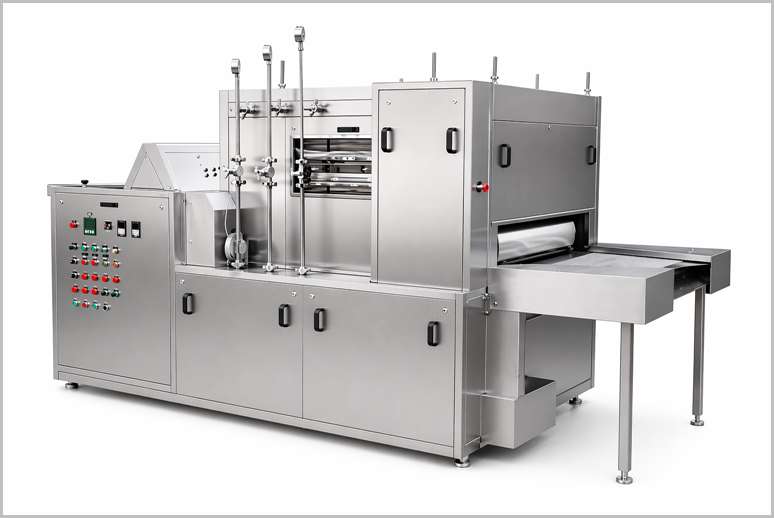
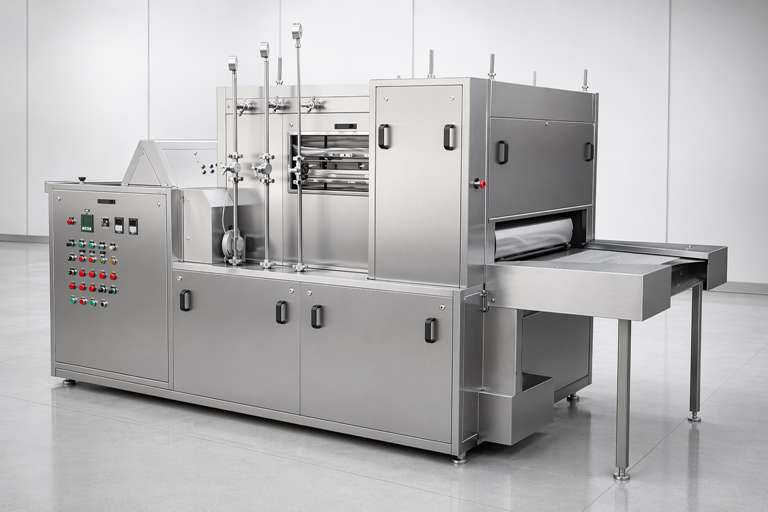
Tunnel Type Vial Washing Machine (also known as an Automatic Linear Tunnel Type Vial Washing Machine) is a specialized, automated piece of equipment primarily used in the pharmaceutical, biotechnology, and injectable drug manufacturing industries. It is designed to thoroughly clean both the internal and external surfaces of glass vials (typically round vials ranging from 2 ml to 100 ml in size) to ensure they are free from contaminants, particles, and residues before filling with sterile products like vaccines, injectables, or medications. This machine operates on a linear conveyor system within a enclosed “tunnel” structure, which maintains separation between the loading (dirty) and unloading (clean) zones to prevent cross-contamination, adhering to cGMP (Current Good Manufacturing Practice) standards.
If you need details on specific models and pricing. let me know!
Containers feed from the de-cartooning station are received on an Infeed turn table through visual inspection unit. An in feed worm inverts container to neck down position and feeds them through a specially designed indexing device. The device carries the container forward and stops. Nozzles carrier enters into the container and activities the jet of water/air. The air/water flow is deactivated after the washing cycle is over. Device indexes the vials for next wash. A separate pumping station gives the right quantum of water at the desired pressure. Washed containers are again inverted to neck upward position to collect in trays or directly feed to sterilizing tunnel.
Model: | ALVW-80 | ALVW-150 |
Production Rate: | 40 to 80 Vials/Minute | 80 to 150 Vials/Minute |
Input Specification:(Container diameter) | 15mm to 35mm | 15mm to 35mm |
Power Specification: | – | – |
Main Machine: | 0.75 H.P. | 0.75 H.P. |
Pumping Station: | 2.25 H.P. | 2.25 H.P. |
Loading Platform: | 0.25 H.P. | 0.25 H.P. |
Electrical Characteristics | 440 Volts, 3 Phase, 4 Wire System, 50 Hertz | 440 Volts, 3 Phase, 4 Wire System, 50 Hertz |
Optional Accessories: | – | – |
Vial Loading Platform | Vial Loading Platform | |
Vial Inspection Station | Vial Inspection Station | |
Pumping Station | Pumping Station | |
Programmable Logic Control with GUI | Programmable Logic Control with GUI | |
Utility: | – | – |
Fresh Water | 5 Liters/Minute | 10 Liters/Minute |
DM Water | 10 Liters/Minute | 20 Liters/Minute |
WFI | 5 Liters/Minute | 5 Liters/Minute |
Air | 30 CFM@5 bar | 30 CFM@5 bar |
Overall Dimension: | 2300mm (L) X 850mm (W) X 915mm (H) | 2300mm (L) X 1000mm (W) X 915mm (H) |
* Power voltage can be adjusted as per customer’s domestic power voltage requirements.
* Rights of technical improvements & modification reserved.
* Illustrations & dimensions are shown for information purpose only.
A Tunnel Type Vial Washing Machine, also known as an Automatic Linear Tunnel Type Vial Washing Machine, is a fully automatic, continuous-motion washing system designed for high-speed cleaning of glass and plastic vials. It uses a linear tunnel structure with multiple washing stations to clean both internal and external surfaces, ensuring complete removal of particles and contaminants while maintaining separation between dirty and clean zones for cGMP compliance.
We offer two standard models:
Higher-speed models are also available based on production requirements.
The machine can wash vials with diameters from 15mm to 35mm, covering 2ml to 100ml vials. It is suitable for both glass and plastic vials with quick changeover using minimum change parts.
It is equipped with 4 Water Washes + 3 Air Washes (total 7 washing stations). Washing nozzles enter inside the vials for thorough internal cleaning. The sequence is fully flexible and user-programmable, typically including DM Water, Purified Water, Water for Injection (WFI), and Compressed Air.
Algeria | Angola | Argentina | Australia | Austria | Bahrain | Bangladesh | Belarus | Belgium | Bolivia | Botswana | Brazil | Bulgaria | Canada | Chile | China | Colombia | Costa Rica | Cuba | Czech Republic | Denmark | Dominican Republic | Ecuador | Egypt | El Salvador | Ethiopia | Finland | France | Germany | Ghana | Greece | Guatemala | Haiti | Honduras | Hong Kong | Hungary | India | Indonesia | Iran | Ireland | Israel | Italy | Ivory Coast | Japan | Jordan | Kazakhstan | Kenya | Kuwait | Lebanon | Libya | Malaysia | Mexico | Mongolia | Morocco | Mozambique | Myanmar | Netherlands | New Zealand | Nicaragua | Nigeria | Norway | Oman | Pakistan | Panama | Paraguay | Peru | Philippines | Poland | Portugal | Qatar | Romania | Russia | Saudi Arabia | Senegal | Slovakia | Singapore | South Africa | South Korea | South Sudan | Spain | Sri Lanka | Sweden | Switzerland | Taiwan | Tanzania | Thailand | Trinidad and Tobago | Tunisia | Turkey | Uganda | Ukraine | United Arab Emirates | United Kingdom | United States | Uruguay | Uzbekistan | Venezuela | Vietnam | Zambia | Zimbabwe
Connect with our engineering team to discuss your specific production requirements. We provide customized, cGMP-compliant machinery solutions designed to optimize your manufacturing facility and maximize output.
©Adinath International | Theme Developed By Pharma Machinery Manufacturer I Website updated on: 09 October 2026
WhatsApp us
