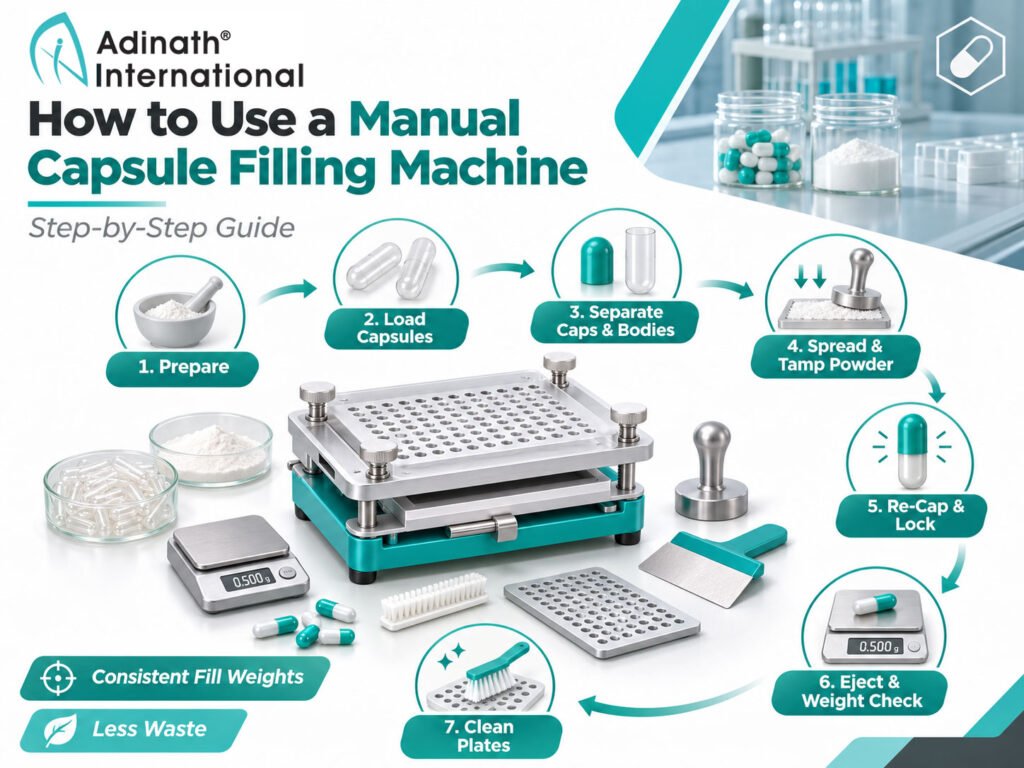
A manual capsule filling machine lets one operator fill a full tray of capsules at a time with nothing more than a set of plates, a few levers and a tamper. Used well, it gives consistent fill weights and very little waste. Used carelessly, it gives light capsules in one corner, heavy ones in another, and dented or split shells. The difference is almost entirely in the method.
This guide explains how to use manual capsule filling machines step by step: what to prepare, how to load and separate empty capsules, how to spread and tamp the powder, how to close and eject the capsules, how to check fill weight and how to clean the plates. It is written for pharmacists, small producers and laboratory staff. It is a general guide; always follow the instructions supplied with your machine and your own site procedures. For the full range of machines, see our capsule filling machines.
What you need
Before you start, gather everything at the bench, so you are not leaving open capsules or powder unattended. A clean, dry, draught-free work area matters: a breeze or fan blows fine powder about, and humid air softens gelatin shells.
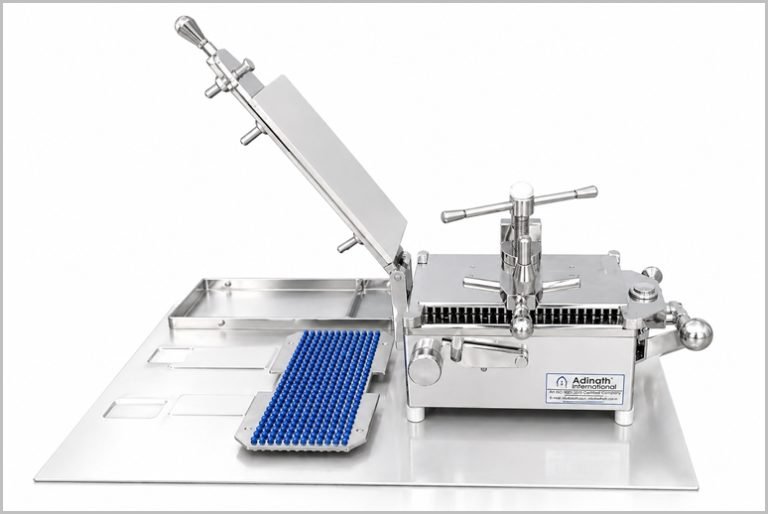
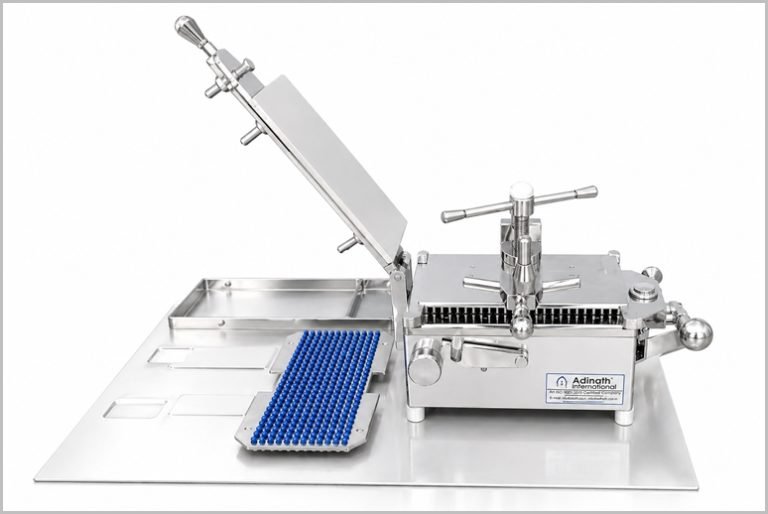
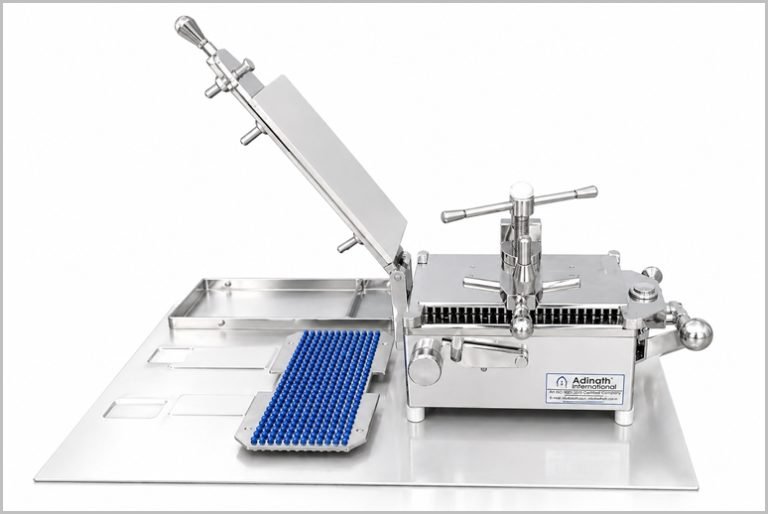
- The machine with plates for the capsule size you are using, for example a manual capsule filling machine, a larger manually operated plate machine or a smaller hand filler.
- Empty capsules of the correct size, gelatin or vegetarian (HPMC), from a closed, labelled container.
- The powder blend, mixed and sieved, and weighed out for the tray.
- Accessories: powder tray, spreader (a flat scraper or card), tamper, soft brush.
- A balance suitable for weighing individual capsules, plus a record sheet.
- Personal protection as required by the site, such as gloves, hair cover and, for fine or potent powders, suitable respiratory protection.
Calculating the powder per tray
Work out the target fill weight per capsule, multiply it by the number of holes, and weigh out that amount plus a small excess to allow for powder left on the plate. Before the first production tray, fill one trial tray to learn how many tamping cycles your blend needs to reach the target. A capsule that is too small for the dose cannot be fixed by harder tamping; choose the size first.
| No. | Step | What happens |
|---|---|---|
| 1 | Filled loading tray | Every hole holds one capsule, body down |
| 2 | Tray on the machine | Capsules transferred into the cap and body plates |
| 3 | Caps lifted off | Bodies held by the locking plate while caps are removed |
| 4 | Bodies level | Open rims flush with the plate surface |
| 5 | Powder spread | Powder worked evenly across all rows |
| 6 | Tamping | Pin plate compresses powder in all bodies |
| 7 | Closing | Caps returned, closing plate holds them, bodies pushed up |
| 8 | Ejection | Closed capsules released from the plate |
| 9 | Weighing | Individual capsules checked against the target |
The sections below follow the step numbers in Figure 1. The sequence is the one used on 100-hole and 300-hole manual machines with a locking lever, a long handle, a tamper and a locking plate. Lever and knob positions differ between models, so match each step to the instructions supplied with your machine.
Loading empty capsules
Pour enough empty capsules onto the loading tray to cover it generously. Move the tray gently from side to side and front to back. The capsules drop into the holes body-first, because the body is narrower than the cap. Keep moving until every hole is filled, then brush or pour surplus capsules back into their container (step 1).
Look across the tray before going further. Remove any capsule that is lying flat, standing too high (often a cap-down capsule) or visibly damaged. An empty hole now means a missing capsule later, so fill any gaps by hand.
Loading is the slowest step in manual work. A separate manual capsule loader can save time: it orients empty capsules and places them into the loading tray, ready for the filler.
Place the loaded tray on the machine in its locating position and release the capsules into the plates as described in your machine’s instructions (step 2).
Separating caps and bodies
Engage the locking lever so that the bodies are gripped in the body plate. Then operate the main handle to lift the cap plate (step 3). The caps come away in the cap plate, which you lift off and put aside, open side up, in a clean place.
Release the lock so that the bodies settle level with the plate surface (step 4). Check the plate: any capsules that did not separate, or bodies that came away with their caps, should be removed now. A few unseparated capsules are normal; many suggest worn plates, a tight capsule lot or a light grip from the locking plate.
Spreading and tamping powder
This is the step that decides the fill weight, so take your time and do it the same way every cycle.
- Fit the powder tray around the body plate so that powder cannot fall over the sides.
- Pour the weighed powder onto the plate, not all in one spot but along one side.
- Spread the powder with the spreader in slow, even strokes, first in one direction and then at right angles, until every body is full (step 5).
- Lower the tamper and press down evenly, so that each pin compresses the powder in its body (step 6).
- Lift the tamper, spread the remaining powder into the space created, and tamp again.
- Repeat the spread-and-tamp cycle the number of times you established in your trial tray.
- Scrape the excess powder off the surface so that the plate is clean and the bodies are level-full.
Tips for even weights
- Use the same number of tamping cycles and the same pressure every time.
- Pay attention to the edges and corners of the plate, which tend to receive less powder.
- Do not leave powder heaped on the rims; it prevents the capsules closing properly.
- If the powder flows poorly or forms lumps, sieve it again before filling.
Re-capping and locking
Brush any powder from the surface of the body plate, then return the cap plate to the machine in its locating position, so that each cap sits directly over its body. Bring the closing plate down onto the caps and set the machine to its closing position (step 7).
Press the main handle down in one steady, firm stroke. This pushes all the bodies up into their caps until the capsules lock. Do not jerk or hammer the handle: a sudden push dents caps and can cause telescoping, where the body is forced through the cap.
Ejecting and weight checking
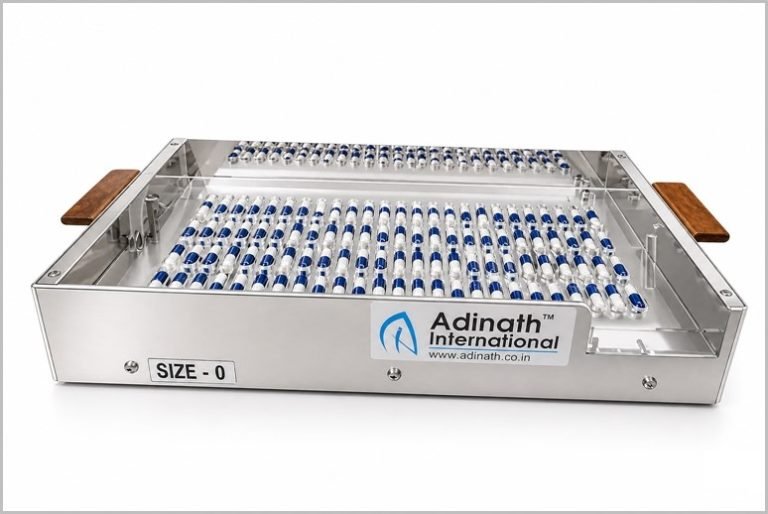
Lift the closing plate, return the machine to its release position and eject the closed capsules into a clean container, either with the handle or by removing and inverting the plate, depending on the model (step 8). Inspect a handful for dents, splits, open or partly closed capsules and loose powder.
How to check fill weight
Weigh a sample of empty capsules first and calculate the average empty shell weight. Then weigh filled capsules individually (step 9). The net fill of each capsule is its gross weight minus the average empty weight.
| What to do | Why |
|---|---|
| Take capsules from the centre, edges and corners of the tray | Shows whether spreading is even across the plate |
| Check the first tray before continuing | Confirms the number of tamping cycles |
| Check at regular intervals during the batch | Detects changes in blend or operator technique |
| Record each result and any change in method | Supports traceability and troubleshooting |
The number of capsules to weigh and the acceptable limits are set by your site procedure and, for medicines, by the applicable pharmacopoeia. If weights are low across the tray, add a tamping cycle; if one area is low, improve the spreading. If weights are high, reduce tamping or the powder per tray.
Once the capsules pass inspection and weight checks, transfer them to a closed, labelled container. If they are to be packed in bottles, the count can be done by hand for small batches or with capsule and tablet counting equipment as volumes grow.
Common problems when learning how to use manual capsule filling machines
New operators tend to meet the same few problems in their first batches. Most are solved by adjusting technique rather than the machine, which is why a short trial tray and a written routine are worth the time.
| Problem | Likely cause | What to check |
|---|---|---|
| Corners light, centre heavy | Uneven spreading | Spreading pattern and strokes |
| All capsules light | Too few tamping cycles; low-density powder | Tamping routine; capsule size |
| Caps will not close fully | Powder above the rim | Scraping after filling |
| Dented or telescoped capsules | Jerky closing stroke; misaligned plates | Closing technique; plate seating |
| Many capsules not separating | Worn plates; tight capsule lot | Plate condition; capsule supplier |
Cleaning the plates
Clean the machine at the end of each batch and before changing product. Follow your site cleaning procedure; the general approach is:
- Remove loose powder from all plates and trays with a soft brush or a vacuum cleaner suitable for powders.
- Dismantle the removable plates and parts as described in the machine manual.
- Wash and rinse the parts with the cleaning agent specified by your procedure, paying attention to the holes, where powder collects.
- Dry every part completely before reassembly. Moisture left in the holes softens the next batch of capsules and makes powder stick.
- Inspect the plates for wear, burrs or damage, reassemble, label the machine as clean and record the cleaning.
Never use sharp tools to clear blocked holes, as scratches and burrs damage capsules later. If you change capsule size, store the plate set in its own labelled case. For general care, the same principles apply to the hand capsule filler range and larger plate machines.
Choosing the right manual machine
Anyone who has learned how to use manual capsule filling machines on one model can transfer the routine to another: the steps above are the same whether your machine has 100 or 300 holes. The larger plate fills more capsules per cycle but is heavier to handle, and loading takes longer. Choose the plate size that suits your batch size and how long one operator can comfortably work.
Think about what happens after filling as well. Laboratories often place the filler alongside other R&D lab machines such as small blenders, while producers who sell in bottles may later add counting equipment to replace counting by hand.
Conclusion
Knowing how to use manual capsule filling machines well comes down to a repeatable routine: load and check the tray, separate cleanly, spread and tamp the same way every cycle, scrape the surface clean, close with a steady stroke, and weigh capsules from across the tray. Clean and dry the plates thoroughly after each batch, and record what you did.
If you are choosing a manual filler or adding plate sets for new capsule sizes, our team can advise. Send us an enquiry about a manual capsule filling machine with your capsule sizes and batch sizes.
 Summarize this article with: