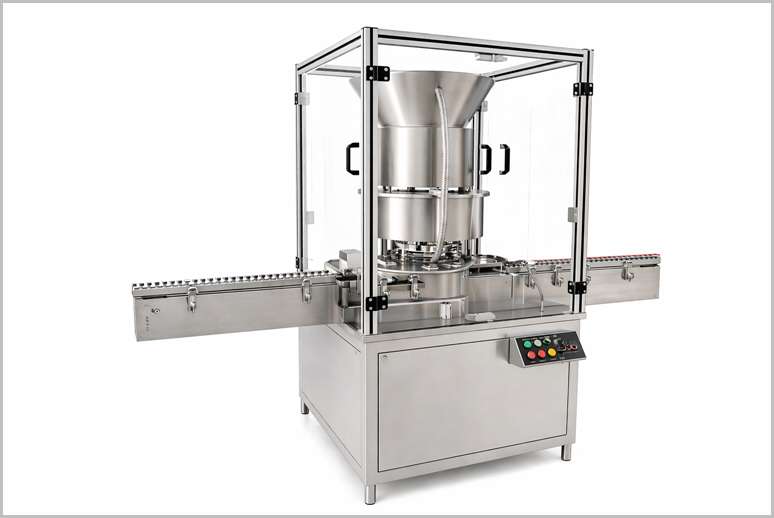
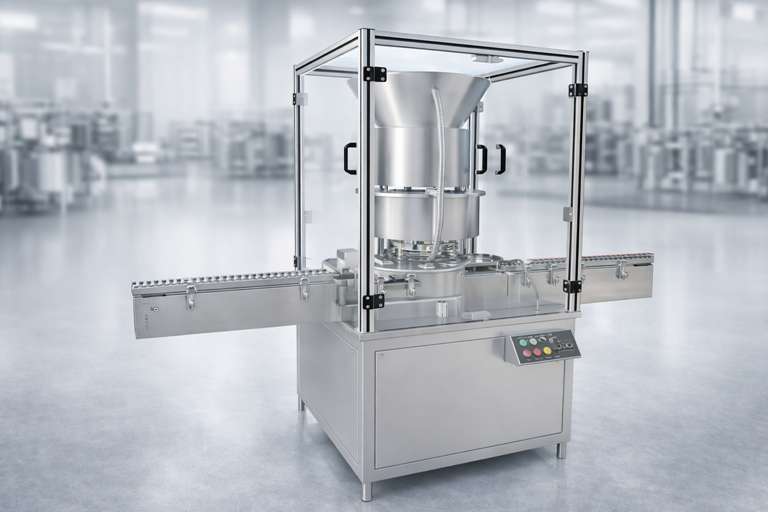
Automatic Vial Cap Sealing Machine are specialized equipment designed for sealing injectable glass vials with aluminum or flip-off caps, widely used in the pharmaceutical, veterinary, and biotech industries. These machines ensure a hermetic seal to maintain container closure integrity, sterility, and drug stability, adhering to Current Good Manufacturing Practices (cGMP) standards. These machines can be integrated into complete sterile Vial Filling Lines, connecting with Vial Filling and Labeling Machines for seamless operation. Monoblock Systems Combine Filling, Stoppering, and Capping in a single platform for enhanced efficiency.
If you need details on specific models, pricing, or comparisons with multi-head machines, let me know!
Duly Stoppered vials are continuously fed from the convetor of filling machine to the flat conveyor belt of sealing machine and move further through infeed worm for correct spacing and transferred to the infeed starwheel. Aluminium caps kept in vibratory bowl automatically orient caps in right direction before entering the delivery chute. Vial during its rotation movement with infeed starwheel picks up aluminum seal from the retaining finger of delivery chute and correctly position on the vial before entering sealing turret. Vial now moves on the spring loaded sealing platform, where free spinning sealing rollers moves gradually inside to complete the sealing operation during rotational movement of sealing platform turret. Now sealed vials are transferred to exit starwheel pocket and further moves out on to the flat conveyor belt. Duly sealed vials are collected on out-feed collection tray.
Model | ACS-60 | ACS-120 | ACS-200 |
No. of Sealing Head | Single | Four | Eight |
Production Rate | Up to 50 Vials/Minute | Up to 100 Vials/Minute | Up to 200 Vials/Minute |
Container Diameter: | 15mm to 80mm | 15mm to 80mm | 15mm to 80mm |
Container Height: | 20mm to 180mm | 20mm to 180mm | 20mm to 180mm |
Cap Diameter: | 13mm, 20mm, 28mm, 30mm & 33mm with the help of change parts. | 13mm, 20mm, 28mm, 30mm & 33mm with the help of change parts. | 13mm, 20mm, 28mm, 30mm & 33mm with the help of change parts. |
Power Supply | 0.5 H.P. | 1 H.P. | 2 H.P. |
Electrical characteristics | 440 Volts, 3 Phase, 50 Hertz, 4 Wire System | 440 Volts, 3 Phase, 50 Hertz, 4 Wire System | 440 Volts, 3 Phase, 50 Hertz, 4 Wire System |
Optional Accessories | Aluminum profile cabinet covering full machine | Aluminum profile cabinet covering full machine | Aluminum profile cabinet covering full machine |
Chuck for flip-off seal | Chuck for flip-off seal | Chuck for flip-off seal | |
PLC with HMI | PLC with HMI | PLC with HMI | |
Overall Dimension | 1300mm X 800mm (W) X 1800mm (H) approx. | 1500mm (L) x 850mm (W) x 1800mm (H) approx. | 2000mm (L) x 850mm (W) x 1800mm (H) approx. |
* Power voltage can be adjusted as per customer’s domestic power voltage requirements.
* Rights of technical improvements & modification reserved.
* Illustrations & dimensions are shown for information purpose only.
An Automatic Vial Cap Sealing Machine is specifically designed to seal injectable glass vials with aluminum or flip-off caps. It is a critical component in pharmaceutical, veterinary, and biotech production lines, ensuring a hermetic seal that maintains sterility and drug stability in compliance with cGMP standards.
The machine is available in several configurations to match your production scale:
The system is highly versatile and can be adjusted for a wide range of containers:
The machine utilizes spring-loaded, free-spinning sealing rollers. This mechanism applies controlled, gradual pressure to the cap during rotation, accommodating minor variations in the vial neck diameter while eliminating the risk of cracking the glass or damaging the aluminum seals.
To maintain high-quality control and reduce waste, the machine features several intelligent sensors:
More Capping and Sealing Machines
 Semi Automatic Vial Cap Sealing Machine
 Automatic Vial Sealing Machine
 Eight Head Vial Cap Sealing Machine
 Four Head Vial Cap Sealing Machine
Algeria | Angola | Argentina | Australia | Austria | Bahrain | Bangladesh | Belarus | Belgium | Bolivia | Botswana | Brazil | Bulgaria | Canada | Chile | China | Colombia | Costa Rica | Cuba | Czech Republic | Denmark | Dominican Republic | Ecuador | Egypt | El Salvador | Ethiopia | Finland | France | Germany | Ghana | Greece | Guatemala | Haiti | Honduras | Hong Kong | Hungary | India | Indonesia | Iran | Ireland | Israel | Italy | Ivory Coast | Japan | Jordan | Kazakhstan | Kenya | Kuwait | Lebanon | Libya | Malaysia | Mexico | Mongolia | Morocco | Mozambique | Myanmar | Netherlands | New Zealand | Nicaragua | Nigeria | Norway | Oman | Pakistan | Panama | Paraguay | Peru | Philippines | Poland | Portugal | Qatar | Romania | Russia | Saudi Arabia | Senegal | Slovakia | Singapore | South Africa | South Korea | South Sudan | Spain | Sri Lanka | Sweden | Switzerland | Taiwan | Tanzania | Thailand | Trinidad and Tobago | Tunisia | Turkey | Uganda | Ukraine | United Arab Emirates | United Kingdom | United States | Uruguay | Uzbekistan | Venezuela | Vietnam | Zambia | Zimbabwe
Connect with our engineering team to discuss your specific production requirements. We provide customized, cGMP-compliant machinery solutions designed to optimize your manufacturing facility and maximize output.
©Adinath International | Theme Developed By Pharma Machinery Manufacturer I Website updated on: 15 October 2026
Request A Quick Quote
Automatic Vial Cap Sealing Machine
Please drop your requirements, one of our technical expert will contact you in next 24 working hours.
WhatsApp us
