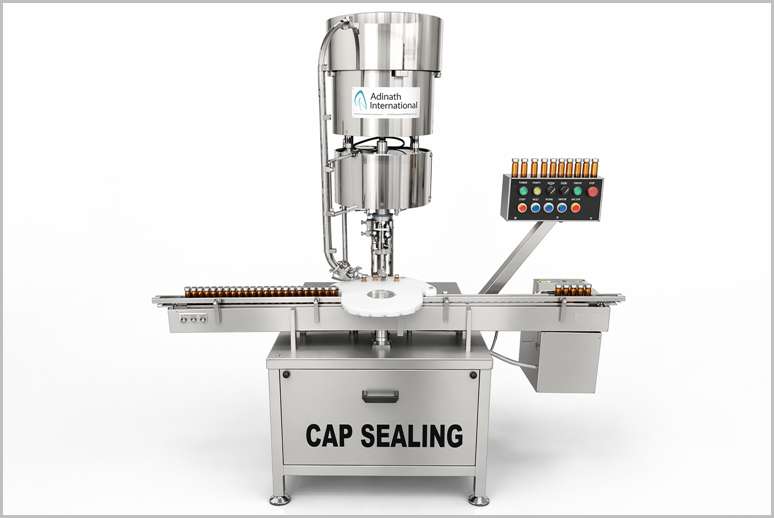
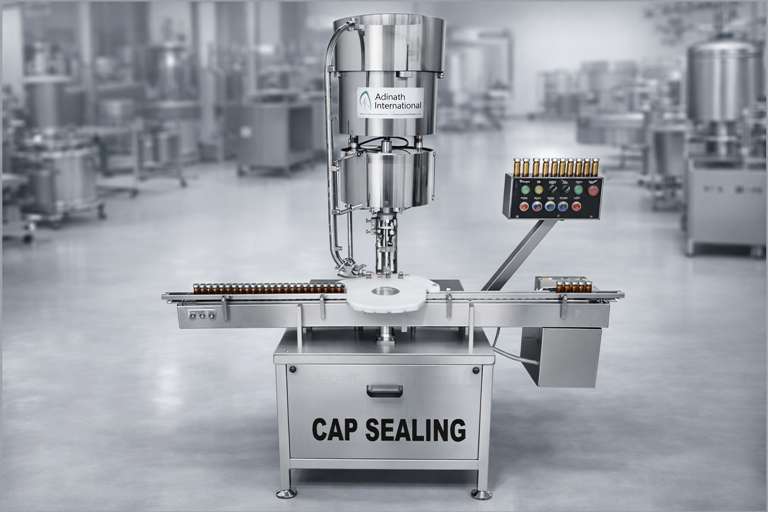
Glass Bottle Capping Machine is a specialized device used in packaging to securely seal caps onto glass bottles, ensuring product integrity and safety. These machines are widely used in industries such as food and beverage, pharmaceuticals, cosmetics, and chemicals for sealing various cap types, including screw caps, lug caps, crown caps, ROPP caps, corks, and snap-on caps. Glass Bottle Capping Machines are essential for ensuring secure, tamper-evident, and airtight seals in various industries. Key considerations include compatibility with bottle and cap specifications, production speed, and automation level. Advanced features like precise torque control, stainless steel construction, and customizable settings enhance efficiency and product quality.
When selecting a glass bottle capping machine, key factors include:
If you need details on specific models, pricing, or comparisons with multi-head machines, let me know!
The filled bottles moving on conveyor belt and fed into an in feed star wheel by in-feed worm. While moving in feed star wheel, bottles pick up caps one by one from delivery chute. The descending rotary sealing heads hold bottle’s neck with desired pressure. The sealing is done in a programmed roll-on manner, accurate positioned of the caps is done mechanically by means of a rotating unscramble, to direct the caps correctly into the chute, when the chute is filled up the rotating unscramble drive is disengaged, hence, there is no chance to damage of caps. The sealing roller takes place due to rotating sealing head and transfer movement of sealing & threading rollers due to sealing cam. The sealed bottles are discharged by exist star wheel on conveyors.
Model | ACSR-60 | ACSR-120 | ACSR-200 |
No. of Capping Heads | Single | Four | Eight |
Production Rate | Up to 50 Containers/Minute | Up to 100 Containers/Minute | Up to 200 Containers/Minute |
Container Diameter: | 24mm to 90mm | 24mm to 90mm | 24mm to 90mm |
Container Height: | 50mm to 250mm | 50mm to 250mm | 50mm to 250mm |
Cap Diameter: | 20mm, 25mm & 28mm with the help of change parts | 20mm, 25mm & 28mm with the help of change parts | 20mm, 25mm & 28mm with the help of change parts |
Power Specification: | 1 H.P. | 1 H.P. | 2 H.P. |
Electrical characteristics | 440 Volts, 3 Phase, 50 Hertz, 4 Wire System | 440 Volts, 3 Phase, 50 Hertz, 4 Wire System | 440 Volts, 3 Phase, 50 Hertz, 4 Wire System |
Conveyor Height | 800mm to 900mm adjustable | 800mm to 900mm adjustable | 800mm to 900mm adjustable |
Optional Accessories | Safety Cabinet Covering Machine | Safety Cabinet Covering Machine | Safety Cabinet Covering Machine |
– | PLC with HMI | PLC with HMI | PLC with HMI |
Overall Dimension | 1500mm (L) X 850mm (W) X 1800mm (H) approx. | 1675 (L) x 1000mm (W) x 1800mm (H) approx. | 2000 (L) x 1000mm (W) x 1800mm (H) approx. |
* Power voltage can be adjusted as per customer’s domestic power voltage requirements.
* Rights of technical improvements & modification reserved.
* Illustrations & dimensions are shown for information purpose only.
The Glass Bottle Capping Machine is a high-speed automatic or semi-automatic machine designed to apply and tighten caps (ROPP, screw, lug, or flip-off) on glass bottles. It ensures a secure, leak-proof, and tamper-evident seal, making it ideal for packaging syrups, oral liquids, tonics, beverages, and pharmaceutical products in glass containers.
The machine is available in different models:
It is suitable for medium to high-volume production lines handling glass bottles.
The machine supports a wide range of glass bottle formats:
It efficiently handles ROPP aluminum caps, plastic/metal screw caps, and other common closures used on glass bottles.
Glass bottles require precise pressure and torque control during capping to avoid breakage. A dedicated Glass Bottle Capping Machine provides controlled sealing pressure, safety clutch mechanisms, and adjustable torque, ensuring safe, consistent, and damage-free capping while maintaining product integrity and leak-proof performance.
Key benefits include reliable leak-proof sealing, high-speed operation, quick size changeover, GMP-compliant stainless steel construction, low maintenance, and easy integration with filling lines. Optional features include:
More Capping and Sealing Machines
 Automatic Bottle Capping Machine
 Automatic Bottle Ropp Capping Machine
 Automatic Bottle Screw Capping Machine
 Bottle Aluminium Capping Machine
Algeria | Angola | Argentina | Australia | Austria | Bahrain | Bangladesh | Belarus | Belgium | Bolivia | Botswana | Brazil | Bulgaria | Canada | Chile | China | Colombia | Costa Rica | Cuba | Czech Republic | Denmark | Dominican Republic | Ecuador | Egypt | El Salvador | Ethiopia | Finland | France | Germany | Ghana | Greece | Guatemala | Haiti | Honduras | Hong Kong | Hungary | India | Indonesia | Iran | Ireland | Israel | Italy | Ivory Coast | Japan | Jordan | Kazakhstan | Kenya | Kuwait | Lebanon | Libya | Malaysia | Mexico | Mongolia | Morocco | Mozambique | Myanmar | Netherlands | New Zealand | Nicaragua | Nigeria | Norway | Oman | Pakistan | Panama | Paraguay | Peru | Philippines | Poland | Portugal | Qatar | Romania | Russia | Saudi Arabia | Senegal | Slovakia | Singapore | South Africa | South Korea | South Sudan | Spain | Sri Lanka | Sweden | Switzerland | Taiwan | Tanzania | Thailand | Trinidad and Tobago | Tunisia | Turkey | Uganda | Ukraine | United Arab Emirates | United Kingdom | United States | Uruguay | Uzbekistan | Venezuela | Vietnam | Zambia | Zimbabwe
Connect with our engineering team to discuss your specific production requirements. We provide customized, cGMP-compliant machinery solutions designed to optimize your manufacturing facility and maximize output.
©Adinath International | Theme Developed By Pharma Machinery Manufacturer I Website updated on: 15 October 2026
Request A Quick Quote
Glass Bottle Capping Machine
Please drop your requirements, one of our technical expert will contact you in next 24 working hours.
WhatsApp us
