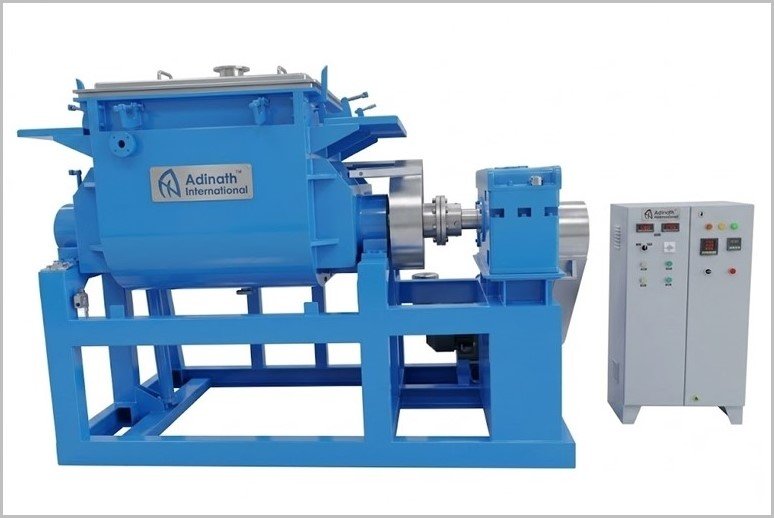
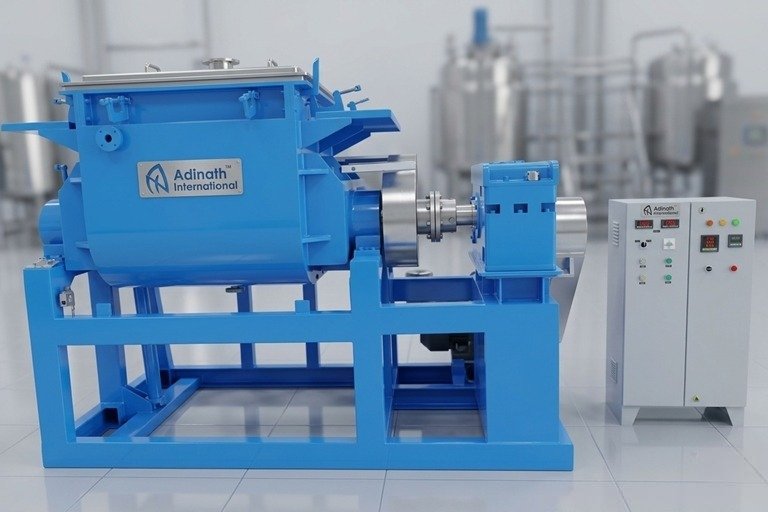
The Brake Lining Compounds Kneader is a specialized, high-performance dispersion kneader engineered exclusively for the precise mixing, kneading, and compounding of brake lining, brake pad, clutch facing, and other friction material formulations. In the highly demanding automotive and industrial friction materials industry, achieving uniform dispersion of ingredients is critical for safety, performance, and durability. This advanced brake lining kneader delivers exceptional results when processing complex formulations containing asbestos-free fibers, resins, fillers, friction modifiers, lubricants, and curing agents.
Modern brake pad and brake lining production requires perfect homogeneity to ensure consistent friction coefficients, heat resistance, noise reduction, and wear properties. The Brake Lining Compounds Kneader excels in handling high-viscosity, abrasive, and temperature-sensitive compounds that standard mixers cannot process effectively. Its heavy-duty sigma blade or intermeshing rotor design creates intense shear forces, ensuring thorough dispersion of raw materials while preventing agglomeration and maintaining batch-to-batch consistency.
Investing in a dedicated Brake Lining Compounds Kneader brings multiple advantages:
Core Mixing Mechanism
Blade Configurations
Model | Capacity – Liters | Motor (H.P.) | ||
Working Capacity approx. | Gross Capacity approx. | General | Heavy Duty | |
ASM – 50 | 50 Liters | 80 Liters | 5 H.P. | 7.5 H.P. |
ASM – 75 | 75 Liters | 110 Liters | 7.5 H.P. | 10 H.P. |
ASM – 100 | 100 Liters | 150 Liters | 10 H.P. | 15 H.P. |
ASM – 150 | 150 Liters | 200 Liters | 15 H.P. | 20 H.P. |
ASM – 200 | 200 Liters | 300 Liters | 20 H.P. | 25 H.P. |
ASM – 400 | 400 Liters | 550 Liters | 30 H.P. | 40 H.P. |
ASM – 500 | 500 Liters | 750 Liters | 40 H.P. | 50 H.P. |
ASM – 750 | 750 Liters | 1150 Liters | 50 H.P. | 60 H.P. |
ASM – 1000 | 1000 Liters | 1500 Liters | 60 H.P. | 70 H.P. |
ASM – 1500 | 1500 Liters | 2100 Liters | 75 H.P. | 80 H.P. |
ASM – 2000 | 2000 Liters | 2600 Liters | 80 H.P. | 90 H.P. |
ASM – 3000 | 3000 Liters | 3800 Liters | 100 H.P. | 120 H.P. |
* Power voltage can be adjusted as per customer’s domestic power voltage requirements.
* Rights of technical improvements & modification reserved.
* Illustrations & dimensions are shown for information purpose only.
It is a specialized high-performance dispersion kneader engineered for the precise mixing, kneading, and compounding of brake lining, brake pad, clutch facing, and other friction material formulations. It processes complex mixtures containing asbestos-free fibers, resins, fillers, friction modifiers, lubricants, and curing agents to deliver uniform dispersion critical for automotive and industrial friction materials.
Perfect homogeneity ensures consistent friction coefficients, heat resistance, noise reduction, and wear properties. The kneader’s intense shear forces prevent agglomeration and maintain batch-to-batch consistency, which is essential for safety, performance, and durability of the finished friction products.
The machine is offered in Stainless Steel 316, Stainless Steel 304, and Mild Steel. Stainless-steel versions can be finished to matt or mirror polish as required. Mild-steel units receive one coat of red oxide primer followed by two coats of epoxy paint.
Models range from ASM-50 (approx. 50 L working / 80 L gross capacity) to ASM-3000 (approx. 3000 L working / 3800 L gross capacity). Motor power is available in both general and heavy-duty ratings, with voltage adjustable to suit local power requirements.
Discharge options include manual (hand-wheel operated) or automatic hydraulic operation. The heavy-duty tilting design allows 75°–140° hydraulic tilting for complete and rapid discharge without leftovers. Screw systems or automatic valve discharge can also be added.
Yes. A jacket for heating or cooling (water or thermal oil) is available, complete with mineral-wool insulation. Rotor cored cooling further maintains compound temperature within ±2–3 °C, preventing premature curing of phenolic resins during intensive kneading.
It uses high-shear sigma/Z-blade or intermeshing rotors engineered for abrasive and fibrous compounds. Rotors, mixing chamber, and side plates are made of hardened alloy steel with hard chrome plating or tungsten carbide coating for superior wear resistance and extended service life. Dust-stop sealing technology prevents powder leakage.
The kneader can be equipped with PLC + HMI automation featuring recipe management, real-time torque and temperature monitoring, and batch traceability. Safety features include emergency stop, rotor reverse, anti-overload protection, a pressure lid system (hydraulic or pneumatic), and full compliance with CE/ATEX standards.
Optional features include a liquid spray system, vacuum system, blades cooling arrangement, screw system, and automatic valve discharge system. These enhance process flexibility for complex friction material formulations.
In the tangential design, Z-shaped blades rotate toward each other at different speeds (typically a 3:2 ratio), creating intense shearing and kneading ideal for high-viscosity compounds. The overlapping design rotates blades at the same speed for faster material interchange and lower shear, suitable for lighter-viscosity mixes. Both designs help achieve thorough dispersion of fibers, resins, and fillers.
Algeria | Angola | Argentina | Australia | Austria | Bahrain | Bangladesh | Belarus | Belgium | Bolivia | Botswana | Brazil | Bulgaria | Canada | Chile | China | Colombia | Costa Rica | Cuba | Czech Republic | Denmark | Dominican Republic | Ecuador | Egypt | El Salvador | Ethiopia | Finland | France | Germany | Ghana | Greece | Guatemala | Haiti | Honduras | Hong Kong | Hungary | India | Indonesia | Iran | Ireland | Israel | Italy | Ivory Coast | Japan | Jordan | Kazakhstan | Kenya | Kuwait | Lebanon | Libya | Malaysia | Mexico | Mongolia | Morocco | Mozambique | Myanmar | Netherlands | New Zealand | Nicaragua | Nigeria | Norway | Oman | Pakistan | Panama | Paraguay | Peru | Philippines | Poland | Portugal | Qatar | Romania | Russia | Saudi Arabia | Senegal | Slovakia | Singapore | South Africa | South Korea | South Sudan | Spain | Sri Lanka | Sweden | Switzerland | Taiwan | Tanzania | Thailand | Trinidad and Tobago | Tunisia | Turkey | Uganda | Ukraine | United Arab Emirates | United Kingdom | United States | Uruguay | Uzbekistan | Venezuela | Vietnam | Zambia | Zimbabwe
Connect with our engineering team to discuss your specific production requirements. We provide customized, cGMP-compliant machinery solutions designed to optimize your manufacturing facility and maximize output.
©Adinath International | Theme Developed By Pharma Machinery Manufacturer I Website updated on: 15 October 2026
Request A Quick Quote
Brake Lining Compounds Kneader
Please drop your requirements, one of our technical expert will contact you in next 24 working hours.
WhatsApp us


