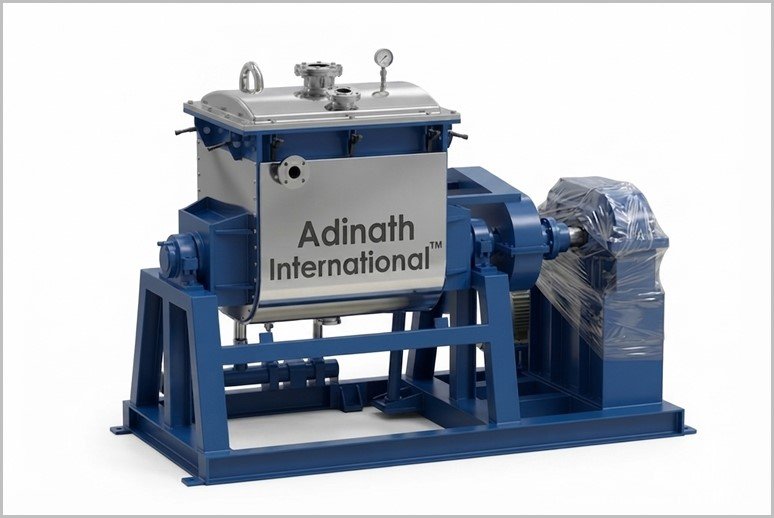
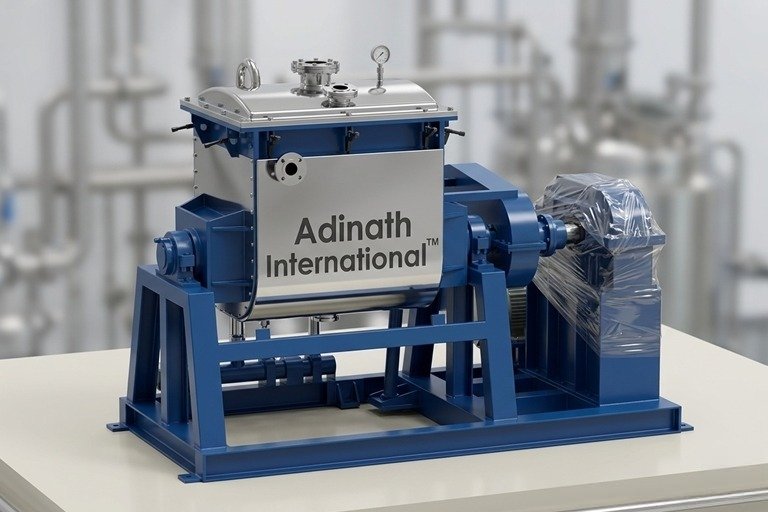
A Butyl Rubber Sigma Mixer (also known as a Z-Blade Mixer, Double Arm Kneader Mixer, or Sigma Blade Kneader) is a heavy-duty industrial batch mixer specially designed for processing high-viscosity, sticky, and rubber-like materials.
Butyl rubber (IIR – polyisobutylene-isoprene rubber) is notoriously challenging to mix due to its extreme tackiness, non-Newtonian flow behavior, and very high viscosity — often ranging from 1 to 10 million centipoise (cP). The sigma blade mixer excels in these demanding applications by providing powerful shearing, folding, and kneading action that ensures thorough dispersion, uniform consistency, and excellent homogenization of butyl rubber compounds.
This robust butyl rubber mixer is widely used in the rubber industry for manufacturing sealants, adhesives, chewing gum bases, waterproofing membranes, automotive components, and other high-performance butyl rubber products.
Kneading Action and Discharge Mechanisms
Tangential Blade Design
Overlapping Blade Design
Model | Capacity – Liters | Motor (H.P.) | ||
Working Capacity approx. | Gross Capacity approx. | General | Heavy Duty | |
ASM – 50 | 50 Liters | 80 Liters | 5 H.P. | 7.5 H.P. |
ASM – 75 | 75 Liters | 110 Liters | 7.5 H.P. | 10 H.P. |
ASM – 100 | 100 Liters | 150 Liters | 10 H.P. | 15 H.P. |
ASM – 150 | 150 Liters | 200 Liters | 15 H.P. | 20 H.P. |
ASM – 200 | 200 Liters | 300 Liters | 20 H.P. | 25 H.P. |
ASM – 400 | 400 Liters | 550 Liters | 30 H.P. | 40 H.P. |
ASM – 500 | 500 Liters | 750 Liters | 40 H.P. | 50 H.P. |
ASM – 750 | 750 Liters | 1150 Liters | 50 H.P. | 60 H.P. |
ASM – 1000 | 1000 Liters | 1500 Liters | 60 H.P. | 70 H.P. |
ASM – 1500 | 1500 Liters | 2100 Liters | 75 H.P. | 80 H.P. |
ASM – 2000 | 2000 Liters | 2600 Liters | 80 H.P. | 90 H.P. |
ASM – 3000 | 3000 Liters | 3800 Liters | 100 H.P. | 120 H.P. |
* Power voltage can be adjusted as per customer’s domestic power voltage requirements.
* Rights of technical improvements & modification reserved.
* Illustrations & dimensions are shown for information purpose only.
It is a heavy-duty industrial batch mixer (also called a Z-blade mixer, double-arm kneader, or sigma blade kneader) specially designed for processing high-viscosity, sticky, rubber-like materials such as butyl rubber (IIR). It delivers powerful shearing, folding, and kneading action to achieve thorough dispersion, uniform consistency, and excellent homogenization.
Butyl rubber is extremely tacky, exhibits non-Newtonian flow behavior, and has very high viscosity (often 1–10 million centipoise). The sigma blade mixer overcomes these challenges with intense shearing, folding, and kneading forces that ensure uniform mixing and dispersion of compounds.
The mixer is offered in Stainless Steel 316, Stainless Steel 304, or Mild Steel. Stainless-steel versions can be finished in matt or mirror polish; mild-steel units receive one coat of red oxide primer plus two coats of epoxy paint.
Models range from ASM-50 (approx. 50 L working / 80 L gross) to ASM-3000 (approx. 3000 L working / 3800 L gross). Motor power is available in general and heavy-duty ratings, with voltage adjustable to local requirements.
Two Z-shaped (sigma) blades rotate toward each other at different speeds (typically a 3:2 ratio in tangential design), transferring material from one end of the trough to the other. The action combines bulk movement, stretching, folding, dividing, and recombining, plus shearing against the blades and walls for effective size reduction and homogenization of sticky materials.
Key features include tungsten carbide or Stellite blade edges and trough wear plates (to resist abrasion from fillers such as carbon black), an extrusion discharge screw that produces sheets or strips directly for a two-roll mill, and a vacuum system with liquid-ring pump plus dust filter to prevent material loss.
Yes. A jacket for heating or cooling with mineral-wool insulation is available. A temperature control unit (TCU) supports switching between steam/hot oil and chilled water, which is important for managing process temperatures and scorch safety in rubber compounding.
Discharge can be manual (hand-wheel operated) or hydraulic (automatic). An extrusion discharge screw (bottom valve) is particularly useful, delivering the product as a sheet or strip ready for further processing on a two-roll mill.
Options include a liquid spray system, vacuum system, blade-cooling arrangement, screw system, automatic valve discharge, PLC with recipe management for reproducible batches, and explosion-proof design when solvents or zinc oxide dusting is involved.
It is widely used in the rubber industry for manufacturing sealants, adhesives, chewing gum bases, waterproofing membranes, automotive components, and other high-performance butyl rubber products that require thorough mixing of high-viscosity, sticky compounds.
Algeria | Angola | Argentina | Australia | Austria | Bahrain | Bangladesh | Belarus | Belgium | Bolivia | Botswana | Brazil | Bulgaria | Canada | Chile | China | Colombia | Costa Rica | Cuba | Czech Republic | Denmark | Dominican Republic | Ecuador | Egypt | El Salvador | Ethiopia | Finland | France | Germany | Ghana | Greece | Guatemala | Haiti | Honduras | Hong Kong | Hungary | India | Indonesia | Iran | Ireland | Israel | Italy | Ivory Coast | Japan | Jordan | Kazakhstan | Kenya | Kuwait | Lebanon | Libya | Malaysia | Mexico | Mongolia | Morocco | Mozambique | Myanmar | Netherlands | New Zealand | Nicaragua | Nigeria | Norway | Oman | Pakistan | Panama | Paraguay | Peru | Philippines | Poland | Portugal | Qatar | Romania | Russia | Saudi Arabia | Senegal | Slovakia | Singapore | South Africa | South Korea | South Sudan | Spain | Sri Lanka | Sweden | Switzerland | Taiwan | Tanzania | Thailand | Trinidad and Tobago | Tunisia | Turkey | Uganda | Ukraine | United Arab Emirates | United Kingdom | United States | Uruguay | Uzbekistan | Venezuela | Vietnam | Zambia | Zimbabwe
Connect with our engineering team to discuss your specific production requirements. We provide customized, cGMP-compliant machinery solutions designed to optimize your manufacturing facility and maximize output.
©Adinath International | Theme Developed By Pharma Machinery Manufacturer I Website updated on: 15 October 2026
Request A Quick Quote
Butyl Rubber Sigma Mixer
Please drop your requirements, one of our technical expert will contact you in next 24 working hours.
WhatsApp us


