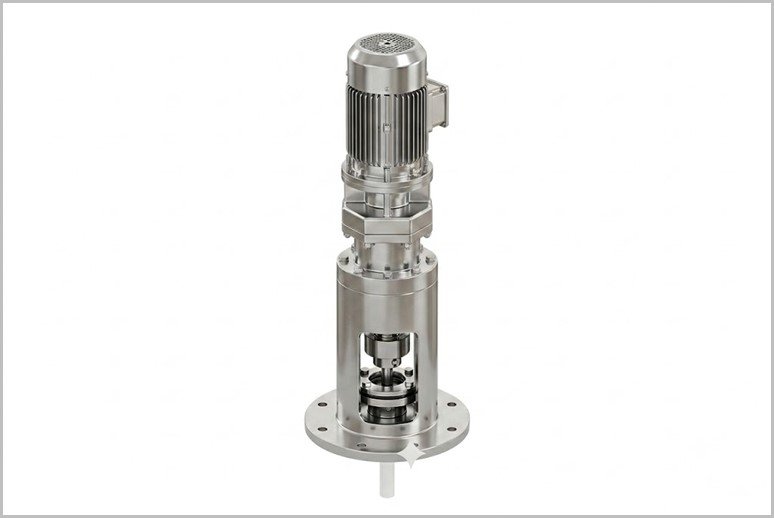
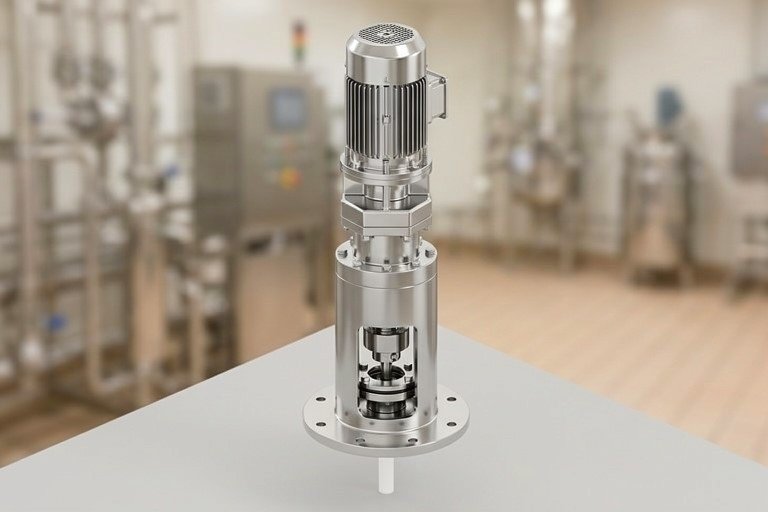
A Side Entry Agitator, also widely known as a side entry mixer, is a specialized industrial mixing device engineered for efficient fluid agitation in large storage tanks and process vessels. Unlike conventional top-entry agitators that mount vertically through the roof or lid, a side entry agitator installs horizontally through a flange or nozzle on the tank’s sidewall. Typically positioned near the bottom and often angled slightly upward, this configuration delivers reliable mixing performance in applications where top access is restricted, headroom is limited, or multiple mixing points are required for uniform coverage.
The design of a side entry agitator centers on practical engineering advantages for large-scale operations. The unit consists of a motor, gearbox, shaft, and impeller assembly that penetrates the vessel wall via a sealed stuffing box or mechanical seal. This horizontal mounting allows the impeller to operate close to the tank floor, promoting strong bottom-up circulation that prevents solids settling and maintains product homogeneity. In crude oil storage, asphalt tanks, wastewater treatment basins, and chemical process vessels, side entry mixers excel because they eliminate the need for extensive roof penetrations or tall support structures.
One of the primary benefits of side entry agitators is their suitability for large-diameter tanks. In vessels exceeding several meters in diameter, a single top-entry unit may leave peripheral zones poorly mixed. Installing multiple side entry mixers around the circumference creates overlapping flow patterns that achieve thorough blending with lower overall power consumption. The angled installation further enhances axial flow, reducing the risk of vortex formation and improving heat-transfer rates when the tank is jacketed or coil-heated.
From an operational standpoint, side entry agitators offer significant maintenance and safety advantages. Because the drive unit remains outside the tank, technicians can service motors, seals, and gearboxes without entering confined spaces or emptying the vessel. This feature is especially valuable in continuous-process industries where downtime must be minimized. Modern designs incorporate advanced sealing systems, such as dual mechanical seals with barrier fluid, to handle abrasive, corrosive, or high-temperature fluids safely and reliably.
When selecting a side entry mixer, engineers evaluate factors including tank geometry, fluid viscosity, specific gravity, and required mixing intensity. Low-viscosity products such as light hydrocarbons often use high-speed propeller-style impellers, while heavier fluids may require slower, higher-torque hydrofoil or pitched-blade designs. Proper impeller diameter relative to tank diameter, tip speed, and mounting angle are calculated to generate the desired Reynolds number and flow regime—whether laminar, transitional, or turbulent.
Industry experience shows that correctly specified side entry agitators deliver consistent results across diverse sectors. In petroleum terminals they keep crude oil and residual fuels homogeneous, preventing stratification. In pulp and paper mills they maintain fiber suspension. In food and beverage processing they ensure uniform blending of syrups or oils. In environmental applications they support sludge conditioning and chemical dosing. Each of these uses relies on the proven reliability of sidewall-mounted mixing technology.
Trust in side entry agitator performance stems from decades of industrial application and continuous refinement by manufacturers who adhere to recognized standards for mechanical integrity, sealing, and materials of construction. Stainless steel, exotic alloys, and specialized coatings protect against corrosion, while robust bearing arrangements and vibration-monitoring options extend service life. Operators benefit from lower installation costs compared with complex top-entry systems that require structural reinforcement of tank roofs.
In summary, a side entry agitator provides an efficient, accessible, and scalable solution for industrial mixing challenges. Its sidewall mounting, near-bottom positioning, and ability to operate in multiples make it the preferred choice for large tanks with limited top access or low headroom. By combining mechanical simplicity with proven hydrodynamic performance, side entry mixers support process reliability, product quality, and operational safety across a wide range of demanding applications.
The agitator consists of:
The impeller rotates to create a strong axial flow, directing liquid toward the tank bottom. This pushes the fluid downward, causing it to rise along the opposite tank wall and circulate back toward the surface. The result is a rolling flow pattern that minimizes dead zones, promotes uniformity, and prevents settling.
Many models feature a mechanical seal with a shut-off device, allowing seal replacement without draining the tank—reducing downtime and safety risks.
Belt Width | Tailored (depends on product dimensions) |
Belt Speed | Customized according to production requirement |
Material | SS (Stainless steel) 304/SS 316 |
Electricity | 3-phase: 415v; 50Hz |
Machine Length | Length can vary depending on industry needs |
* Power voltage can be adjusted as per customer’s domestic power voltage requirements.
* Rights of technical improvements & modification reserved.
* Illustrations & dimensions are shown for information purpose only.
A Side Entry Agitator (also called a side entry mixer) is an industrial mixing device mounted horizontally through a flange or nozzle on the sidewall of a storage tank or process vessel, typically near the bottom and often angled slightly upward. It consists of a motor, gearbox, shaft, and impeller assembly that penetrates the vessel wall via a sealed stuffing box or mechanical seal, delivering efficient fluid agitation without requiring top access.
Unlike top-entry agitators that mount vertically through the tank roof or lid, side entry units install horizontally on the sidewall. This design suits tanks with restricted top access, limited headroom, or large diameters, eliminates extensive roof penetrations and tall support structures, uses shorter shafts, and allows multiple units around the circumference for better coverage with often lower power consumption.
The motor and gearbox (located outside the tank) drive a shaft with an impeller (typically a marine propeller, hydrofoil, or axial-flow type) that rotates to create strong axial flow directed toward the tank bottom. Fluid is pushed downward, rises along the opposite wall, and circulates back, producing a rolling flow pattern that minimizes dead zones, promotes uniformity, and prevents solids settling.
Key benefits include lower power use than many top-entry units in large tanks (often 1/3 to 2/3 the consumption), ability to install multiple units for thorough mixing without long shafts, external drive and seals that enable servicing without emptying the tank or entering confined spaces, space savings, reduced need for internal baffles or heavy roof supports, and effective prevention of sedimentation and stratification.
They are widely used in crude oil storage, asphalt tanks, wastewater treatment, chemical process vessels, pulp and paper (fiber suspension), food and beverage (syrups, oils, milk, juices, wine), and sectors such as pharmaceutical, nutraceutical, herbal, Ayurvedic, biotech, cosmetic, and chemical industries for homogenization and maintaining product uniformity.
Yes. Many designs incorporate mechanical seals (single, double, or cartridge) with shut-off or retractable features that allow seal replacement while the tank remains full, significantly reducing downtime and safety risks associated with draining the vessel.
They are ideal for low- to medium-viscosity fluids such as light hydrocarbons, oils, wine, milk, juices, chemicals, pulp, and similar products. Impeller selection (high-speed propeller for low-viscosity or higher-torque hydrofoil/pitched-blade for heavier fluids) is matched to viscosity, specific gravity, and required mixing intensity.
Robust and sanitary designs commonly use stainless steel SS 304 or SS 316L, along with other alloys or specialized coatings as needed for corrosion resistance. Construction prioritizes mechanical integrity for handling abrasive, corrosive, or high-temperature fluids.
Engineers consider tank geometry and diameter, fluid viscosity and specific gravity, required mixing intensity, impeller diameter relative to tank diameter, tip speed, mounting angle (often offset 7–10° or inclined), and desired flow regime (laminar, transitional, or turbulent). Multiple units may be specified around large tanks for overlapping flow patterns and uniform coverage.
The external motor, gearbox, and seal arrangement allow servicing without entering the tank or emptying it, reducing downtime in continuous processes. Shorter shafts, robust bearings, vibration-monitoring options, and advanced sealing systems (including dual mechanical seals with barrier fluid) enhance reliability, safety, and service life while keeping installation costs lower than complex top-entry systems.
Algeria | Angola | Argentina | Australia | Austria | Bahrain | Bangladesh | Belarus | Belgium | Bolivia | Botswana | Brazil | Bulgaria | Canada | Chile | China | Colombia | Costa Rica | Cuba | Czech Republic | Denmark | Dominican Republic | Ecuador | Egypt | El Salvador | Ethiopia | Finland | France | Germany | Ghana | Greece | Guatemala | Haiti | Honduras | Hong Kong | Hungary | India | Indonesia | Iran | Ireland | Israel | Italy | Ivory Coast | Japan | Jordan | Kazakhstan | Kenya | Kuwait | Lebanon | Libya | Malaysia | Mexico | Mongolia | Morocco | Mozambique | Myanmar | Netherlands | New Zealand | Nicaragua | Nigeria | Norway | Oman | Pakistan | Panama | Paraguay | Peru | Philippines | Poland | Portugal | Qatar | Romania | Russia | Saudi Arabia | Senegal | Slovakia | Singapore | South Africa | South Korea | South Sudan | Spain | Sri Lanka | Sweden | Switzerland | Taiwan | Tanzania | Thailand | Trinidad and Tobago | Tunisia | Turkey | Uganda | Ukraine | United Arab Emirates | United Kingdom | United States | Uruguay | Uzbekistan | Venezuela | Vietnam | Zambia | Zimbabwe
Connect with our engineering team to discuss your specific production requirements. We provide customized, cGMP-compliant machinery solutions designed to optimize your manufacturing facility and maximize output.
©Adinath International | Theme Developed By Pharma Machinery Manufacturer I Website updated on: 15 October 2026
Request A Quick Quote
Side Entry Agitator
Please drop your requirements, one of our technical expert will contact you in next 24 working hours.
WhatsApp us


