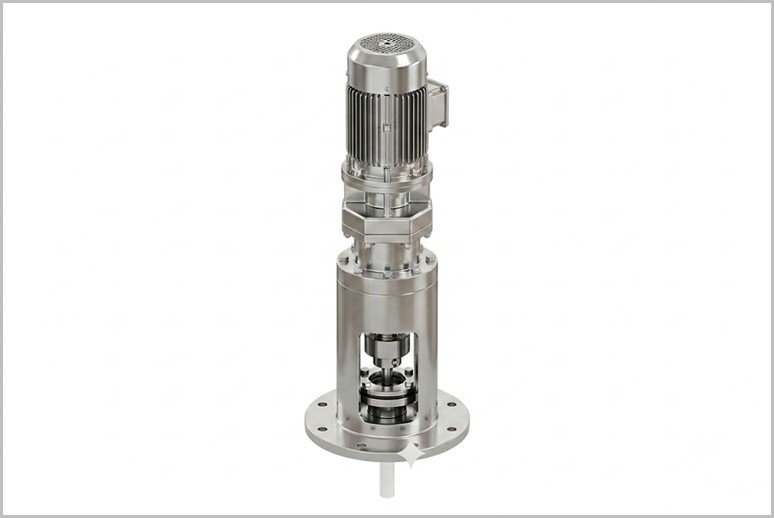
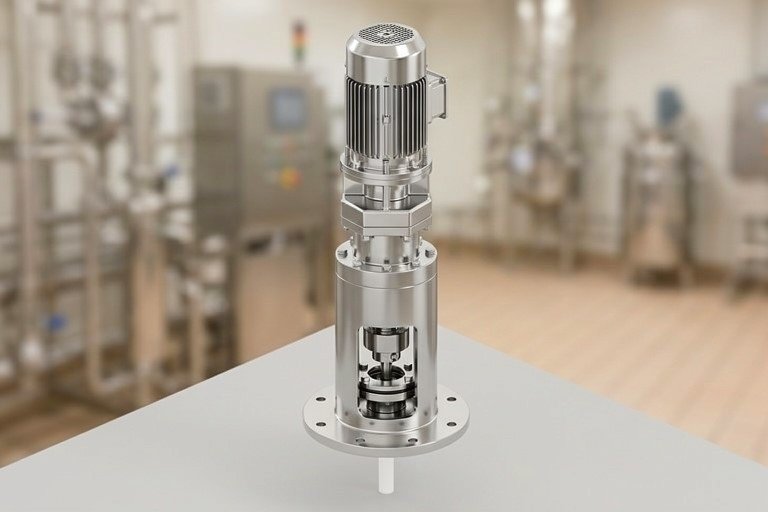
An industrial agitator (frequently referred to as an industrial mixer or stirrer) is an advanced mechanical fluid-processing device engineered to blend, mix, homogenize, suspend solid particles, disperse gases, or accelerate chemical reactions within large storage tanks, processing vessels, and reactors. Across modern process engineering, industrial agitators are foundational components. They are critical for operations that demand absolute material consistency, optimized heat transfer efficiency, and reliable suspension management.
Understanding the Core Function of an Industrial Agitator
An industrial agitator (also called an industrial mixer or stirrer) is a mechanical fluid-processing device designed to blend, mix, homogenize, suspend solid particles, disperse gases, or accelerate chemical reactions inside storage tanks, processing vessels, and reactors.
It transfers kinetic energy from a motor-driven rotating shaft and impeller into the fluid. This creates controlled flow patterns (axial or radial) that eliminate dead zones, concentration gradients, and stratification inside the vessel.
Key functions include homogenizing liquids, solids, gases, slurries or suspensions; blending miscible liquids; dissolving solids; suspending particles; dispersing gases as fine bubbles; forming emulsions; promoting chemical reactions; and enhancing heat transfer for uniform temperature control.
An agitator typically consists of a drive motor (often with a gearbox), a shaft, and one or more impellers. Baffles are frequently added inside the tank to prevent vortex formation and improve mixing efficiency.
Common types include propeller, turbine, paddle, anchor, and helical agitators. Each is selected based on fluid viscosity, required flow pattern (axial, radial, or tangential), and specific process needs.
Agitators are widely used in the pharmaceutical, nutraceutical, herbal, Ayurvedic, biotech, cosmetic, and chemical industries for processes requiring consistent mixing and material uniformity.
It ensures product uniformity and consistency, improves reaction rates and heat transfer efficiency, reduces batch cycle times, minimizes energy consumption, and can be customized for different viscosities and tank sizes.
Without a correctly designed agitator, processes can suffer from stratification, uneven temperature profiles, inefficient reactions, and poor product quality. A well-designed unit creates precise turbulence and shear for reliable, high-quality results.
Yes. They are engineered to process liquids, solids, gases, slurries, and suspensions across a wide range of viscosities, making them suitable for diverse industrial applications.
By continuously circulating the fluid, the agitator brings all parts of the medium into frequent contact with the vessel wall, jacket, or coil, ensuring faster and more uniform heating or cooling.
Algeria | Angola | Argentina | Australia | Austria | Bahrain | Bangladesh | Belarus | Belgium | Bolivia | Botswana | Brazil | Bulgaria | Canada | Chile | China | Colombia | Costa Rica | Cuba | Czech Republic | Denmark | Dominican Republic | Ecuador | Egypt | El Salvador | Ethiopia | Finland | France | Germany | Ghana | Greece | Guatemala | Haiti | Honduras | Hong Kong | Hungary | India | Indonesia | Iran | Ireland | Israel | Italy | Ivory Coast | Japan | Jordan | Kazakhstan | Kenya | Kuwait | Lebanon | Libya | Malaysia | Mexico | Mongolia | Morocco | Mozambique | Myanmar | Netherlands | New Zealand | Nicaragua | Nigeria | Norway | Oman | Pakistan | Panama | Paraguay | Peru | Philippines | Poland | Portugal | Qatar | Romania | Russia | Saudi Arabia | Senegal | Slovakia | Singapore | South Africa | South Korea | South Sudan | Spain | Sri Lanka | Sweden | Switzerland | Taiwan | Tanzania | Thailand | Trinidad and Tobago | Tunisia | Turkey | Uganda | Ukraine | United Arab Emirates | United Kingdom | United States | Uruguay | Uzbekistan | Venezuela | Vietnam | Zambia | Zimbabwe
Connect with our engineering team to discuss your specific production requirements. We provide customized, cGMP-compliant machinery solutions designed to optimize your manufacturing facility and maximize output.
©Adinath International | Theme Developed By Pharma Machinery Manufacturer I Website updated on: 15 October 2026
Request A Quick Quote
Agitator
Please drop your requirements, one of our technical expert will contact you in next 24 working hours.
WhatsApp us


