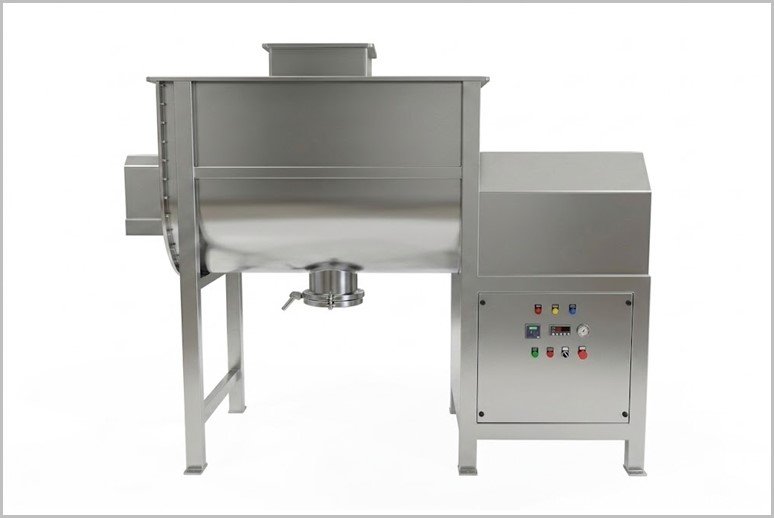

In the complex ecosystem of modern chemical processing, achieving absolute homogeneity is not just a production step—it is a baseline requirement for safety, quality, and regulatory compliance. Dry powder mixers are indispensable assets across the manufacturing sector, engineered specifically to combine powders, granules, and bulk solids into uniform mixtures. Whether managing fine chemical compounds or heavy industrial formulations, understanding the mechanics, applications, and selection criteria of these blending systems is vital for optimizing plant productivity.
Conclusion
Dry powder mixers represent the backbone of efficient, scalable chemical manufacturing. By leveraging advanced agitator technology and matching the specific blending mechanism to the physical properties of the bulk solids, processing plants can drastically reduce cycle times, minimize material degradation, and elevate final product consistency. Investing in reliable, high-specification mixing technology safeguards operational integrity and secures long-term manufacturing success.
Material is charged in the blender through nozzles or feed-hoppers mounted on the top cover of the blender. Suppose if screw feeder is opted with mixer, then material to be load onto screw feeder and it will feed powder into blender. Filling to be done about 70 percent of the total volume of the container. This is generally up to the level of the outer ribbon’s tip. After feeding completes then please close the top cover of the blender and tighten the latches. Now start the machine form the control panel.
During the blending operation, the outer ribbons of the agitator interchange the material from the ends to the center while the inner ribbons transfer the material from the center to ends. Radial movement is achieved because of the rotational motion of the ribbons. The difference in the peripheral speeds of the outer and inner ribbons results in axial movement of the material along the horizontal axis of the blender. As a result of the radial and the counter-current axial movement, homogenous blending is achieved in short time. Blending is generally performed in 15 to 20 minutes cycle time. Mixing efficiency of ribbon blender depends upon particle size and its bulk density. Generally, ribbon mixer blender with 95% efficiency in most of the cases. Ingredients with similar particle size and bulk densities tend to mix faster as compared to ingredients with variation in these attributes.
After mixing, material is discharged from a discharge valve located at center bottom of container. The discharge can be fitted with any of these valves like slide-gate, butterfly, flush bottom, spherical and other types depending on the application. The operation of the valves can be manual or pneumatically actuated as per requirements. Sifter can be installed at discharge of the blender for sieving the output materials. Ribbon blenders can be designed for multiple discharge ports. Unlike tumbling blenders where 100% discharge of material is achieved by gravity, in a ribbon blender the material is discharged by rotation of the ribbon agitator. Finished powder can be collected directly on mobile container or can discharge onto conveyor for further operations.
Model | Gross Volume approx. | Working Volume approx. | Power |
RM-10 | 10 Liters | 5 Liters | 0.5 H.P. |
RM-50 | 50 Liters | 20 Liters | 1 H.P. |
RM-75 | 75 Liters | 50 Liters | 1 H.P. |
RM-150 | 150 Liters | 100 Liters | 2 H.P. |
RM-250 | 250 Liters | 150 Liters | 3 H.P. |
RM-450 | 450 Liters | 300 Liters | 5 H.P. |
RM-600 | 600 Liters | 450 Liters | 7.5 H.P. |
RM-1100 | 1100 Liters | 750 Liters | 10 H.P. |
RM-1500 | 1500 Liters | 1000 Liters | 12.5 H.P. |
RM-2000 | 2000 Liters | 1250 Liters | 15 H.P. |
RM-3000 | 3000 Liters | 1875 Liters | 20 H.P. |
RM-5000 | 5000 Liters | 3000 Liters | 25 H.P. |
RM-10000 | 10000 Liters | 6000 Liters | 40 H.P. |
* Power voltage can be adjusted as per customer’s domestic power voltage requirements.
* Rights of technical improvements & modification reserved.
* Illustrations & dimensions are shown for information purpose only.
Key Features of Dry Powder Mixers
Key Features of Chemical Agitators
A dry powder mixer (also called a chemical agitator or ribbon blender) is industrial equipment designed to blend powders, granules, and bulk solids into a uniform, homogeneous mixture. It is essential in chemical processing for achieving consistent product quality, safety, and regulatory compliance.
Material is loaded through top nozzles, hoppers, or an optional screw feeder until the blender is filled to about 70% of its volume (typically up to the tip of the outer ribbon). The ribbon agitator then rotates: outer ribbons move material from the ends toward the center while inner ribbons move it from the center toward the ends. Combined radial and counter-current axial movement produces thorough mixing, usually in 15–20 minutes, with typical efficiency around 95%.
Models range from small laboratory/pilot units to large production systems. Working capacities start at approximately 5 liters (RM-10) and go up to 6,000 liters (RM-10000), with corresponding gross volumes and power ratings from 0.5 HP to 40 HP. Larger custom sizes up to 25,000 liters are also available.
The mixers are available in all grades of stainless steel, carbon steel, and special alloy steels. Stainless-steel product-contact surfaces are polished to the required finish, while exterior non-stainless surfaces are finished with enamel paint.
Key features include a ribbon agitator optimized for center discharge, atmospheric operation, a centrally located flush-bottom discharge valve, stuffing boxes with pure Teflon gland packing, and sealing options of gland packing, mechanical seal, or double mechanical seal. Discharge valves can be slide-gate, butterfly, flush-bottom, spherical, or other types, operated manually or pneumatically. Multiple discharge ports and an optional sifter at the outlet are also possible.
Blending is generally completed in 15–20 minutes. Mixing efficiency depends on particle size and bulk density; ingredients with similar particle sizes and densities mix faster than those with large differences. Overall efficiency is typically around 95% in most applications.
They are widely used in the pharmaceutical, nutraceutical, herbal, Ayurvedic, biotech, cosmetic, and chemical industries for blending fine chemical compounds, heavy industrial formulations, and other dry bulk solids.
Benefits include uniform homogeneous mixing in a short time, easy cleaning with low leakage and residue-free discharge, compact design with high capacity and relatively low energy consumption (potential 20–30% energy savings), consistent product quality, and improved reaction completeness/yield when used in process applications.
Standard drive systems use squirrel-cage three-phase induction motors (suitable for 415 V, 50 Hz, or adjustable to customer voltage requirements) coupled with a worm reduction gearbox and single-speed drive. Power ratings are matched to each model size as listed in the technical specifications.
Yes—capacity, material of construction, sealing type, discharge valve style, number of discharge ports, and optional features such as a screw feeder or discharge sifter can be customized. After mixing, material is discharged through the center-bottom valve by the continued rotation of the ribbon agitator (unlike gravity-only tumbling blenders) into a mobile container or onto a conveyor for further processing.
More Other Machines
 Automatic Online Dry Powder Vial Inspection Machine
 Chemical Agitator
 Agitator
 Anchor Mixer Agitator
Algeria | Angola | Argentina | Australia | Austria | Bahrain | Bangladesh | Belarus | Belgium | Bolivia | Botswana | Brazil | Bulgaria | Canada | Chile | China | Colombia | Costa Rica | Cuba | Czech Republic | Denmark | Dominican Republic | Ecuador | Egypt | El Salvador | Ethiopia | Finland | France | Germany | Ghana | Greece | Guatemala | Haiti | Honduras | Hong Kong | Hungary | India | Indonesia | Iran | Ireland | Israel | Italy | Ivory Coast | Japan | Jordan | Kazakhstan | Kenya | Kuwait | Lebanon | Libya | Malaysia | Mexico | Mongolia | Morocco | Mozambique | Myanmar | Netherlands | New Zealand | Nicaragua | Nigeria | Norway | Oman | Pakistan | Panama | Paraguay | Peru | Philippines | Poland | Portugal | Qatar | Romania | Russia | Saudi Arabia | Senegal | Slovakia | Singapore | South Africa | South Korea | South Sudan | Spain | Sri Lanka | Sweden | Switzerland | Taiwan | Tanzania | Thailand | Trinidad and Tobago | Tunisia | Turkey | Uganda | Ukraine | United Arab Emirates | United Kingdom | United States | Uruguay | Uzbekistan | Venezuela | Vietnam | Zambia | Zimbabwe
Connect with our engineering team to discuss your specific production requirements. We provide customized, cGMP-compliant machinery solutions designed to optimize your manufacturing facility and maximize output.
©Adinath International | Theme Developed By Pharma Machinery Manufacturer I Website updated on: 15 October 2026
Request A Quick Quote
Dry Powder Mixers Chemical Agitator
Please drop your requirements, one of our technical expert will contact you in next 24 working hours.
WhatsApp us
