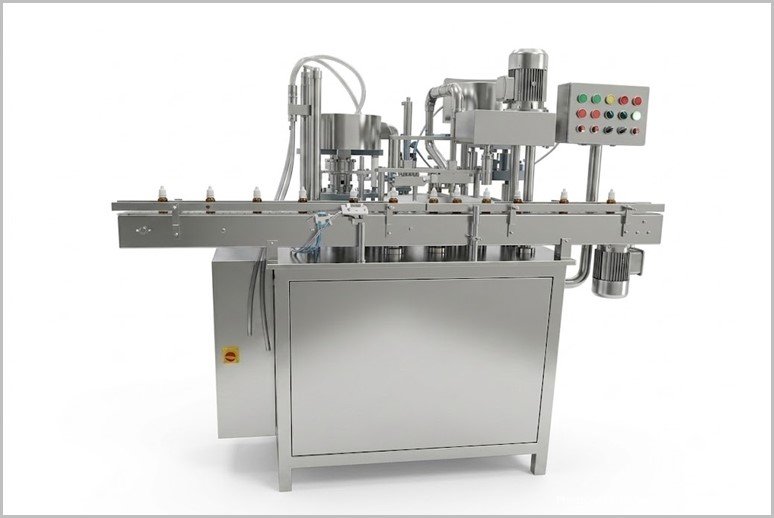
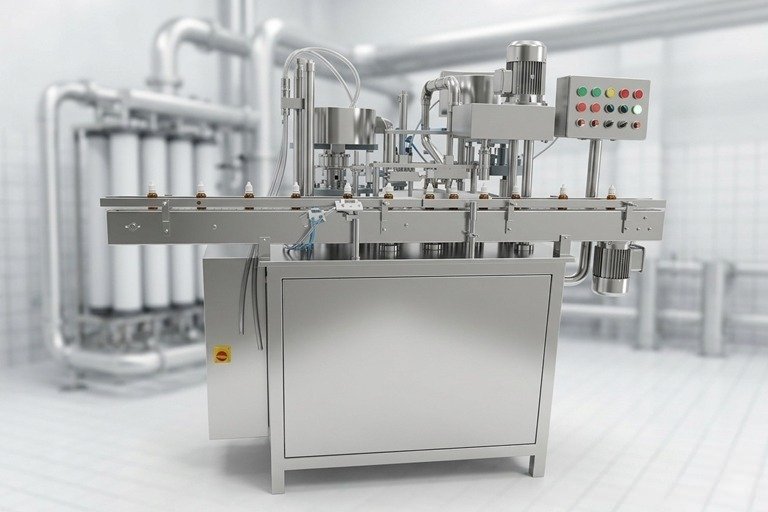
An Eye Drop Filler Capper, also commonly referred to as an eye drop filling and capping machine, is a highly specialized automated pharmaceutical packaging equipment engineered for the accurate and efficient production of small-dose liquid products. This advanced machine is specifically designed to handle sensitive formulations such as eye drops, ear drops, and nasal sprays. It fills bottles—typically 2ml to 30ml plastic or glass vials—with exceptional precision, inserts inner plugs or stoppers along with dropper tips, and securely applies outer caps in a seamless, high-speed process.
In today’s competitive pharmaceutical manufacturing landscape, the eye drop filler capper machine plays a critical role in maintaining product integrity, ensuring sterility, and meeting stringent regulatory requirements. Ophthalmic products demand the highest levels of cleanliness and accuracy because even minor contamination can lead to serious health risks. Modern eye drop filling machines are built to comply with Good Manufacturing Practice (GMP) standards, incorporating advanced features that minimize human intervention and reduce the possibility of microbial contamination.
The working principle of an Automatic Eye Drop Filling and Capping Machine (Monoblock System) is engineered around maintaining strict sterility, precise volumetric dosing, and leak-proof sealing for small-volume pharmaceutical containers (like eye, ear, and nasal drops). Because ophthalmic products require zero contamination and exact dosing of high-value active ingredients, the machine operates through a highly synchronized, continuous sequential workflow:
Step-by-Step Working Principle
Model | AI-EFCM |
Filling Accuracy | ±0.5% |
Volume of Bottle | 5ml to 100ml (Optional) |
Production Speed | 120 bph maximum |
Compatible Materials | Glass and plastic bottles |
Control System | PLC-based, Digital Interface |
Electrical Specification | 3-phase, 415V, 50 Hz |
Other Options | HEPA filtration; flushing with nitrogen |
* Power voltage can be adjusted as per customer’s domestic power voltage requirements.
* Rights of technical improvements & modification reserved.
* Illustrations & dimensions are shown for information purpose only.
An Eye Drop Filler Capper (also called an eye drop filling and capping machine) is specialized automated pharmaceutical packaging equipment designed for precise production of small-dose liquid products such as eye drops, ear drops, and nasal sprays. It fills plastic or glass bottles (typically in the 2–30 ml or 5–100 ml range), inserts inner plugs or dropper tips, and securely applies outer caps in a continuous process while maintaining sterility and accuracy.
It is ideal for sensitive ophthalmic, otic, and nasal liquid formulations. It works with both glass and plastic bottles/vials in volumes generally from 5 ml to 100 ml (with options for smaller sizes). The machine supports various bottle shapes and liquid viscosities and is used across pharmaceutical, nutraceutical, herbal, Ayurvedic, biotech, cosmetic, and chemical industries.
Empty bottles are fed via an unscrambler or conveyor and positively indexed by a rotary star wheel. At the filling station, high-precision pumps (peristaltic, piston, or ceramic) deliver accurate micro-doses. Bottles then move to the plugging station where vibratory bowls and pick-and-place systems insert dropper plugs. Finally, outer screw caps are applied with torque-controlled heads, and finished bottles are discharged to secondary packaging.
Filling accuracy is typically ±0.5% to ±1–2% depending on the pump system, minimizing product giveaway. Production speeds range from 40–100 bottles per minute on compact models up to 120 bph (or higher, 300+ on high-speed lines), depending on configuration and bottle size.
The machine uses peristaltic pumps (liquid contacts only sterile silicone tubing), piston pumps, or ceramic rotary piston pumps. These provide precise volumetric dosing without contaminating the product and are especially suitable for high-value, sensitive ophthalmic liquids.
It features stainless steel (316L) construction, operates under laminar flow, and can include isolators, ORABS, HEPA filtration, and nitrogen flushing. The closed-system design minimizes human intervention and microbial contamination risk. It is built to meet GMP, FDA, EMA, and WHO guidelines for ophthalmic and nasal products.
Key features include “No bottle, no fill” sensors, automatic stop on errors, defect detection and rejection systems, torque-controlled capping to prevent over- or under-tightening, and in-process controls. PLC-based digital interfaces allow easy monitoring and adjustments.
Yes. Many models are monoblock (integrated filling-plugging-capping) units and can form part of full lines that include bottle unscrambling, nitrogen purging, labeling, inspection, and cartoning for end-to-end automated production.
Benefits include high dosing accuracy and consistency, enhanced sterility, significantly higher throughput versus manual methods, reduced labor and material waste, regulatory compliance, and versatility across bottle sizes, shapes, and liquid types—leading to better yield and cost efficiency.
Typical specifications include ±0.5% filling accuracy, 5–100 ml bottle volume range, maximum speed around 120 bottles per hour (higher on other configurations), compatibility with glass and plastic bottles, PLC-based controls with digital interface, 3-phase 415 V 50 Hz power (adjustable), and options for HEPA filtration and nitrogen flushing. Contact parts and construction follow GMP standards.
More Other Machines
 Eye Drop Filler Machine
 Automatic Eye Drop Filling Machine
 Biological Indicator Tube Filler
 Biological Indicator Tube Filler Sealer
Algeria | Angola | Argentina | Australia | Austria | Bahrain | Bangladesh | Belarus | Belgium | Bolivia | Botswana | Brazil | Bulgaria | Canada | Chile | China | Colombia | Costa Rica | Cuba | Czech Republic | Denmark | Dominican Republic | Ecuador | Egypt | El Salvador | Ethiopia | Finland | France | Germany | Ghana | Greece | Guatemala | Haiti | Honduras | Hong Kong | Hungary | India | Indonesia | Iran | Ireland | Israel | Italy | Ivory Coast | Japan | Jordan | Kazakhstan | Kenya | Kuwait | Lebanon | Libya | Malaysia | Mexico | Mongolia | Morocco | Mozambique | Myanmar | Netherlands | New Zealand | Nicaragua | Nigeria | Norway | Oman | Pakistan | Panama | Paraguay | Peru | Philippines | Poland | Portugal | Qatar | Romania | Russia | Saudi Arabia | Senegal | Slovakia | Singapore | South Africa | South Korea | South Sudan | Spain | Sri Lanka | Sweden | Switzerland | Taiwan | Tanzania | Thailand | Trinidad and Tobago | Tunisia | Turkey | Uganda | Ukraine | United Arab Emirates | United Kingdom | United States | Uruguay | Uzbekistan | Venezuela | Vietnam | Zambia | Zimbabwe
Connect with our engineering team to discuss your specific production requirements. We provide customized, cGMP-compliant machinery solutions designed to optimize your manufacturing facility and maximize output.
©Adinath International | Theme Developed By Pharma Machinery Manufacturer I Website updated on: 15 October 2026
Request A Quick Quote
Eye Drop Filler Capper
Please drop your requirements, one of our technical expert will contact you in next 24 working hours.
WhatsApp us
