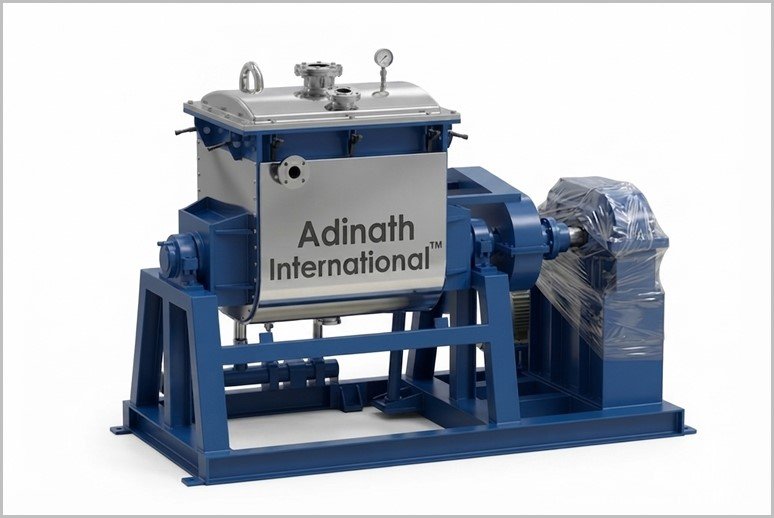
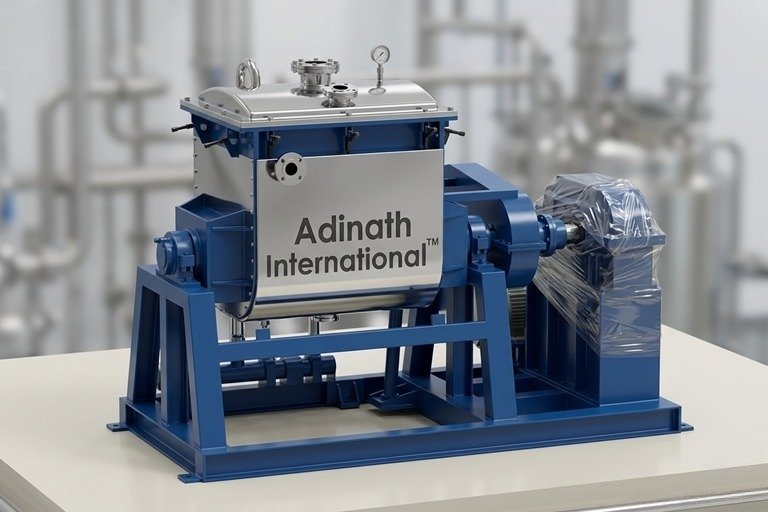
The Detergent Cake Mixer is an essential industrial machine used in the production of high-quality detergent cakes, also known as laundry bars or washing soap bars. This heavy-duty sigma mixer efficiently blends key ingredients such as soap flakes, surfactants, fillers, colorants, perfumes, optical brighteners, and slurries to create a uniform, homogeneous mixture. The well-mixed mass is then ready for the next stages of plodding, extrusion, cutting, and stamping into final cake shapes.
In the competitive detergent manufacturing industry, the Detergent Cake Mixer plays a critical role in ensuring product consistency, better cleaning performance, and superior texture. Poor mixing can lead to uneven distribution of ingredients, resulting in low-quality bars that break easily or deliver inconsistent results. A good detergent cake sigma mixer eliminates these issues through intensive kneading and homogenization.
Agitation Kinematics & Shear Dynamics
Product Extraction Methods
Tangential Impeller Configuration
Overlapping Impeller Configuration
Model | Capacity – Liters | Motor (H.P.) | ||
Working Capacity approx. | Gross Capacity approx. | General | Heavy Duty | |
ASM – 50 | 50 Liters | 80 Liters | 5 H.P. | 7.5 H.P. |
ASM – 75 | 75 Liters | 110 Liters | 7.5 H.P. | 10 H.P. |
ASM – 100 | 100 Liters | 150 Liters | 10 H.P. | 15 H.P. |
ASM – 150 | 150 Liters | 200 Liters | 15 H.P. | 20 H.P. |
ASM – 200 | 200 Liters | 300 Liters | 20 H.P. | 25 H.P. |
ASM – 400 | 400 Liters | 550 Liters | 30 H.P. | 40 H.P. |
ASM – 500 | 500 Liters | 750 Liters | 40 H.P. | 50 H.P. |
ASM – 750 | 750 Liters | 1150 Liters | 50 H.P. | 60 H.P. |
ASM – 1000 | 1000 Liters | 1500 Liters | 60 H.P. | 70 H.P. |
ASM – 1500 | 1500 Liters | 2100 Liters | 75 H.P. | 80 H.P. |
ASM – 2000 | 2000 Liters | 2600 Liters | 80 H.P. | 90 H.P. |
ASM – 3000 | 3000 Liters | 3800 Liters | 100 H.P. | 120 H.P. |
* Power voltage can be adjusted as per customer’s domestic power voltage requirements.
* Rights of technical improvements & modification reserved.
* Illustrations & dimensions are shown for information purpose only.
It is a heavy-duty industrial sigma mixer designed to blend soap flakes, surfactants, fillers, colorants, perfumes, optical brighteners, and slurries into a uniform, homogeneous mass ready for plodding, extrusion, cutting, and stamping into detergent cakes (laundry bars or washing soap bars).
The mixer is offered in Mild Steel, SS 304, or SS 316. Mild-steel units receive an anti-corrosive red-oxide primer plus a dual-layer epoxy paint finish. Stainless-steel surfaces can be supplied in matte or high-gloss mirror finish as required.
Precision-engineered tangential ‘Z’-profile blades operate with an ultra-tight clearance to the inner trough wall. This produces intensive stretching, folding, splitting, and shear that eliminates lumps and prevents build-up.
Unloading can be performed by manual hand-wheel tilting, automated hydraulic tilting, bottom-mounted discharge valves, or a lateral extrusion screw beside the mixing chamber.
Yes. Optional temperature-control jackets support external heating or cooling. The trough is insulated with high-density mineral wool and protected by external metal cladding for consistent batch temperature.
Tangential blades meet side-by-side (typically at a 3:2 speed ratio) and deliver higher shear suited to stiff, high-viscosity detergent formulations. Overlapping blades intermesh at identical speed above the central crest and provide gentler action with faster cross-transfer for lower-viscosity materials.
Models span working capacities from approximately 50 liters (ASM-50) up to 3000 liters (ASM-3000), with corresponding gross volumes and both general-duty and heavy-duty motor options (e.g., 15–20 HP for the 150-liter class, scaling upward). Voltage can be matched to local supply requirements.
Resilient PTFE shaft seals provide leak-free, sanitary performance compatible with detergent and food-grade applications, while the tight blade-to-wall clearance minimizes product retention.
Available modular options include liquid-spray systems, vacuum integration, blade-cooling arrangements, screw discharge systems, and automatic valve discharge systems.
While optimized for detergent-cake production, the same design is widely used for high-viscosity pastes and compounds in the pharmaceutical, nutraceutical, herbal, Ayurvedic, biotech, cosmetic, and chemical industries.
Algeria | Angola | Argentina | Australia | Austria | Bahrain | Bangladesh | Belarus | Belgium | Bolivia | Botswana | Brazil | Bulgaria | Canada | Chile | China | Colombia | Costa Rica | Cuba | Czech Republic | Denmark | Dominican Republic | Ecuador | Egypt | El Salvador | Ethiopia | Finland | France | Germany | Ghana | Greece | Guatemala | Haiti | Honduras | Hong Kong | Hungary | India | Indonesia | Iran | Ireland | Israel | Italy | Ivory Coast | Japan | Jordan | Kazakhstan | Kenya | Kuwait | Lebanon | Libya | Malaysia | Mexico | Mongolia | Morocco | Mozambique | Myanmar | Netherlands | New Zealand | Nicaragua | Nigeria | Norway | Oman | Pakistan | Panama | Paraguay | Peru | Philippines | Poland | Portugal | Qatar | Romania | Russia | Saudi Arabia | Senegal | Slovakia | Singapore | South Africa | South Korea | South Sudan | Spain | Sri Lanka | Sweden | Switzerland | Taiwan | Tanzania | Thailand | Trinidad and Tobago | Tunisia | Turkey | Uganda | Ukraine | United Arab Emirates | United Kingdom | United States | Uruguay | Uzbekistan | Venezuela | Vietnam | Zambia | Zimbabwe
Connect with our engineering team to discuss your specific production requirements. We provide customized, cGMP-compliant machinery solutions designed to optimize your manufacturing facility and maximize output.
©Adinath International | Theme Developed By Pharma Machinery Manufacturer I Website updated on: 15 October 2026
Request A Quick Quote
Detergent Cake Mixer 150-kgs-200-kgs-300-kgs-500-kgs-1000-kgs
Please drop your requirements, one of our technical expert will contact you in next 24 working hours.
WhatsApp us


