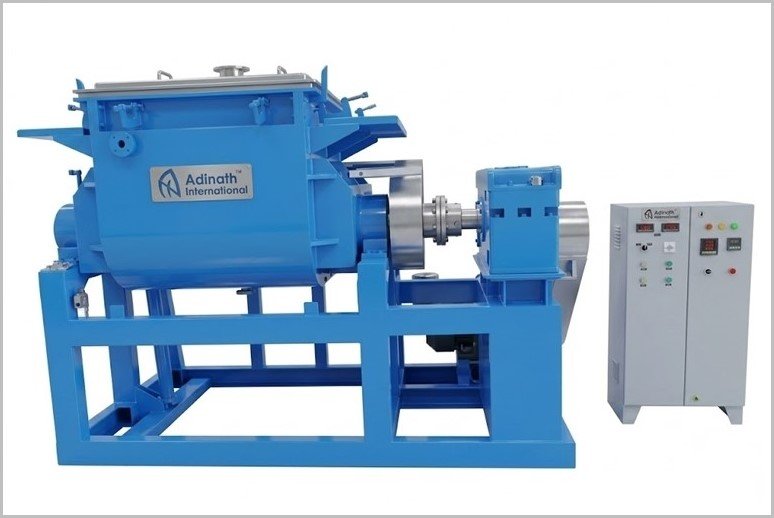
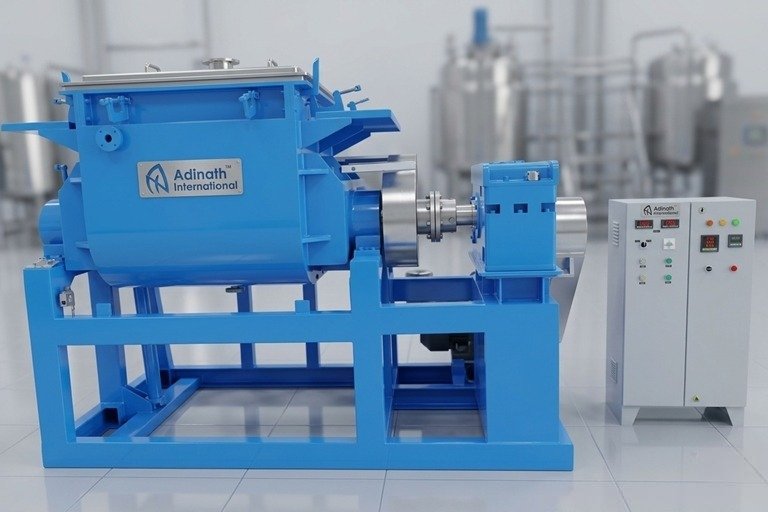
A Food Grade Sigma Mixer, also commonly referred to as a sigma blade mixer, Z-blade mixer, or double arm kneader, is a robust industrial mixing machine engineered specifically for the demanding requirements of modern food production. Designed to handle high-viscosity materials with precision and hygiene, this powerful equipment ensures thorough mixing, kneading, and blending while maintaining strict sanitary standards essential for food safety. Whether you’re manufacturing dough, confectionery, sauces, or specialty food pastes, a food-grade sigma mixer delivers consistent results that meet regulatory compliance and consumer expectations.
The sigma blade mixer stands out due to its unique double-arm design featuring two sigma-shaped (or Z-shaped) blades that rotate at different speeds in a trough. This counter-rotating action creates a highly effective folding and shearing motion, perfectly suited for tough, sticky, and viscous products that standard mixers cannot handle.
Manufactured from high-quality, food-grade stainless steel (typically 304 or 316L), these mixers prioritize hygiene. Their polished surfaces, easy-to-clean design, and optional features like CIP (Clean-In-Place) systems make them compliant with FDA, USDA, and other global food safety regulations. Many models include jacketed troughs for temperature control, allowing precise heating or cooling during mixing — critical for products like chocolate, caramel, or yeast doughs.
Blend Mechanics & Material Transformation
Unloading Alternatives
Processed material evacuation can be accomplished through three distinct discharge routes:
Agitator Engineering & Field Applications
Tangential Blade Layout
Overlapping Blade Layout
Model | Capacity – Liters | Motor (H.P.) | ||
Working Capacity approx. | Gross Capacity approx. | General | Heavy Duty | |
ASM – 50 | 50 Liters | 80 Liters | 5 H.P. | 7.5 H.P. |
ASM – 75 | 75 Liters | 110 Liters | 7.5 H.P. | 10 H.P. |
ASM – 100 | 100 Liters | 150 Liters | 10 H.P. | 15 H.P. |
ASM – 150 | 150 Liters | 200 Liters | 15 H.P. | 20 H.P. |
ASM – 200 | 200 Liters | 300 Liters | 20 H.P. | 25 H.P. |
ASM – 400 | 400 Liters | 550 Liters | 30 H.P. | 40 H.P. |
ASM – 500 | 500 Liters | 750 Liters | 40 H.P. | 50 H.P. |
ASM – 750 | 750 Liters | 1150 Liters | 50 H.P. | 60 H.P. |
ASM – 1000 | 1000 Liters | 1500 Liters | 60 H.P. | 70 H.P. |
ASM – 1500 | 1500 Liters | 2100 Liters | 75 H.P. | 80 H.P. |
ASM – 2000 | 2000 Liters | 2600 Liters | 80 H.P. | 90 H.P. |
ASM – 3000 | 3000 Liters | 3800 Liters | 100 H.P. | 120 H.P. |
* Power voltage can be adjusted as per customer’s domestic power voltage requirements.
* Rights of technical improvements & modification reserved.
* Illustrations & dimensions are shown for information purpose only.
A Food Grade Sigma Mixer (also known as a sigma blade mixer or Z-blade mixer) is a robust industrial kneader designed for high-viscosity food materials like dough, confectionery, sauces, and specialty pastes. It uses counter-rotating sigma-shaped blades for thorough mixing, kneading, and shearing while maintaining strict hygiene standards with food-grade stainless steel construction (typically 304 or 316L), polished surfaces, and compliance with FDA/USDA regulations.
It is primarily built with food-grade Stainless Steel 304 or 316 for all product-contact surfaces to ensure hygiene and corrosion resistance. Polishing options include matt or mirror finish. Mild Steel is also available for non-contact parts with red oxide and epoxy paint. PTFE shaft seals are provided for food-grade compatibility.
The mixer features two ‘Z’ (sigma) shaped blades that rotate at different speeds (typically 3:2 ratio in tangential design) in a U- or W-shaped trough. This creates a combination of bulk movement, stretching, folding, dividing, recombining, shearing, and tearing for uniform mixing of viscous materials without dead zones. Tangential blades suit higher viscosities, while overlapping blades work well for lighter ones.
Models range from lab/pilot scale to large production units. Examples include ASM-50 (50L working / 80L gross) up to ASM-3000 (3000L working / 3800L gross), with motor power from 5 HP to 120 HP depending on the model and duty (general or heavy duty). Custom capacities are possible.
Yes. Optional jacketed troughs with mineral wool insulation and cladding allow precise heating or cooling (using steam, hot oil, or water). This is essential for products like chocolate, caramel, or yeast doughs to maintain optimal consistency during mixing.
Discharge can be achieved via hand-wheel operated (manual) tilting, hydraulic operated (automatic) tilting, bottom valves, or an optional extrusion screw. Hydraulic systems often include reverse blade rotation for complete and efficient emptying of viscous materials.
Key hygiene features include polished stainless steel surfaces, minimum gap between trough and blades to prevent product sticking, PTFE seals, and optional CIP (Clean-In-Place) systems. The design prioritizes compliance with global food safety standards and easy maintenance.
While optimized for food production (dough, confectionery, sauces, pastes), it is also widely used in Pharmaceutical, Nutraceutical, Herbal, Ayurvedic, Biotech, Cosmetic, and Chemical industries for processing high-viscosity formulations requiring uniform dispersion and hygiene.
Available options include liquid spray systems, vacuum systems for de-aeration, blades cooling arrangement, screw/extrusion systems, automatic valve discharge, variable speed drives, and more. These enhance efficiency, safety, and suitability for specific food processing needs.
Tangential ‘Z’ blades (different speeds) provide high shear for higher-viscosity sticky materials. Overlapping blades (same speed) offer faster material interchange for lighter viscosities. A minimum gap design prevents sticking, ensuring thorough mixing across various food-grade applications.
More Sigma Mixers
 Food Grade Sigma Kneader
 1000 Liters Sigma Mixer
 500 Liters Sigma Mixer
 Acrylic Latex Sealant Sigma Mixer
Algeria | Angola | Argentina | Australia | Austria | Bahrain | Bangladesh | Belarus | Belgium | Bolivia | Botswana | Brazil | Bulgaria | Canada | Chile | China | Colombia | Costa Rica | Cuba | Czech Republic | Denmark | Dominican Republic | Ecuador | Egypt | El Salvador | Ethiopia | Finland | France | Germany | Ghana | Greece | Guatemala | Haiti | Honduras | Hong Kong | Hungary | India | Indonesia | Iran | Ireland | Israel | Italy | Ivory Coast | Japan | Jordan | Kazakhstan | Kenya | Kuwait | Lebanon | Libya | Malaysia | Mexico | Mongolia | Morocco | Mozambique | Myanmar | Netherlands | New Zealand | Nicaragua | Nigeria | Norway | Oman | Pakistan | Panama | Paraguay | Peru | Philippines | Poland | Portugal | Qatar | Romania | Russia | Saudi Arabia | Senegal | Slovakia | Singapore | South Africa | South Korea | South Sudan | Spain | Sri Lanka | Sweden | Switzerland | Taiwan | Tanzania | Thailand | Trinidad and Tobago | Tunisia | Turkey | Uganda | Ukraine | United Arab Emirates | United Kingdom | United States | Uruguay | Uzbekistan | Venezuela | Vietnam | Zambia | Zimbabwe
Connect with our engineering team to discuss your specific production requirements. We provide customized, cGMP-compliant machinery solutions designed to optimize your manufacturing facility and maximize output.
©Adinath International | Theme Developed By Pharma Machinery Manufacturer I Website updated on: 15 October 2026
Request A Quick Quote
Food Grade Sigma Mixer
Please drop your requirements, one of our technical expert will contact you in next 24 working hours.
WhatsApp us
