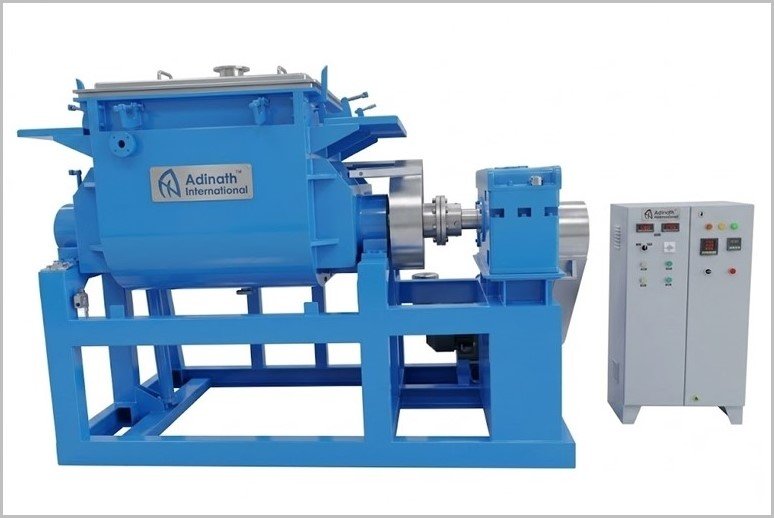
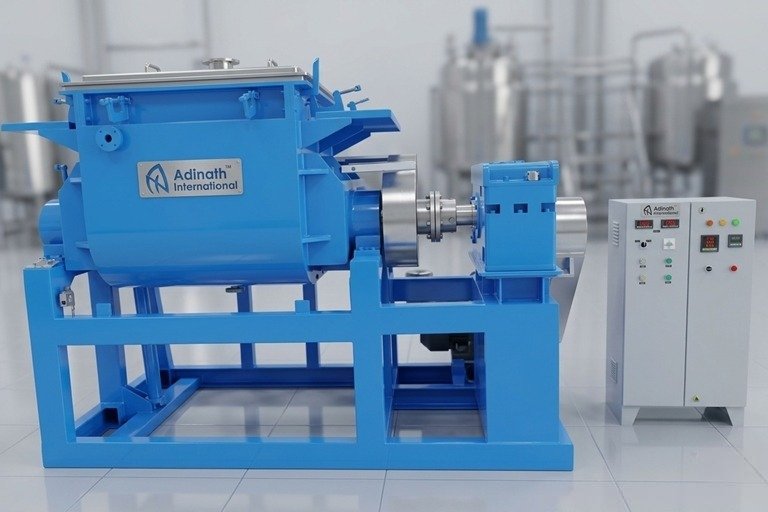
The Kneader Machine for Rubber Commercial Dough Mixer generally refers to two related but distinct types of equipment: industrial rubber kneaders and commercial dough mixers/kneaders used in bakeries. While both are called “kneaders” due to their ability to knead viscous materials, they serve completely different industries and have important differences in design, construction, and application.
A Rubber Kneader Machine (also known as Sigma Kneader, Z-Blade Mixer, or Double Arm Kneader) is a heavy-duty industrial machine designed for processing high-viscosity rubber compounds. It is widely used in the rubber industry for blending raw rubber with fillers like carbon black and silica, processing oils, accelerators, and other additives. These machines feature powerful counter-rotating sigma or Z-shaped blades that deliver intense shearing and kneading action necessary for uniform dispersion in extremely sticky and elastic materials.
Rubber kneaders are built with robust construction, jacketed chambers for temperature control, and vacuum systems to produce high-performance compounds for tires, seals, gaskets, hoses, and technical rubber products.
Functional Principles & Processing Dynamics
Agitator Layouts & Target Applications
Tangential Agitator Arrangement
Overlapping Agitator Arrangement
Model | Capacity – Liters | Motor (H.P.) | ||
Working Capacity approx. | Gross Capacity approx. | General | Heavy Duty | |
ASM – 50 | 50 Liters | 80 Liters | 5 H.P. | 7.5 H.P. |
ASM – 75 | 75 Liters | 110 Liters | 7.5 H.P. | 10 H.P. |
ASM – 100 | 100 Liters | 150 Liters | 10 H.P. | 15 H.P. |
ASM – 150 | 150 Liters | 200 Liters | 15 H.P. | 20 H.P. |
ASM – 200 | 200 Liters | 300 Liters | 20 H.P. | 25 H.P. |
ASM – 400 | 400 Liters | 550 Liters | 30 H.P. | 40 H.P. |
ASM – 500 | 500 Liters | 750 Liters | 40 H.P. | 50 H.P. |
ASM – 750 | 750 Liters | 1150 Liters | 50 H.P. | 60 H.P. |
ASM – 1000 | 1000 Liters | 1500 Liters | 60 H.P. | 70 H.P. |
ASM – 1500 | 1500 Liters | 2100 Liters | 75 H.P. | 80 H.P. |
ASM – 2000 | 2000 Liters | 2600 Liters | 80 H.P. | 90 H.P. |
ASM – 3000 | 3000 Liters | 3800 Liters | 100 H.P. | 120 H.P. |
* Power voltage can be adjusted as per customer’s domestic power voltage requirements.
* Rights of technical improvements & modification reserved.
* Illustrations & dimensions are shown for information purpose only.
These are heavy-duty industrial mixers, often called dispersion kneaders or internal mixers, used primarily in rubber and plastics manufacturing. They handle high-viscosity, elastic materials like natural/synthetic rubber, silicone, sealants, adhesives, and chemicals.
Commercial Dough Mixer Kneaders
These are food-grade machines for bakeries, pizzerias, and restaurants. Common types include spiral mixers (most popular for dough) or planetary mixers with dough hooks.
It is a heavy-duty industrial mixer (also called a sigma kneader, Z-blade mixer, or double-arm kneader) designed for high-viscosity materials. In the rubber industry it blends raw rubber with fillers, oils, and additives; the same principle is used for commercial dough and other thick pastes.
Two counter-rotating Z-shaped (sigma) blades operate at differential speeds inside a trough. They create continuous shearing, stretching, folding, and kneading that thoroughly disperses ingredients and reduces particle agglomerates.
The machine is offered in Mild Steel (with red-oxide primer and dual epoxy coating) or Stainless Steel grades SS 304 and SS 316. Stainless-steel surfaces can be finished in mirror polish or matte texture.
Working capacities range from approximately 50 liters (ASM-50) to 3 000 liters (ASM-3000), with corresponding gross volumes and motor ratings for general or heavy-duty service. Voltage can be matched to local supply.
Unloading can be manual (hand-wheel) or automatic (hydraulic). Additional choices include tilting the trough, bottom outlet valves, side-mounted extrusion screws, or an automatic valve discharge system.
Yes. Jacketed chambers provide heating or cooling, mineral-wool insulation with outer cladding retains energy, and optional blade-cooling arrangements manage heat generated by high-viscosity compounds.
Tangential blades (usually running at a 3:2 speed ratio) deliver high shear for heavy, sticky materials such as rubber compounds. Overlapping blades rotate at the same speed, give milder shear, and suit lower-viscosity or free-flowing products.
Precision Z-blades with ultra-tight clearances to the trough wall minimize buildup, food-grade PTFE shaft packings maintain hygiene and prevent leakage, and robust construction handles intensive shearing of elastic or abrasive batches.
Typical applications include rubber compounding (tires, seals, hoses, gaskets), commercial dough preparation, pharmaceuticals, nutraceuticals, cosmetics, chemicals, herbal/Ayurvedic products, and biotech formulations.
Available options include a liquid-spray system, vacuum system, blade-cooling arrangement, extrusion-screw discharge, automatic valve discharge, and custom heating/cooling jackets.
Algeria | Angola | Argentina | Australia | Austria | Bahrain | Bangladesh | Belarus | Belgium | Bolivia | Botswana | Brazil | Bulgaria | Canada | Chile | China | Colombia | Costa Rica | Cuba | Czech Republic | Denmark | Dominican Republic | Ecuador | Egypt | El Salvador | Ethiopia | Finland | France | Germany | Ghana | Greece | Guatemala | Haiti | Honduras | Hong Kong | Hungary | India | Indonesia | Iran | Ireland | Israel | Italy | Ivory Coast | Japan | Jordan | Kazakhstan | Kenya | Kuwait | Lebanon | Libya | Malaysia | Mexico | Mongolia | Morocco | Mozambique | Myanmar | Netherlands | New Zealand | Nicaragua | Nigeria | Norway | Oman | Pakistan | Panama | Paraguay | Peru | Philippines | Poland | Portugal | Qatar | Romania | Russia | Saudi Arabia | Senegal | Slovakia | Singapore | South Africa | South Korea | South Sudan | Spain | Sri Lanka | Sweden | Switzerland | Taiwan | Tanzania | Thailand | Trinidad and Tobago | Tunisia | Turkey | Uganda | Ukraine | United Arab Emirates | United Kingdom | United States | Uruguay | Uzbekistan | Venezuela | Vietnam | Zambia | Zimbabwe
Connect with our engineering team to discuss your specific production requirements. We provide customized, cGMP-compliant machinery solutions designed to optimize your manufacturing facility and maximize output.
©Adinath International | Theme Developed By Pharma Machinery Manufacturer I Website updated on: 15 October 2026
Request A Quick Quote
Kneader Machine For Rubber Commercial Dough Mixer
Please drop your requirements, one of our technical expert will contact you in next 24 working hours.
WhatsApp us


