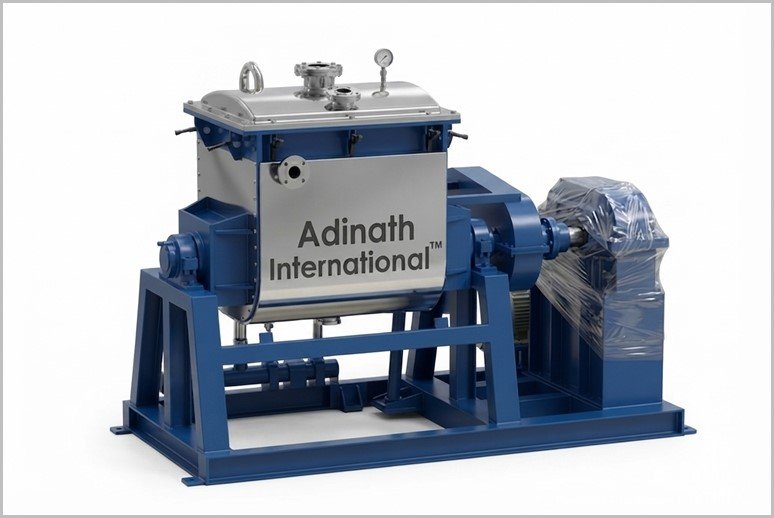
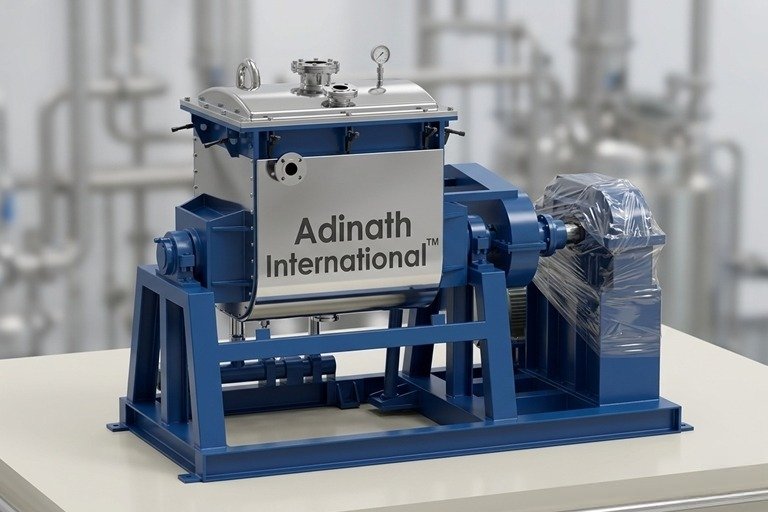
A Refractory Sealing Compound Kneader is a specialized industrial mixing device used to process high-viscosity, paste-like refractory sealing compounds. It is usually constructed as a sigma blade kneader, also referred to as a double-arm sigma mixer or Z-blade kneader. This robust machine provides strong shearing and kneading forces necessary to create consistent, high-quality sealing mastics suitable for use in extreme temperature environments.
Refractory sealing compounds are heat-resistant materials composed of substances such as silicates, alumina, zirconia, or other high-temperature additives. These materials are commonly applied to seal joints, cracks, gaps, and fissures in industrial furnaces, boilers, chimneys, ovens, coke ovens, kilns, and foundries. The Refractory Sealing Compound Kneader ensures complete blending of these thick, elastic-plastic mixtures, resulting in a sealed, long-lasting barrier that maintains its integrity at temperatures ranging from 1000°C to 1400°C or even higher without shrinking, cracking, or failing.
Agitation Mechanics & Internal Blending Dynamics
Product Extraction Methods
Tangential Blade Arrangement
Overlapping Blade Arrangement
Model | Capacity – Liters | Motor (H.P.) | ||
Working Capacity approx. | Gross Capacity approx. | General | Heavy Duty | |
ASM – 50 | 50 Liters | 80 Liters | 5 H.P. | 7.5 H.P. |
ASM – 75 | 75 Liters | 110 Liters | 7.5 H.P. | 10 H.P. |
ASM – 100 | 100 Liters | 150 Liters | 10 H.P. | 15 H.P. |
ASM – 150 | 150 Liters | 200 Liters | 15 H.P. | 20 H.P. |
ASM – 200 | 200 Liters | 300 Liters | 20 H.P. | 25 H.P. |
ASM – 400 | 400 Liters | 550 Liters | 30 H.P. | 40 H.P. |
ASM – 500 | 500 Liters | 750 Liters | 40 H.P. | 50 H.P. |
ASM – 750 | 750 Liters | 1150 Liters | 50 H.P. | 60 H.P. |
ASM – 1000 | 1000 Liters | 1500 Liters | 60 H.P. | 70 H.P. |
ASM – 1500 | 1500 Liters | 2100 Liters | 75 H.P. | 80 H.P. |
ASM – 2000 | 2000 Liters | 2600 Liters | 80 H.P. | 90 H.P. |
ASM – 3000 | 3000 Liters | 3800 Liters | 100 H.P. | 120 H.P. |
* Power voltage can be adjusted as per customer’s domestic power voltage requirements.
* Rights of technical improvements & modification reserved.
* Illustrations & dimensions are shown for information purpose only.
It is a specialized industrial sigma blade (double-arm or Z-blade) kneader designed to process high-viscosity, paste-like refractory sealing compounds. It delivers intense shearing and kneading action to produce consistent, high-quality sealing mastics for extreme-temperature applications.
It handles heat-resistant refractory sealing compounds made from silicates, alumina, zirconia, and other high-temperature additives. These form thick, elastic-plastic mixtures used to seal joints, cracks, and gaps in furnaces, boilers, chimneys, ovens, kilns, and foundries.
Synchronized, counter-rotating Z-shaped (sigma) blades operate at differential speeds (typically in a 3:2 ratio) inside a trough. This creates tangential mixing with continuous axial transfer, intense shearing, folding, stretching, and particle reduction between the blades and vessel walls for thorough homogenization of high-viscosity materials.
The machine is built from high-strength Mild Steel (MS), Stainless Steel 304 (SS 304), or Stainless Steel 316 (SS 316). Surfaces can be customized to a matte or high-gloss mirror finish. It includes an anti-corrosive red oxide primer base plus dual epoxy protective coating, and PTFE shaft seals for sanitary operation.
Models range from ASM-50 (approx. 50 L working / 80 L gross) to ASM-3000 (approx. 3000 L working / 3800 L gross). Motors are available in general and heavy-duty versions (e.g., 5–7.5 HP for smaller models up to 100–120 HP for the largest), with voltage adjustable to local requirements.
Discharge options include manual hand-wheel tilting, automated hydraulic tilting, bottom valves, or an optional extrusion screw. Integrated temperature jackets allow external heating or cooling, protected by mineral wool insulation and external cladding.
Precision-crafted tangential Z-shaped agitators, ultra-close clearance between blades and trough walls (to prevent sticking or accumulation), robust construction for abrasive high-viscosity materials, and optional modular systems for vacuum or controlled fluid spray.
Available options include a Liquid Spray System, Vacuum System (for de-aeration), Blades Cooling Arrangement, Screw/Extrusion System, and Automatic Valve Discharge System for greater process customization.
It is mainly used for producing refractory mastics, patching compounds, ramming mixtures, and hot-repair materials. These create durable, high-temperature seals (typically 1000°C–1400°C or higher) that resist shrinking, cracking, or failure in industrial furnaces, boilers, kilns, and similar equipment.
Its intense shearing, folding, compressing, and kneading action provides excellent dispersion of fillers and handles abrasive, non-flowing, high-viscosity pastes far more effectively than standard mixers (such as planetary types). Sealed operation and hydraulic tilting further support consistent, high-quality results for extreme-temperature sealing applications.
Algeria | Angola | Argentina | Australia | Austria | Bahrain | Bangladesh | Belarus | Belgium | Bolivia | Botswana | Brazil | Bulgaria | Canada | Chile | China | Colombia | Costa Rica | Cuba | Czech Republic | Denmark | Dominican Republic | Ecuador | Egypt | El Salvador | Ethiopia | Finland | France | Germany | Ghana | Greece | Guatemala | Haiti | Honduras | Hong Kong | Hungary | India | Indonesia | Iran | Ireland | Israel | Italy | Ivory Coast | Japan | Jordan | Kazakhstan | Kenya | Kuwait | Lebanon | Libya | Malaysia | Mexico | Mongolia | Morocco | Mozambique | Myanmar | Netherlands | New Zealand | Nicaragua | Nigeria | Norway | Oman | Pakistan | Panama | Paraguay | Peru | Philippines | Poland | Portugal | Qatar | Romania | Russia | Saudi Arabia | Senegal | Slovakia | Singapore | South Africa | South Korea | South Sudan | Spain | Sri Lanka | Sweden | Switzerland | Taiwan | Tanzania | Thailand | Trinidad and Tobago | Tunisia | Turkey | Uganda | Ukraine | United Arab Emirates | United Kingdom | United States | Uruguay | Uzbekistan | Venezuela | Vietnam | Zambia | Zimbabwe
Connect with our engineering team to discuss your specific production requirements. We provide customized, cGMP-compliant machinery solutions designed to optimize your manufacturing facility and maximize output.
©Adinath International | Theme Developed By Pharma Machinery Manufacturer I Website updated on: 15 October 2026
Request A Quick Quote
Refractory Sealing Compound Kneader
Please drop your requirements, one of our technical expert will contact you in next 24 working hours.
WhatsApp us


