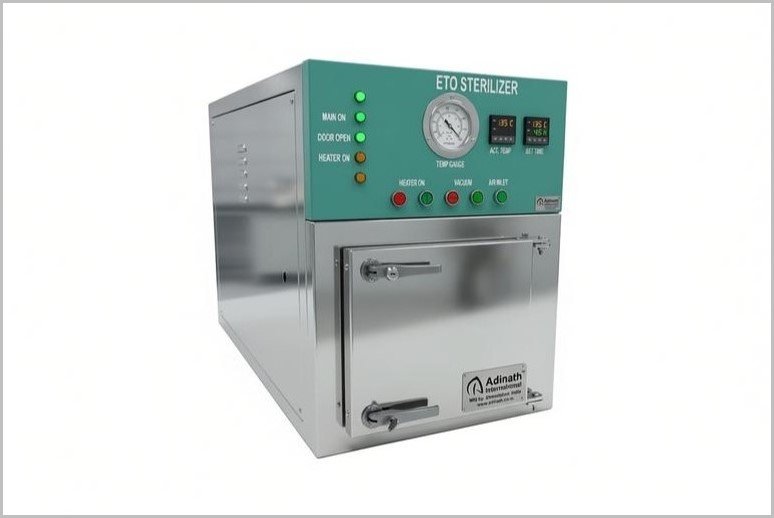
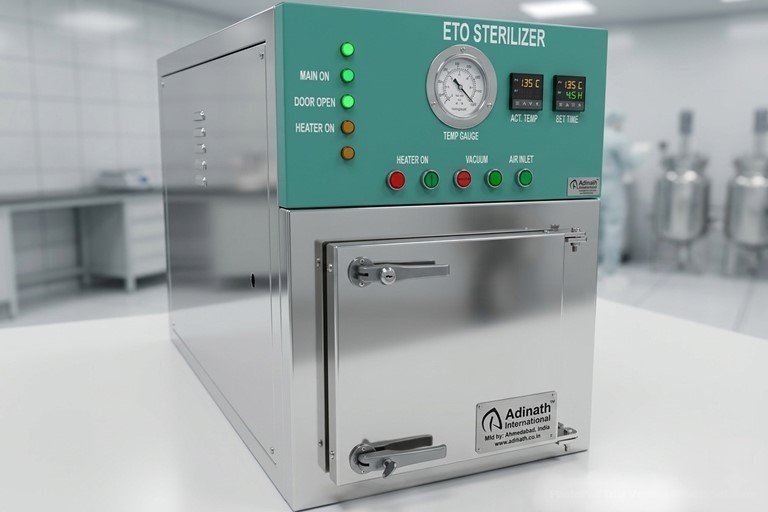
A Hospital EO Sterilizer, also known as an Ethylene Oxide Sterilizer, is a critical piece of sterilization equipment used in healthcare facilities to safely process heat- and moisture-sensitive instruments, devices, and supplies. This advanced system utilizes ethylene oxide (EO or ETO) gas — a highly effective, colorless, and odorless alkylating agent — to penetrate deep into complex materials such as plastics, rubber, optics, electronics, and multi-lumen instruments, destroying bacteria, viruses, fungi, and resistant spores without causing damage.
For hospitals and medical centers, the Hospital EO Sterilizer is indispensable for items that cannot tolerate the high temperatures of steam autoclaves or the effects of radiation and other methods. It plays a vital role in maintaining patient safety by ensuring a Sterility Assurance Level (SAL) of 10⁻⁶.
Indian Manufacturing Excellence & Operational Variants
As a foremost producer of industrial EtO sterilizers in India, we engineer equipment across two specific control frameworks:
Model | AETOS – 2.6 | AETOS – 4.5 | AETOS – 8 |
Working Capacity in Cu. Ft. | 2.6 | 4.5 | 8 |
Working Volume | 70 Liters | 125 Liters | 200 Liters |
Chamber Size | 12” (W) x 12” (H) x 32”
| 12” (W) x 12” (H) x 54” (D) OR 15” (W) x 15” (H) x 36” (D) | 20” (W) x 18” (H) x 38” (D) OR 16” (W) x 16” (H) x 54” (D) |
Sterilant Gas | 40 grams cartridge | 100 grams cartridge | 170 grams cartridge |
Sterilization Cycle | Warm & Cold Cycles are possible. | Warm & Cold Cycles are possible. | Warm & Cold Cycles are possible. |
Aeration | In-built aeration facility provided. | In-built aeration facility provided. | In-built aeration facility provided. |
Utility | Compressed Air (100 psig) | Compressed Air (100 psig) | Compressed Air (100 psig) |
Power Supply | 1 K.W. | 2 K.W. | 2.5 K.W. |
Power Voltage | 220 volts, Single Phase, 50 Hertz | 220 volts, Single Phase, 50 Hertz | 220 volts, Single Phase, 50 Hertz |
* Power voltage can be adjusted as per customer’s domestic power voltage requirements.
* Rights of technical improvements & modification reserved.
* Illustrations & dimensions are shown for information purpose only.
The process typically involves several stages and takes 12–24 hours per cycle, including preconditioning, sterilization, and aeration:
It is critical for sterilizing heat- and moisture-sensitive instruments, devices, and supplies that cannot withstand steam autoclaves or radiation. Using ethylene oxide (EO) gas, it achieves a Sterility Assurance Level (SAL) of 10⁻⁶ while protecting plastics, rubber, optics, electronics, and multi-lumen instruments.
The process operates as a cool, dry cycle at approximately 50°C. Full cycles (including preconditioning, sterilization, and aeration) generally take 12–24 hours, with an average processing window of roughly 8 hours per run depending on the load and model.
It is ideal for single-use medical and surgical items such as intravenous infusion tubing, hypodermic syringes, procedural packs, urinary drainage bags, catheters, coronary stents, cardiovascular catheters, intraocular lenses (IOLs), optical scopes, fluid tubing, and precision blades.
Chambers use high-grade stainless steel (SS 304 / SS 316) for all product-contact surfaces. Units are offered in semi-automatic versions (pneumatically controlled ball valves and push-button operation) or fully automatic PLC-HMI systems with touchscreen interfaces for unattended cycle execution. Modular designs allow sizes from 0.5 m³ to 40 m³.
Key models include:
All support warm and cold cycles, include in-built aeration, require compressed air at 100 psig, and run on 220 V single-phase power (1–2.5 kW, adjustable to local voltage).
The low-temperature, moisture-free process (~50°C) combined with EO’s exceptional diffusion properties allows deep penetration into narrow channels and complex geometries. The gas alkylates microbial DNA, destroying bacteria, viruses, fungi, and spores while preserving material integrity and extending the lifespan of delicate equipment.
In-built aeration removes residual EO gas after the sterilization phase, reducing residues to safe levels (per ISO 11135 standards, e.g., <4 mg/device for most items). This ensures operator safety, product readiness, and environmental compliance.
Complete qualification documentation suites (IQ – Installation Qualification, DQ – Design Qualification, and OQ – Operational Qualification) are available as an optional add-on service upon request.
It delivers 99.9999% sterility assurance for delicate, moisture-sensitive devices, leaves items residue-free after proper aeration, supports efficient batch processing in busy hospitals, and has been a dominant low-temperature sterilization method since the 1960s. It also helps prevent microbial spoilage while safeguarding product quality.
While designed for hospitals and healthcare, they are also widely applied in pharmaceutical, nutraceutical, herbal, Ayurvedic, biotech, cosmetic, and chemical industries for sterilizing heat- and moisture-sensitive products, as well as certain packaged foodstuffs and other sensitive materials.
More Sterilization Equipments
 2 Cubic Feet EO Gas Sterilizer
 3 Cubic Feet EO Sterilizer
 4 Cubic Feet EO Gas Sterilizer
 EO Cartridge Sterilizer
Algeria | Angola | Argentina | Australia | Austria | Bahrain | Bangladesh | Belarus | Belgium | Bolivia | Botswana | Brazil | Bulgaria | Canada | Chile | China | Colombia | Costa Rica | Cuba | Czech Republic | Denmark | Dominican Republic | Ecuador | Egypt | El Salvador | Ethiopia | Finland | France | Germany | Ghana | Greece | Guatemala | Haiti | Honduras | Hong Kong | Hungary | India | Indonesia | Iran | Ireland | Israel | Italy | Ivory Coast | Japan | Jordan | Kazakhstan | Kenya | Kuwait | Lebanon | Libya | Malaysia | Mexico | Mongolia | Morocco | Mozambique | Myanmar | Netherlands | New Zealand | Nicaragua | Nigeria | Norway | Oman | Pakistan | Panama | Paraguay | Peru | Philippines | Poland | Portugal | Qatar | Romania | Russia | Saudi Arabia | Senegal | Slovakia | Singapore | South Africa | South Korea | South Sudan | Spain | Sri Lanka | Sweden | Switzerland | Taiwan | Tanzania | Thailand | Trinidad and Tobago | Tunisia | Turkey | Uganda | Ukraine | United Arab Emirates | United Kingdom | United States | Uruguay | Uzbekistan | Venezuela | Vietnam | Zambia | Zimbabwe
Connect with our engineering team to discuss your specific production requirements. We provide customized, cGMP-compliant machinery solutions designed to optimize your manufacturing facility and maximize output.
©Adinath International | Theme Developed By Pharma Machinery Manufacturer I Website updated on: 15 October 2026
Request A Quick Quote
Hospital EO Sterilizer
Please drop your requirements, one of our technical expert will contact you in next 24 working hours.
WhatsApp us
