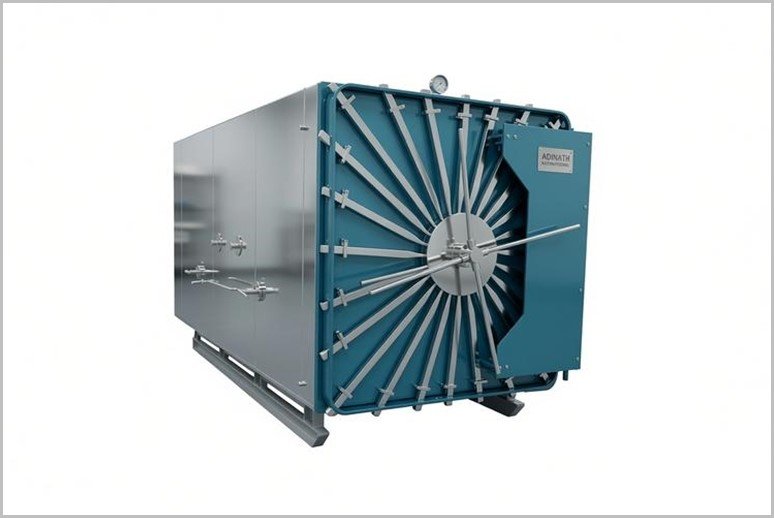
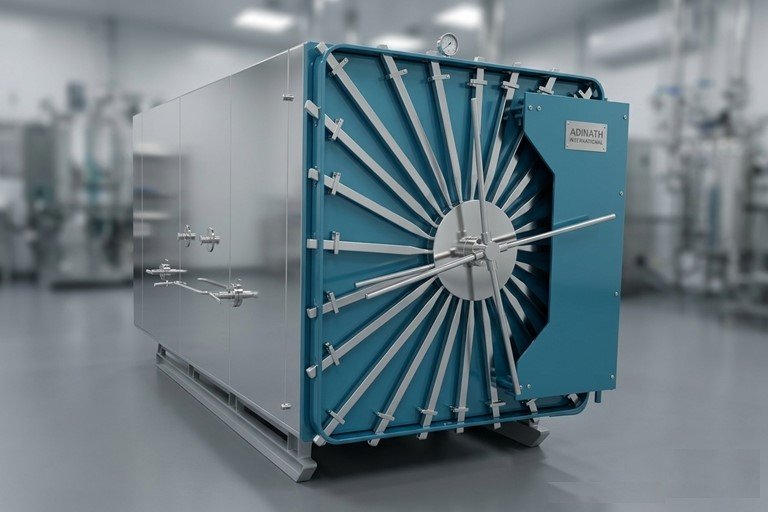
In the challenging fields of healthcare, pharmaceuticals, and precision manufacturing, ensuring complete sterility is essential. An EO Sterilizer Machine, also referred to as an Ethylene Oxide Sterilizer, is one of the most reliable and adaptable options for sterilizing items that cannot withstand high heat or moisture. Unlike conventional steam autoclaves or dry heat ovens, EO sterilization works at lower temperatures, making it the preferred choice for delicate, intricate, and heat-sensitive materials. An Ethylene Oxide (EO) Sterilizer is a specialized system that uses EO gas, a strong alkylating agent, to kill bacteria, viruses, fungi, and spores.
The gas can reach deep into packaging, device channels, and porous surfaces, interfering with the DNA and proteins of microorganisms. This process achieves a very high Sterility Assurance Level (SAL) of 10⁻⁶, which means the chance of any single microorganism surviving is one in a million.
EO sterilization typically takes place at controlled low temperatures, ranging from 80 to 150°F (27 to 66°C), with carefully managed humidity and vacuum or pressure cycles. This careful method ensures that sensitive medical equipment remains intact while still satisfying strict regulatory requirements from organizations such as the FDA, ISO 11135, and AAMI.
Leading Indian Manufacturer & Control Options
As a premier producer of industrial ethylene oxide sterilizers in India, we engineer our systems across two distinct operational models:
Model | AETOS – 2.6 | AETOS – 4.5 | AETOS – 8 |
Working Capacity in Cu. Ft. | 2.6 | 4.5 | 8 |
Working Volume | 70 Liters | 125 Liters | 200 Liters |
Chamber Size | 12” (W) x 12” (H) x 32”
| 12” (W) x 12” (H) x 54” (D) OR 15” (W) x 15” (H) x 36” (D) | 20” (W) x 18” (H) x 38” (D) OR 16” (W) x 16” (H) x 54” (D) |
Sterilant Gas | 40 grams cartridge | 100 grams cartridge | 170 grams cartridge |
Sterilization Cycle | Warm & Cold Cycles are possible. | Warm & Cold Cycles are possible. | Warm & Cold Cycles are possible. |
Aeration | In-built aeration facility provided. | In-built aeration facility provided. | In-built aeration facility provided. |
Utility | Compressed Air (100 psig) | Compressed Air (100 psig) | Compressed Air (100 psig) |
Power Supply | 1 K.W. | 2 K.W. | 2.5 K.W. |
Power Voltage | 220 volts, Single Phase, 50 Hertz | 220 volts, Single Phase, 50 Hertz | 220 volts, Single Phase, 50 Hertz |
* Power voltage can be adjusted as per customer’s domestic power voltage requirements.
* Rights of technical improvements & modification reserved.
* Illustrations & dimensions are shown for information purpose only.
The process occurs in a sealed chamber and involves four main phases, lasting 3–12 hours per cycle depending on load size and material:
Advanced systems use microdoses and recirculation for efficiency, reducing gas use by up to 90% compared to older methods.
It operates at controlled low temperatures of approximately 27–66°C (80–150°F), commonly around 50°C. This cool, dry process protects delicate, heat- and moisture-sensitive materials (such as plastics, electronics, and complex medical devices) that would be damaged by steam autoclaves or dry-heat methods.
The process delivers a Sterility Assurance Level (SAL) of 10⁻⁶, meaning the probability of a single viable microorganism surviving is one in a million. This high efficacy is achieved through EO gas’s ability to alkylate and disrupt the DNA and proteins of bacteria, viruses, fungi, and spores.
Yes. In addition to medical devices, it is suitable for preventing microbial growth and spoilage in seasonings, dried fruit kernels, packaged cereal grains, and similar products, making it useful beyond healthcare and pharmaceutical applications.
All areas that contact the product load are built from premium stainless steel—typically SS 304 or SS 316 grades—to ensure durability, corrosion resistance, and compliance with hygienic standards.
A full run averages roughly 8 hours. This includes preconditioning/humidification, EO gas exposure, and the subsequent aeration/evacuation phases needed to remove residual gas.
Two main options are available:
Yes. Comprehensive qualification documentation packages covering Installation Qualification (IQ), Operational Qualification (OQ), and Design Qualification (DQ) can be supplied upon request to support regulatory compliance.
The units require compressed air at 100 psig. Power supply ranges from 1 kW to 2.5 kW depending on the model, typically at 220 V single-phase 50 Hz (adjustable to customer’s local voltage).
EO gas has exceptional permeability and diffusion properties. Combined with vacuum cycles, controlled humidity (typically 40–80 % RH), and recirculation, it reaches deep into multi-layer packaging, device channels, porous surfaces, and intricate geometries that steam or radiation cannot easily access.
Systems are offered in modular designs ranging from compact 0.5-cubic-meter models up to large 40-cubic-meter industrial units. Standard smaller models include AETOS-2.6 (≈70 L), AETOS-4.5 (≈125 L), and AETOS-8 (≈200 L), with corresponding EO cartridge sizes.
More Sterilization Equipments
 2 Cubic Feet EO Gas Sterilizer
 4 Cubic Feet EO Gas Sterilizer
 3 Cubic Feet EO Sterilizer
 Cath Lab Ethylene Oxide Gas Sterilizer
Algeria | Angola | Argentina | Australia | Austria | Bahrain | Bangladesh | Belarus | Belgium | Bolivia | Botswana | Brazil | Bulgaria | Canada | Chile | China | Colombia | Costa Rica | Cuba | Czech Republic | Denmark | Dominican Republic | Ecuador | Egypt | El Salvador | Ethiopia | Finland | France | Germany | Ghana | Greece | Guatemala | Haiti | Honduras | Hong Kong | Hungary | India | Indonesia | Iran | Ireland | Israel | Italy | Ivory Coast | Japan | Jordan | Kazakhstan | Kenya | Kuwait | Lebanon | Libya | Malaysia | Mexico | Mongolia | Morocco | Mozambique | Myanmar | Netherlands | New Zealand | Nicaragua | Nigeria | Norway | Oman | Pakistan | Panama | Paraguay | Peru | Philippines | Poland | Portugal | Qatar | Romania | Russia | Saudi Arabia | Senegal | Slovakia | Singapore | South Africa | South Korea | South Sudan | Spain | Sri Lanka | Sweden | Switzerland | Taiwan | Tanzania | Thailand | Trinidad and Tobago | Tunisia | Turkey | Uganda | Ukraine | United Arab Emirates | United Kingdom | United States | Uruguay | Uzbekistan | Venezuela | Vietnam | Zambia | Zimbabwe
Connect with our engineering team to discuss your specific production requirements. We provide customized, cGMP-compliant machinery solutions designed to optimize your manufacturing facility and maximize output.
©Adinath International | Theme Developed By Pharma Machinery Manufacturer I Website updated on: 15 October 2026
Request A Quick Quote
Industrial EO Gas Sterilizer
Please drop your requirements, one of our technical expert will contact you in next 24 working hours.
WhatsApp us
