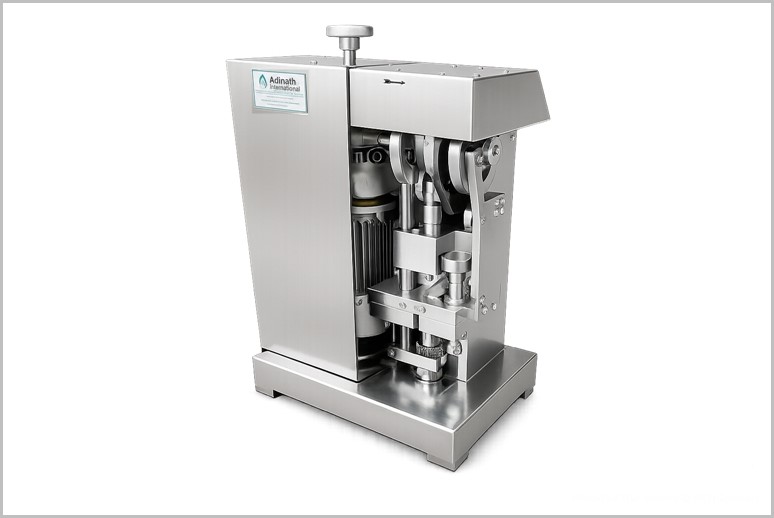
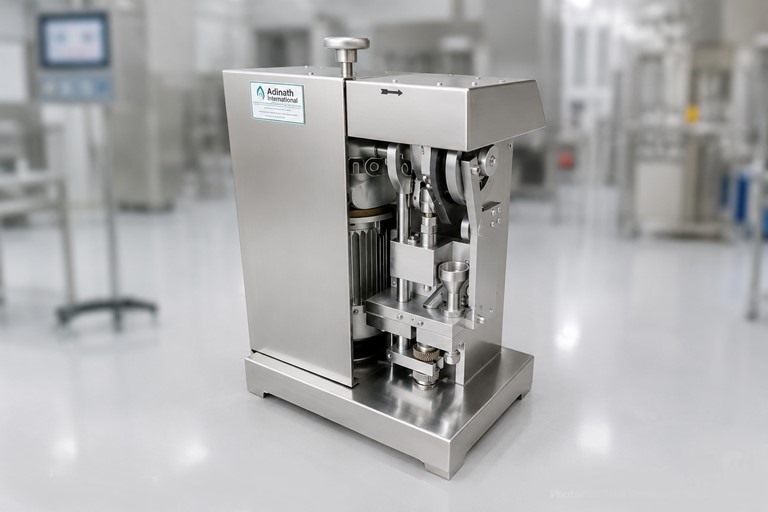
Lab Scale Tablet Press Machine is a compact, specialized piece of equipment designed for producing small batches of tablets from powdered or granular materials. These machines are primarily used in research and development (R&D) settings, such as pharmaceutical labs, where precision, flexibility, and compliance with standards like cGMP (Current Good Manufacturing Practice) are essential. Unlike large industrial presses, lab scale models focus on low-volume production, making them ideal for formulation testing, pilot studies, and small-scale manufacturing in industries like pharmaceuticals, nutraceuticals, chemicals, food, and metallurgy.
If you need details on specific models and pricing, let me know!
The process involves feeding powder/granules into a hopper, which gravity-feeds into dies. Punches then compress the material under controlled force, and the finished tablet is ejected. Modern models include sensors for real-time adjustments to ensure uniformity in weight, hardness, and thickness. For single-punch types, it’s a manual lever press; rotary models use a rotating turret for continuous operation.
Model | ATP 1 |
Max. Compression Force | 4 ton |
Max. Dia. of Tablet | 12mm |
Max. Depth of Fill | 12mm |
Thickness of Largest Tablet | 6mm |
Production Output | Up to 2500 Tablets/hour depending upon product type & tablet shape/size. |
Power Required | 1 H.P. |
Power Voltage | 220 Volts, Single Phase, 50 Hertz/440 volts, 3 Phase, 50 Hertz |
Overall Dimension | 450mm (L) x 550mm (W) x 750mm (H) approx. |
Net Weight | 100 kgs. approx. |
Gross Weight | 150 kgs. approx. |
* Power voltage can be adjusted as per customer’s domestic power voltage requirements.
* Rights of technical improvements & modification reserved.
* Illustrations & dimensions are shown for information purpose only.
Lab scale tablet presses typically include:
These features enable quick setup for trials, reducing time and costs in early-stage development.
A Lab Scale Tablet Press Machine is a compact, precision-engineered device designed for producing small batches of tablets from powders or granules. It is primarily used in R&D laboratories, pharmaceutical development, pilot studies, and small-scale manufacturing. Unlike large production presses, it focuses on flexibility, accuracy, and minimal material usage while complying with cGMP standards.
Key features include a cGMP-compliant design, motorized operation with a hand wheel option for settings, stainless steel covering on moving parts, easy-to-remove parts for cleaning and autoclaving, compact footprint with an external hopper, and suitability for round, oval, and caplet-shaped tablets. It requires low maintenance and is easy to operate.
The ATP 1 model offers a maximum compression force of 4 tons, supports tablets up to 12mm in diameter and 6mm thickness, with a maximum fill depth of 12mm. It can produce up to 2,500 tablets per hour (depending on formulation and tablet size). It requires 1 H.P. power and has compact dimensions of approximately 450mm (L) x 550mm (W) x 750mm (H).
Major advantages include low material consumption (ideal for expensive APIs), compact benchtop design for lab spaces, ease of operation and cleaning, precision control for consistent tablet quality, and excellent support for formulation development, scalability studies, and pilot production. It helps reduce costs and risks during early-stage R&D.
Powder or granules are fed from the hopper into the die cavity. Punches then compress the material under controlled force to form the tablet, which is subsequently ejected. Single-punch models often use manual or motorized lever action, while small rotary versions use a rotating turret for more continuous operation. Sensors in modern models help maintain uniformity in weight, hardness, and thickness.
More Tablet Press Machines
 Pilot Scale Tablet Press Machine
 Chlorine Tablet Press Machine
 Confectionary Tablet Press Machine
 Flower Basket Tablet Press Machine
Algeria | Angola | Argentina | Australia | Austria | Bahrain | Bangladesh | Belarus | Belgium | Bolivia | Botswana | Brazil | Bulgaria | Canada | Chile | China | Colombia | Costa Rica | Cuba | Czech Republic | Denmark | Dominican Republic | Ecuador | Egypt | El Salvador | Ethiopia | Finland | France | Germany | Ghana | Greece | Guatemala | Haiti | Honduras | Hong Kong | Hungary | India | Indonesia | Iran | Ireland | Israel | Italy | Ivory Coast | Japan | Jordan | Kazakhstan | Kenya | Kuwait | Lebanon | Libya | Malaysia | Mexico | Mongolia | Morocco | Mozambique | Myanmar | Netherlands | New Zealand | Nicaragua | Nigeria | Norway | Oman | Pakistan | Panama | Paraguay | Peru | Philippines | Poland | Portugal | Qatar | Romania | Russia | Saudi Arabia | Senegal | Slovakia | Singapore | South Africa | South Korea | South Sudan | Spain | Sri Lanka | Sweden | Switzerland | Taiwan | Tanzania | Thailand | Trinidad and Tobago | Tunisia | Turkey | Uganda | Ukraine | United Arab Emirates | United Kingdom | United States | Uruguay | Uzbekistan | Venezuela | Vietnam | Zambia | Zimbabwe
Connect with our engineering team to discuss your specific production requirements. We provide customized, cGMP-compliant machinery solutions designed to optimize your manufacturing facility and maximize output.
©Adinath International | Theme Developed By Pharma Machinery Manufacturer I Website updated on: 15 October 2026
Request A Quick Quote
Lab Scale Tablet Press Machine
Please drop your requirements, one of our technical expert will contact you in next 24 working hours.
WhatsApp us
