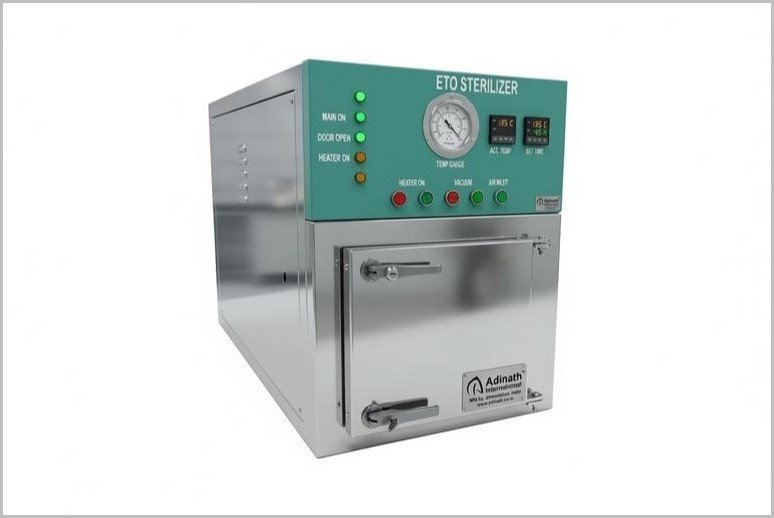
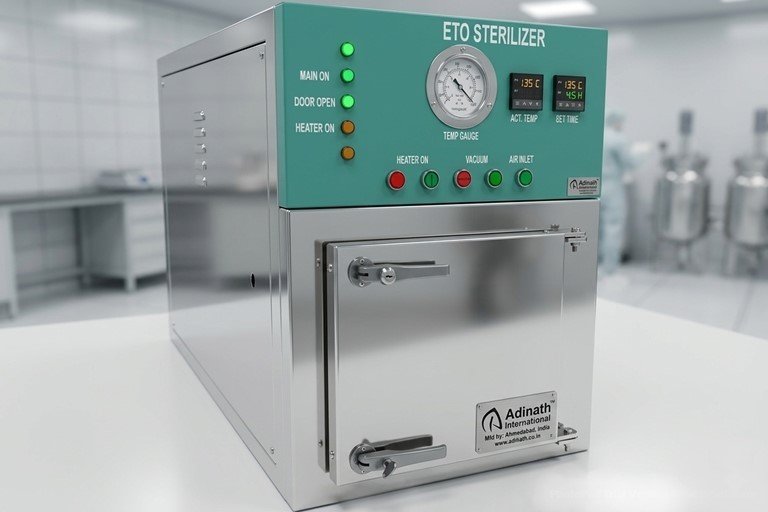
A Cath Lab Ethylene Oxide Gas Sterilizer (also known as ETO Sterilizer) is a specialized medical-grade system designed for safe, low-temperature sterilization of highly sensitive instruments used in cardiac catheterization laboratories. Unlike high-heat steam autoclaves, this technology employs ethylene oxide (ETO/EO) gas — a powerful, colorless alkylating agent — to penetrate complex devices and eliminate bacteria, viruses, fungi, and resistant spores without compromising delicate materials.
Operating at low temperatures (typically 30–60°C), ETO sterilization is the preferred method for heat- and moisture-sensitive equipment that cannot withstand traditional autoclaving. This makes it indispensable in modern Cath Labs where precision instruments are critical for life-saving procedures.
The sterilization cycle follows a general sequence, though exact timings and gas concentrations can vary widely depending on the load and requirements. The outline below is provided only as a typical reference.
The unit operates with disposable EO cartridges available in 40 g, 100 g, and 170 g sizes. It features a single-door chamber equipped with a straightforward locking mechanism. An electronic heating system maintains a consistent chamber temperature of 50 °C. Built for long-term reliability, the machine incorporates a suitably sized venturi housed within a sturdy cabinet. Dedicated control switches manage heating, gas injection, and power supply.
Preconditioning – Warm Humid Exposure Items are held in a controlled warm and humid atmosphere for approximately 12 hours. Conditions of about 70 % relative humidity and 55 °C are maintained to achieve uniform temperature and moisture throughout the load.
Gas Injection and Exposure A vacuum is drawn, after which EO gas is introduced into the chamber. The load remains under these conditions (same temperature and humidity) for roughly 4 to 8 hours.
Gas Removal and Aeration Vacuum is repeatedly applied while fresh air is admitted to purge residual EO from the chamber. This flushing and aeration phase typically continues for 8 to 12 hours until the sterilant is fully cleared.
Model | AETOS – 2.6 | AETOS – 4.5 | AETOS – 8 |
Working Capacity in Cu. Ft. | 2.6 | 4.5 | 8 |
Working Volume | 70 Liters | 125 Liters | 200 Liters |
Chamber Size | 12” (W) x 12” (H) x 32”
| 12” (W) x 12” (H) x 54” (D) OR 15” (W) x 15” (H) x 36” (D) | 20” (W) x 18” (H) x 38” (D) OR 16” (W) x 16” (H) x 54” (D) |
Sterilant Gas | 40 grams cartridge | 100 grams cartridge | 170 grams cartridge |
Sterilization Cycle | Warm & Cold Cycles are possible. | Warm & Cold Cycles are possible. | Warm & Cold Cycles are possible. |
Aeration | In-built aeration facility provided. | In-built aeration facility provided. | In-built aeration facility provided. |
Utility | Compressed Air (100 psig) | Compressed Air (100 psig) | Compressed Air (100 psig) |
Power Supply | 1 K.W. | 2 K.W. | 2.5 K.W. |
Power Voltage | 220 volts, Single Phase, 50 Hertz | 220 volts, Single Phase, 50 Hertz | 220 volts, Single Phase, 50 Hertz |
* Power voltage can be adjusted as per customer’s domestic power voltage requirements.
* Rights of technical improvements & modification reserved.
* Illustrations & dimensions are shown for information purpose only.
It operates at low temperatures (typically 30–60°C, commonly around 50°C), making it ideal for heat- and moisture-sensitive instruments used in cardiac catheterization. Steam autoclaves use high heat that can damage delicate materials, plastics, rubbers, electronics, and complex devices with narrow lumens.
It is suitable for disposable syringes, IV sets, single-use surgical kits, gloves, infusion sets, urine collection bags, contraceptive devices, and other medical products—especially those with complex geometries, sealed packaging, or long narrow lumens common in interventional tools.
A general cycle includes:
Models include AETOS-2.6 (2.6 cu. ft. / 70 L, 40 g cartridge), AETOS-4.5 (4.5 cu. ft. / 125 L, 100 g cartridge), and AETOS-8 (8 cu. ft. / 200 L, 170 g cartridge). All support warm and cold cycles with built-in aeration.
Power ranges from 1 kW to 2.5 kW depending on model, typically 220 V single-phase 50 Hz (adjustable to local voltage). It requires compressed air at 100 psig.
It features in-built aeration, repeated vacuum/air washes, and an exhaust/abatement system (scrubbers or similar) to remove residual ethylene oxide. This protects operators and meets environmental compliance.
Product-contact surfaces are Stainless Steel 304 and 316. The chamber has a modular design. Installation Qualification (IQ), Operational Qualification (OQ), and Design Qualification (DQ) documents are available on request.
It safely handles plastics, rubbers, electronics, and heat-labile polymers; penetrates sealed packages and narrow lumens; destroys resistant microorganisms (bacteria, viruses, fungi, spores); and complies with standards such as ISO 11135, FDA guidelines, and AAMI recommendations.
Core components include the pressure/vacuum-rated sterilization chamber, vacuum system, heating/temperature control, humidification system, EO gas delivery (cartridges or cylinders), recirculation, nitrogen/air inbleed, exhaust/abatement, control/monitoring (PLC/HMI with sensors), and aeration features.
Beyond Cath Labs and hospitals, it serves pharmaceutical, nutraceutical, herbal, Ayurvedic, biotech, cosmetic, and chemical industries, as well as medical device manufacturing for heat- and moisture-sensitive products.
More Sterilization Equipments
 Ethylene Oxide Gas Sterilizer
 4 CFT Ethylene Oxide Sterilizer
 Ethylene Oxide Cylindrical Sterilizer
 Ethylene Oxide Sterilizer
Algeria | Angola | Argentina | Australia | Austria | Bahrain | Bangladesh | Belarus | Belgium | Bolivia | Botswana | Brazil | Bulgaria | Canada | Chile | China | Colombia | Costa Rica | Cuba | Czech Republic | Denmark | Dominican Republic | Ecuador | Egypt | El Salvador | Ethiopia | Finland | France | Germany | Ghana | Greece | Guatemala | Haiti | Honduras | Hong Kong | Hungary | India | Indonesia | Iran | Ireland | Israel | Italy | Ivory Coast | Japan | Jordan | Kazakhstan | Kenya | Kuwait | Lebanon | Libya | Malaysia | Mexico | Mongolia | Morocco | Mozambique | Myanmar | Netherlands | New Zealand | Nicaragua | Nigeria | Norway | Oman | Pakistan | Panama | Paraguay | Peru | Philippines | Poland | Portugal | Qatar | Romania | Russia | Saudi Arabia | Senegal | Slovakia | Singapore | South Africa | South Korea | South Sudan | Spain | Sri Lanka | Sweden | Switzerland | Taiwan | Tanzania | Thailand | Trinidad and Tobago | Tunisia | Turkey | Uganda | Ukraine | United Arab Emirates | United Kingdom | United States | Uruguay | Uzbekistan | Venezuela | Vietnam | Zambia | Zimbabwe
Connect with our engineering team to discuss your specific production requirements. We provide customized, cGMP-compliant machinery solutions designed to optimize your manufacturing facility and maximize output.
©Adinath International | Theme Developed By Pharma Machinery Manufacturer I Website updated on: 15 October 2026
Request A Quick Quote
Cath Lab Ethylene Oxide Gas Sterilizer
Please drop your requirements, one of our technical expert will contact you in next 24 working hours.
WhatsApp us
