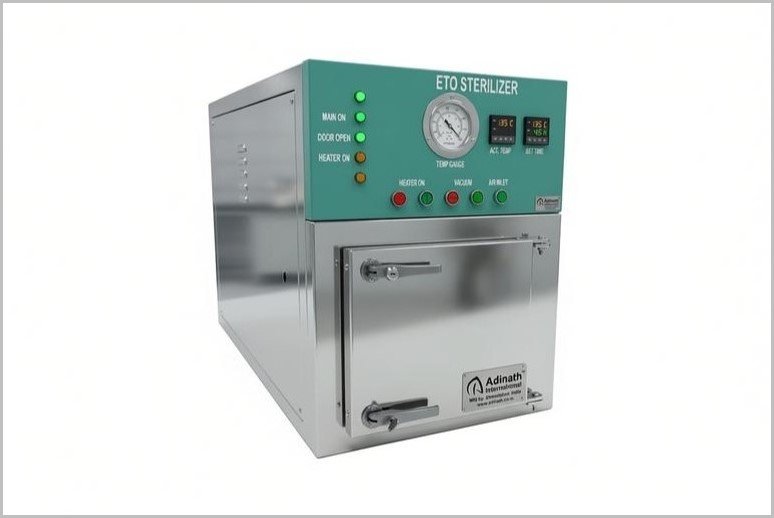
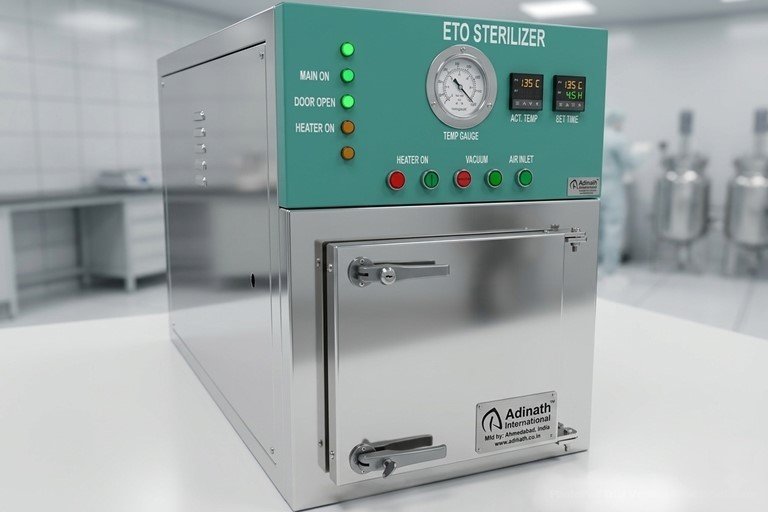
An ethylene oxide cylindrical sterilizer (EO cylindrical sterilizer) is a specialized, high-performance sterilization system used in hospitals, pharmaceutical manufacturing, medical device production, and industrial settings. It employs ethylene oxide (EO) gas to safely sterilize heat- and moisture-sensitive instruments, devices, and materials that cannot tolerate steam autoclaving or high temperatures. EO gas effectively penetrates packaging and complex geometries, destroying microorganisms by alkylating their DNA and proteins, achieving a Sterility Assurance Level (SAL) of 10⁻⁶ — the gold standard for critical medical devices.
The cylindrical chamber design is highly valued for its exceptional structural integrity under vacuum and pressure cycles. Cylindrical vessels distribute stress evenly, making them ideal for handling the demanding conditions of EO sterilization. These rigid, sealed chambers offer superior gas distribution, efficient vacuum performance, and enhanced safety compared to other configurations. They are commonly built to meet rigorous standards such as ASME-PVHO (Pressure Vessels for Human Occupancy) and ISO 11135.
Operational Principles and Cycle Phases
The following section outlines the core mechanism and sequential phases of a standard ethylene oxide (EO) sterilization procedure. Due to significant variations in gas concentrations and exposure times across different applications, this workflow acts strictly as a general guideline.
System Architecture and Hardware
Step 1: Pre-Conditioning (Climatic Stabilization)
Step 2: Sterilant Injection (Gas Exposure)
Step 3: Aeration and Exhaust (Gas Extraction)
Model | AETOS – 2.6 | AETOS – 4.5 | AETOS – 8 |
Working Capacity in Cu. Ft. | 2.6 | 4.5 | 8 |
Working Volume | 70 Liters | 125 Liters | 200 Liters |
Chamber Size | 12” (W) x 12” (H) x 32”
| 12” (W) x 12” (H) x 54” (D) OR 15” (W) x 15” (H) x 36” (D) | 20” (W) x 18” (H) x 38” (D) OR 16” (W) x 16” (H) x 54” (D) |
Sterilant Gas | 40 grams cartridge | 100 grams cartridge | 170 grams cartridge |
Sterilization Cycle | Warm & Cold Cycles are possible. | Warm & Cold Cycles are possible. | Warm & Cold Cycles are possible. |
Aeration | In-built aeration facility provided. | In-built aeration facility provided. | In-built aeration facility provided. |
Utility | Compressed Air (100 psig) | Compressed Air (100 psig) | Compressed Air (100 psig) |
Power Supply | 1 K.W. | 2 K.W. | 2.5 K.W. |
Power Voltage | 220 volts, Single Phase, 50 Hertz | 220 volts, Single Phase, 50 Hertz | 220 volts, Single Phase, 50 Hertz |
* Power voltage can be adjusted as per customer’s domestic power voltage requirements.
* Rights of technical improvements & modification reserved.
* Illustrations & dimensions are shown for information purpose only.
The EO sterilization process in a cylindrical chamber follows a controlled, multi-stage cycle to ensure safety and efficacy. Key parameters include gas concentration, temperature, relative humidity (40–80%), and exposure time. Here’s a step-by-step overview:
It is a specialized high-performance sterilization system that uses ethylene oxide (EO) gas to sterilize heat- and moisture-sensitive instruments, devices, and materials that cannot withstand steam autoclaving or high temperatures. It is commonly used in hospitals, pharmaceutical manufacturing, medical device production, and industrial settings. The cylindrical chamber design provides superior structural integrity, even stress distribution, efficient gas distribution, and enhanced vacuum performance.
EO gas penetrates packaging and complex geometries, destroying microorganisms by alkylating their DNA and proteins to achieve a Sterility Assurance Level (SAL) of 10⁻⁶. The process typically includes preconditioning (controlled humidity and temperature), vacuum purging, EO gas injection and exposure, aeration/de-gassing to remove residuals, and exhaust with monitoring.
A standard cycle generally involves:
It is ideal for disposable syringes, intravenous administration kits, single-use surgical packages, medical gloves, infusion assemblies, urine collection bags, contraceptive instruments, and a wide range of other heat- or moisture-sensitive clinical and medical devices.
Product-contact components are made from premium stainless steel (SS 304 and SS 316). The cylindrical design offers high structural integrity under vacuum and pressure cycles. Models feature modular chamber architecture for scalable configurations, single-entry doors with simple closures, and heavy-duty outer chassis construction.
Models include AETOS–2.6 (≈70 liters / 2.6 cu. ft.), AETOS–4.5 (≈125 liters / 4.5 cu. ft.), and AETOS–8 (≈200 liters / 8 cu. ft.). They use disposable EO cartridges (40 g, 100 g, or 170 g), offer in-built aeration, require compressed air (100 psig), and operate on single-phase power (typically 1–2.5 kW at 220 V / 50 Hz, adjustable as needed). Chamber dimensions vary by model.
Comprehensive Installation Qualification (IQ), Operational Qualification (OQ), and Design Qualification (DQ) documentation packages are available to support validation and regulatory compliance.
They are applied in the pharmaceutical, nutraceutical, herbal, Ayurvedic, biotech, cosmetic, and chemical industries, as well as in hospitals and medical device manufacturing for sterilizing heat-sensitive items.
Systems incorporate engineering controls (ventilation, enclosed loading), PPE requirements, and monitoring. They comply with standards such as ISO 11135, ISO 10993-7 (residual limits), OSHA 29 CFR 1910.1047, and NIOSH guidelines. EO is flammable, explosive, and a potential carcinogen, so proper aeration, residual control, training, and signage are essential. Modern designs often include features to reduce emissions.
The cylindrical vessel distributes stress evenly under vacuum and pressure cycles, providing exceptional structural integrity, superior gas distribution, efficient vacuum performance, and enhanced overall safety compared with alternative shapes. It is commonly engineered to meet rigorous standards such as ASME-PVHO and ISO 11135.
More Sterilization Equipments
 4 CFT Ethylene Oxide Sterilizer
 Cath Lab Ethylene Oxide Gas Sterilizer
 Ethylene Oxide Gas Sterilizer
 Ethylene Oxide Sterilizer
Algeria | Angola | Argentina | Australia | Austria | Bahrain | Bangladesh | Belarus | Belgium | Bolivia | Botswana | Brazil | Bulgaria | Canada | Chile | China | Colombia | Costa Rica | Cuba | Czech Republic | Denmark | Dominican Republic | Ecuador | Egypt | El Salvador | Ethiopia | Finland | France | Germany | Ghana | Greece | Guatemala | Haiti | Honduras | Hong Kong | Hungary | India | Indonesia | Iran | Ireland | Israel | Italy | Ivory Coast | Japan | Jordan | Kazakhstan | Kenya | Kuwait | Lebanon | Libya | Malaysia | Mexico | Mongolia | Morocco | Mozambique | Myanmar | Netherlands | New Zealand | Nicaragua | Nigeria | Norway | Oman | Pakistan | Panama | Paraguay | Peru | Philippines | Poland | Portugal | Qatar | Romania | Russia | Saudi Arabia | Senegal | Slovakia | Singapore | South Africa | South Korea | South Sudan | Spain | Sri Lanka | Sweden | Switzerland | Taiwan | Tanzania | Thailand | Trinidad and Tobago | Tunisia | Turkey | Uganda | Ukraine | United Arab Emirates | United Kingdom | United States | Uruguay | Uzbekistan | Venezuela | Vietnam | Zambia | Zimbabwe
Connect with our engineering team to discuss your specific production requirements. We provide customized, cGMP-compliant machinery solutions designed to optimize your manufacturing facility and maximize output.
©Adinath International | Theme Developed By Pharma Machinery Manufacturer I Website updated on: 15 October 2026
Request A Quick Quote
Ethylene Oxide Cylindrical Sterilizer
Please drop your requirements, one of our technical expert will contact you in next 24 working hours.
WhatsApp us
