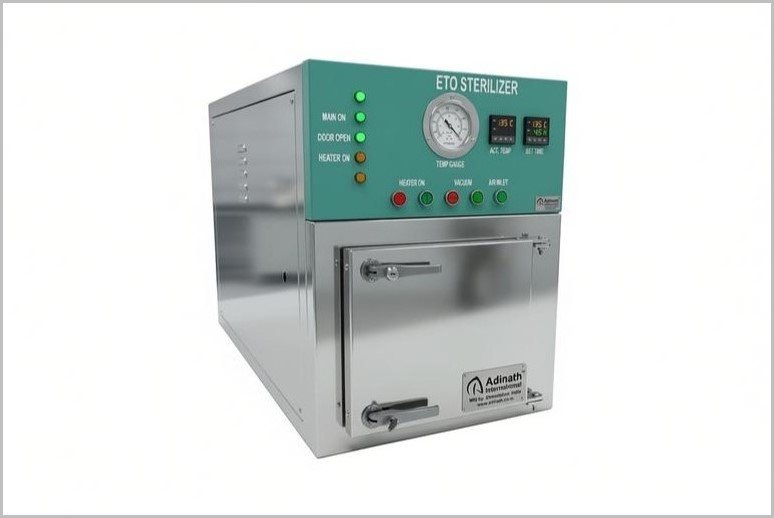
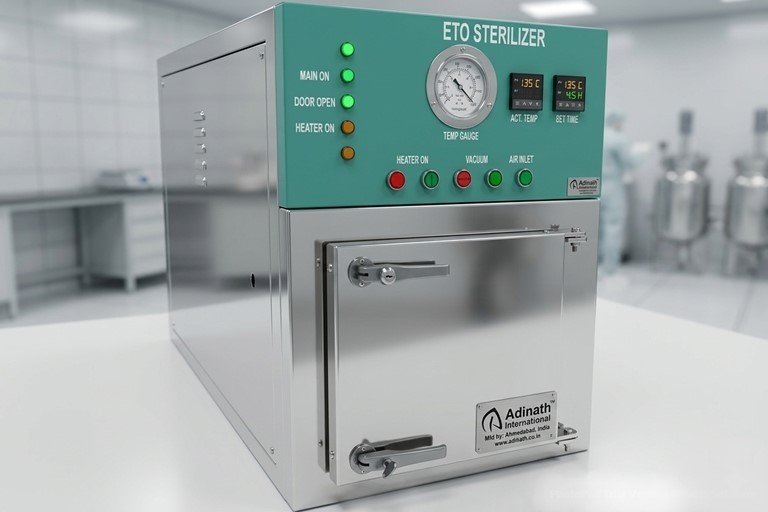
An ethylene oxide gas sterilizer (also known as an EO sterilizer) is a highly specialized sterilization system that utilizes ethylene oxide (EO) — a colorless, flammable gas — as the primary sterilizing agent. This advanced technology is essential for effectively eliminating bacteria, viruses, fungi, and spores from medical devices, surgical instruments, and other items that cannot withstand high heat or moisture.
In healthcare facilities, hospitals, pharmaceutical manufacturing plants, and medical device production units, ethylene oxide sterilization has become the gold standard for processing heat- and moisture-sensitive materials. Unlike traditional autoclave steam sterilization, which relies on high temperatures, EO gas can penetrate deep into complex device geometries, intricate tubing, porous materials, and sealed packaging without causing damage or deformation.
Let’s take a look at the working principle and several stages involved in the sterilization process. Since, there is no standardized process owing to a vast diversity in exposure periods and gas concentration, the process below is a typical one and must be taken into consideration for reference purposes only.
The machine uses single use EO cartridges of 40, 100 and 170 grams. The chamber is facilitated with a single door and a simple locking system. There is an electronically controlled heating system in place to ensure a uniform heating at 50 degrees centigrade. The machine is designed for optimum durability as it contains venturi of adequate capacity inside a robust cabinet. There are control buttons for heating, gas purging and power supply requirements.
The product is exposed to a warm and humid environment for about 12 hours. 70 percent RH and 55 A Cº is maintained for a uniform temperature and humidity.
Now the vacuum is pulled and ETO gas is introduced at this stage. The exposure is for about 4 to 8 hours at the same RH and temperature as before.
Vacuum is continually pulled for the removal of ETO gas and air is introduced into the sterilization chamber to clear out the entire ETO gas. This process lasts for about 8 to 12 hours.
Model | AETOS – 2.6 | AETOS – 4.5 | AETOS – 8 |
Working Capacity in Cu. Ft. | 2.6 | 4.5 | 8 |
Working Volume | 70 Liters | 125 Liters | 200 Liters |
Chamber Size | 12” (W) x 12” (H) x 32”
| 12” (W) x 12” (H) x 54” (D) OR 15” (W) x 15” (H) x 36” (D) | 20” (W) x 18” (H) x 38” (D) OR 16” (W) x 16” (H) x 54” (D) |
Sterilant Gas | 40 grams cartridge | 100 grams cartridge | 170 grams cartridge |
Sterilization Cycle | Warm & Cold Cycles are possible. | Warm & Cold Cycles are possible. | Warm & Cold Cycles are possible. |
Aeration | In-built aeration facility provided. | In-built aeration facility provided. | In-built aeration facility provided. |
Utility | Compressed Air (100 psig) | Compressed Air (100 psig) | Compressed Air (100 psig) |
Power Supply | 1 K.W. | 2 K.W. | 2.5 K.W. |
Power Voltage | 220 volts, Single Phase, 50 Hertz | 220 volts, Single Phase, 50 Hertz | 220 volts, Single Phase, 50 Hertz |
* Power voltage can be adjusted as per customer’s domestic power voltage requirements.
* Rights of technical improvements & modification reserved.
* Illustrations & dimensions are shown for information purpose only.
An Ethylene Oxide gas sterilizer is a complex, multi-system machine designed for low-temperature sterilization of heat- and moisture-sensitive medical devices, instruments, and materials. The main components work together to control the critical process parameters (EO concentration, temperature, humidity, pressure/vacuum, and time)
An ethylene oxide (EO) gas sterilizer is a specialized low-temperature sterilization system that uses ethylene oxide—a colorless, flammable gas—as the sterilizing agent. It effectively eliminates bacteria, viruses, fungi, and spores from heat- and moisture-sensitive medical devices, surgical instruments, and other items that cannot withstand high-temperature steam sterilization.
It is commonly used for disposable syringes, IV sets, disposable surgical sets, gloves, infusion sets, urine collecting bags, birth control apparatus, and a wide range of other medical devices. It is ideal for complex geometries, intricate tubing, porous materials, and items in sealed packaging.
A typical cycle includes three main stages:
Key features include easy operation, stainless-steel (SS 304/316) contact parts, modular chamber construction, provision of IQ/OQ/DQ documentation, and effective prevention of microbiological contamination. It supports both warm and cold cycles with built-in aeration.
The main models are:
Benefits include deep penetration through breathable packaging for in-package sterilization, a low-temperature process that preserves delicate materials, compatibility with most plastics, metals, and composites, and high efficacy against a broad spectrum of microorganisms including bacteria, viruses, spores, and fungi.
Core components include the sterilization chamber (SS 304/316, pressure/vacuum-rated), vacuum system, heating/temperature control system (typically 37–63°C), humidification system, EO gas delivery system (cartridges or cylinders), recirculation fans, nitrogen/air inbleed system, exhaust/abatement system for residual gas, control & monitoring system (PLC/HMI with sensors), and integrated aeration features.
It is widely used in the pharmaceutical, nutraceutical, herbal, Ayurvedic, biotech, cosmetic, and chemical industries, as well as in hospitals, healthcare facilities, and medical device manufacturing units for sterilizing heat- and moisture-sensitive products.
Yes, the units feature in-built aeration. Aeration is critical for safely removing residual EO gas from the chamber and sterilized items after the exposure phase, ensuring operator safety and product readiness while meeting environmental compliance requirements.
The sterilizers are constructed with contact parts in SS 304 and 316, feature modular chambers, and can be supplied with IQ (Installation Qualification), OQ (Operational Qualification), and DQ (Design Qualification) documentation. Power voltage can be adjusted to meet customer-specific requirements.
More Sterilization Equipments
 Cath Lab Ethylene Oxide Gas Sterilizer
 4 CFT Ethylene Oxide Sterilizer
 Ethylene Oxide Cylindrical Sterilizer
 Ethylene Oxide Sterilizer
Algeria | Angola | Argentina | Australia | Austria | Bahrain | Bangladesh | Belarus | Belgium | Bolivia | Botswana | Brazil | Bulgaria | Canada | Chile | China | Colombia | Costa Rica | Cuba | Czech Republic | Denmark | Dominican Republic | Ecuador | Egypt | El Salvador | Ethiopia | Finland | France | Germany | Ghana | Greece | Guatemala | Haiti | Honduras | Hong Kong | Hungary | India | Indonesia | Iran | Ireland | Israel | Italy | Ivory Coast | Japan | Jordan | Kazakhstan | Kenya | Kuwait | Lebanon | Libya | Malaysia | Mexico | Mongolia | Morocco | Mozambique | Myanmar | Netherlands | New Zealand | Nicaragua | Nigeria | Norway | Oman | Pakistan | Panama | Paraguay | Peru | Philippines | Poland | Portugal | Qatar | Romania | Russia | Saudi Arabia | Senegal | Slovakia | Singapore | South Africa | South Korea | South Sudan | Spain | Sri Lanka | Sweden | Switzerland | Taiwan | Tanzania | Thailand | Trinidad and Tobago | Tunisia | Turkey | Uganda | Ukraine | United Arab Emirates | United Kingdom | United States | Uruguay | Uzbekistan | Venezuela | Vietnam | Zambia | Zimbabwe
Connect with our engineering team to discuss your specific production requirements. We provide customized, cGMP-compliant machinery solutions designed to optimize your manufacturing facility and maximize output.
©Adinath International | Theme Developed By Pharma Machinery Manufacturer I Website updated on: 23 October 2026
Request A Quick Quote
Ethylene Oxide Gas Sterilizer
Please drop your requirements, one of our technical expert will contact you in next 24 working hours.
WhatsApp us
