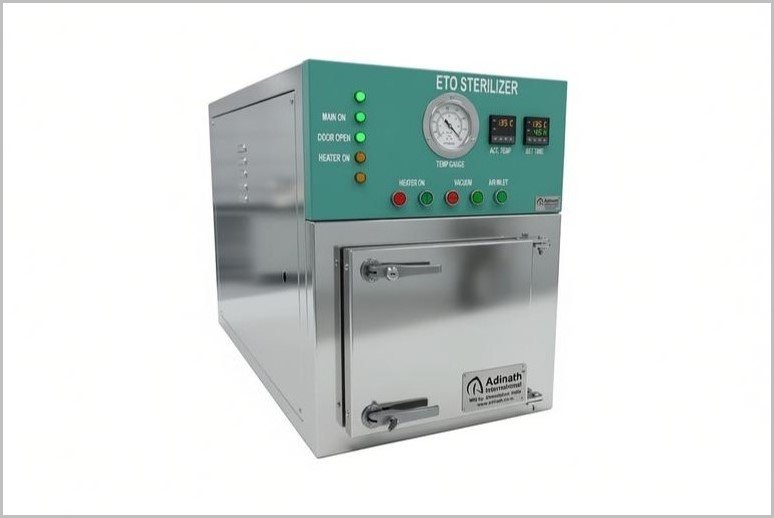
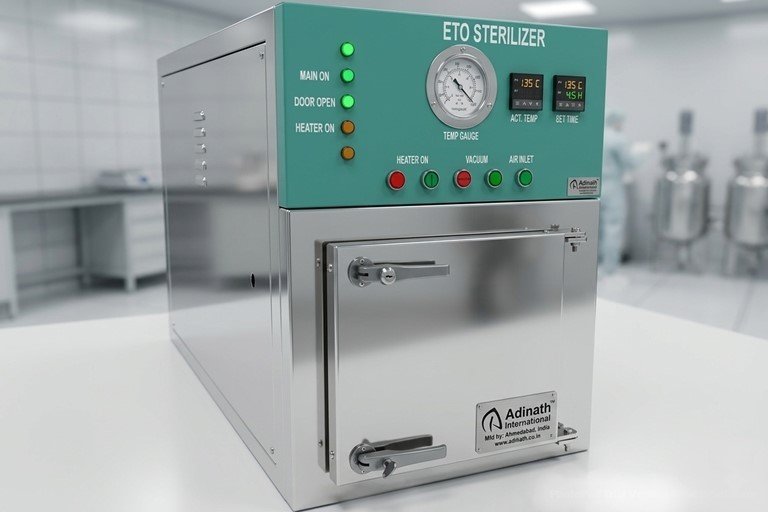
An ethylene oxide sterilizer, commonly known as an EO sterilizer, is a specialized low-temperature sterilization system that uses ethylene oxide (EO) gas to achieve complete microbial destruction on heat- or moisture-sensitive materials. This highly effective antimicrobial process penetrates complex packaging, lumens, and intricate surfaces to eliminate bacteria, viruses, fungi, and resistant spores, consistently delivering a Sterility Assurance Level (SAL) of 10⁻⁶ — the industry benchmark for medical devices.
Ethylene oxide sterilization operates at low temperatures, typically between 37°C and 63°C, making it the preferred method for materials that cannot withstand the high heat and pressure of steam autoclaves. Its compatibility with a wide range of materials, including plastics, polymers, electronics, and delicate assemblies, makes EO sterilizers essential in modern healthcare and pharmaceutical manufacturing.
Regulations and Safety
System Overview & Core Mechanisms
Step-by-Step Cycle Phases
Model | AETOS – 2.6 | AETOS – 4.5 | AETOS – 8 |
Working Capacity in Cu. Ft. | 2.6 | 4.5 | 8 |
Working Volume | 70 Liters | 125 Liters | 200 Liters |
Chamber Size | 12” (W) x 12” (H) x 32”
| 12” (W) x 12” (H) x 54” (D) OR 15” (W) x 15” (H) x 36” (D) | 20” (W) x 18” (H) x 38” (D) OR 16” (W) x 16” (H) x 54” (D) |
Sterilant Gas | 40 grams cartridge | 100 grams cartridge | 170 grams cartridge |
Sterilization Cycle | Warm & Cold Cycles are possible. | Warm & Cold Cycles are possible. | Warm & Cold Cycles are possible. |
Aeration | In-built aeration facility provided. | In-built aeration facility provided. | In-built aeration facility provided. |
Utility | Compressed Air (100 psig) | Compressed Air (100 psig) | Compressed Air (100 psig) |
Power Supply | 1 K.W. | 2 K.W. | 2.5 K.W. |
Power Voltage | 220 volts, Single Phase, 50 Hertz | 220 volts, Single Phase, 50 Hertz | 220 volts, Single Phase, 50 Hertz |
* Power voltage can be adjusted as per customer’s domestic power voltage requirements.
* Rights of technical improvements & modification reserved.
* Illustrations & dimensions are shown for information purpose only.
An ethylene oxide sterilizer is a low-temperature sterilization system that uses EO gas to destroy bacteria, viruses, fungi, and resistant spores on heat- or moisture-sensitive materials. It achieves a Sterility Assurance Level (SAL) of 10⁻⁶ by penetrating complex packaging, lumens, and intricate surfaces. The process typically operates between 37°C and 63°C (often around 50–55°C).
EO sterilization is preferred for materials that cannot withstand the high heat and pressure of steam autoclaves. It is compatible with plastics, polymers, electronics, and delicate assemblies, making it essential for medical devices and pharmaceutical manufacturing where device integrity must be preserved.
The cycle generally includes three phases:
It is ideal for single-use healthcare items such as hypodermic injection tools, intravenous lines, clinical drape kits, protective gloves, fluid administration sets, urinary collection pouches, contraceptive devices, and other diagnostic or therapeutic gear. It is also suitable for plastics, rubbers, electronics, and multi-layered or wrapped items.
Internal surfaces and product-contact components are made from premium stainless steel (SS 304 and SS 316). Models feature a sectional, flexible chamber design, single-door configuration with a reliable locking mechanism, electronically managed heating, a high-capacity venturi system, and physical push-button controls. Full IQ, OQ, and DQ documentation packages are available.
Common models include AETOS – 2.6 (≈70 liters / 2.6 cu. ft.), AETOS – 4.5 (≈125 liters / 4.5 cu. ft.), and AETOS – 8 (≈200 liters / 8 cu. ft.). They use disposable EO cartridges (40g, 100g, or 170g), support warm and cold cycles, include in-built aeration, require compressed air (100 psig), and operate on 220 V single-phase power (power ratings from 1 kW to 2.5 kW; voltage can be adjusted).
The systems use disposable EtO cartridges of different capacities. A vacuum is drawn before gas injection, temperature is maintained (typically around 50°C), and residual gas is removed via continuous vacuum followed by fresh-air purging during the aeration phase.
These sterilizers are widely applied in the pharmaceutical, nutraceutical, herbal, Ayurvedic, biotech, cosmetic, and chemical industries for sterilizing heat-sensitive products and devices.
Key benefits include excellent material compatibility (safe for heat-sensitive plastics and electronics), strong penetration power for wrapped or complex items, preservation of device functionality and integrity, high throughput for large volumes of sensitive devices, and consistent achievement of SAL 10⁻⁶.
Alternatives include vaporized hydrogen peroxide (VHP) for faster cycles with lower toxicity, radiation (gamma or electron beam) for dense materials, chlorine dioxide gas for heat-sensitive items, and steam or dry heat for non-sensitive devices. EO remains the method of choice when deep penetration and compatibility with complex or heat-labile medical devices are required.
More Sterilization Equipments
 4 CFT Ethylene Oxide Sterilizer
 Cath Lab Ethylene Oxide Gas Sterilizer
 Ethylene Oxide Cylindrical Sterilizer
 Ethylene Oxide Gas Sterilizer
Algeria | Angola | Argentina | Australia | Austria | Bahrain | Bangladesh | Belarus | Belgium | Bolivia | Botswana | Brazil | Bulgaria | Canada | Chile | China | Colombia | Costa Rica | Cuba | Czech Republic | Denmark | Dominican Republic | Ecuador | Egypt | El Salvador | Ethiopia | Finland | France | Germany | Ghana | Greece | Guatemala | Haiti | Honduras | Hong Kong | Hungary | India | Indonesia | Iran | Ireland | Israel | Italy | Ivory Coast | Japan | Jordan | Kazakhstan | Kenya | Kuwait | Lebanon | Libya | Malaysia | Mexico | Mongolia | Morocco | Mozambique | Myanmar | Netherlands | New Zealand | Nicaragua | Nigeria | Norway | Oman | Pakistan | Panama | Paraguay | Peru | Philippines | Poland | Portugal | Qatar | Romania | Russia | Saudi Arabia | Senegal | Slovakia | Singapore | South Africa | South Korea | South Sudan | Spain | Sri Lanka | Sweden | Switzerland | Taiwan | Tanzania | Thailand | Trinidad and Tobago | Tunisia | Turkey | Uganda | Ukraine | United Arab Emirates | United Kingdom | United States | Uruguay | Uzbekistan | Venezuela | Vietnam | Zambia | Zimbabwe
Connect with our engineering team to discuss your specific production requirements. We provide customized, cGMP-compliant machinery solutions designed to optimize your manufacturing facility and maximize output.
©Adinath International | Theme Developed By Pharma Machinery Manufacturer I Website updated on: 23 October 2026
Request A Quick Quote
Ethylene Oxide Sterilizer
Please drop your requirements, one of our technical expert will contact you in next 24 working hours.
WhatsApp us
