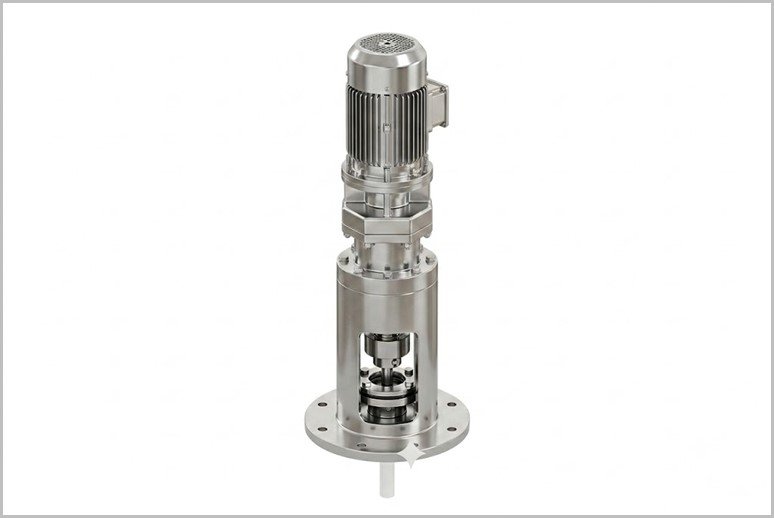
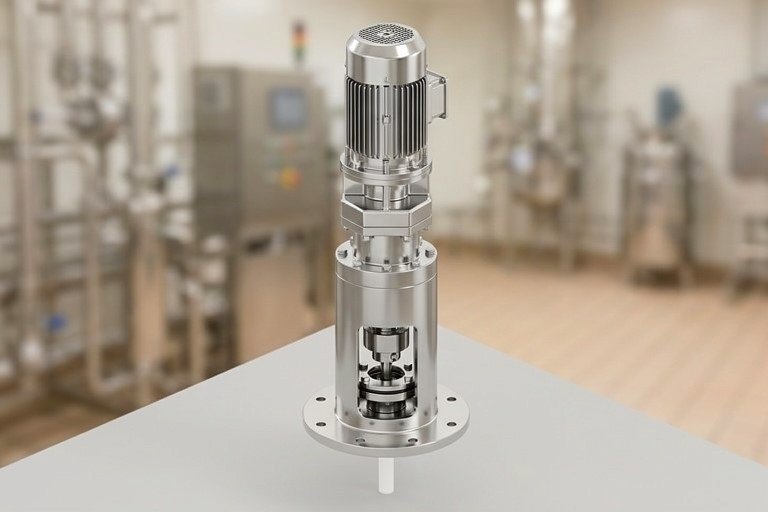
An industrial liquid agitator—frequently referred to as an industrial mixer, fluid stirrer, or tank agitator—is a heavy-duty mechanical system engineered to blend, mix, homogenize, or agitate liquids combined with solids or gases within large industrial vessels and storage tanks. At its core, the system operates via an electric motor that drives a rotating shaft equipped with an engineered impeller (a configuration of specialized blades). This assembly imparts precise kinetic energy into the fluid medium, establishing vital flow dynamics such as axial flow (vertical up/down circulation), radial flow (horizontal outward dispersion), or high-intensity turbulent shear.
Deploying the correct agitator configuration prevents particle settling, ensures total batch uniformity, maximizes thermal distribution for optimal heat transfer, and accelerates complex chemical reactions. These systems form the backbone of modern processing facilities where operational efficiency, safety compliance, and repeatable product quality are non-negotiable.
Optimizing Equipment Selection: An Expert Engineering Approach
Choosing the optimal industrial liquid agitator demands a rigorous evaluation of variable process parameters to avoid costly downtime, mechanical failure, or sub-par batch performance:
An industrial liquid agitator (also called an industrial mixer, fluid stirrer, or tank agitator) is a heavy-duty mechanical system designed to blend, mix, homogenize, or agitate liquids—often combined with solids or gases—inside large industrial vessels and storage tanks. It uses an electric motor that drives a rotating shaft fitted with an engineered impeller to create controlled flow patterns.
An electric motor rotates a shaft equipped with specialized impeller blades. This imparts kinetic energy into the liquid, generating axial flow (vertical circulation), radial flow (horizontal dispersion), or high-intensity turbulent shear. The resulting flow dynamics ensure uniform mixing, prevent particle settling, improve heat transfer, and accelerate chemical reactions.
Key parameters include fluid viscosity and density (Newtonian vs. non-Newtonian), tank geometry and scale, and the primary process objective (solid suspension, chemical blending, gas dispersion, or heat transfer). Correct selection prevents downtime, mechanical failure, and inconsistent batch quality.
It offers custom-designed blades and shafts, power capacity matched to viscosity, flameproof or non-flameproof enclosures, multiple impeller types (paddle, anchor, propeller, turbine, etc.), flexible mounting options (top, side, or bottom entry), and sealing systems ranging from simple retainers to double mechanical seals.
All product-contact parts are fabricated from SS 304, SS 316, or SS 316L stainless steel for excellent hygiene, corrosion resistance, and compliance with pharmaceutical and food-grade standards.
The agitators are manufactured in a wide capacity range from 10 liters to 50,000 liters, making them suitable for both small-scale laboratory or pilot plants and large industrial production vessels.
It is widely applied in the pharmaceutical, nutraceutical, herbal, Ayurvedic, biotech, cosmetic, and chemical industries for processes requiring reliable liquid mixing, blending, dissolution, dispersion, homogenization, or emulsification.
A wide selection of impeller types is offered, including paddle, anchor, propeller, turbine, and other specialized designs. The impeller is chosen based on fluid properties and process goals to achieve the desired axial, radial, or mixed flow pattern.
Yes. The agitators are designed to adapt to any vessel shape and can be supplied with or without bottom support. Mounting options include top-entry, side-entry, or bottom-entry configurations to suit specific tank designs and process needs.
It ensures complete batch uniformity, prevents particle settling, maximizes thermal distribution for efficient heat transfer, accelerates chemical reactions, handles low to high viscosity liquids and suspensions, and delivers hygienic, reliable performance suitable for cGMP-regulated industries.
Algeria | Angola | Argentina | Australia | Austria | Bahrain | Bangladesh | Belarus | Belgium | Bolivia | Botswana | Brazil | Bulgaria | Canada | Chile | China | Colombia | Costa Rica | Cuba | Czech Republic | Denmark | Dominican Republic | Ecuador | Egypt | El Salvador | Ethiopia | Finland | France | Germany | Ghana | Greece | Guatemala | Haiti | Honduras | Hong Kong | Hungary | India | Indonesia | Iran | Ireland | Israel | Italy | Ivory Coast | Japan | Jordan | Kazakhstan | Kenya | Kuwait | Lebanon | Libya | Malaysia | Mexico | Mongolia | Morocco | Mozambique | Myanmar | Netherlands | New Zealand | Nicaragua | Nigeria | Norway | Oman | Pakistan | Panama | Paraguay | Peru | Philippines | Poland | Portugal | Qatar | Romania | Russia | Saudi Arabia | Senegal | Slovakia | Singapore | South Africa | South Korea | South Sudan | Spain | Sri Lanka | Sweden | Switzerland | Taiwan | Tanzania | Thailand | Trinidad and Tobago | Tunisia | Turkey | Uganda | Ukraine | United Arab Emirates | United Kingdom | United States | Uruguay | Uzbekistan | Venezuela | Vietnam | Zambia | Zimbabwe
Connect with our engineering team to discuss your specific production requirements. We provide customized, cGMP-compliant machinery solutions designed to optimize your manufacturing facility and maximize output.
©Adinath International | Theme Developed By Pharma Machinery Manufacturer I Website updated on: 15 October 2026
Request A Quick Quote
Industrial Liquid Agitator
Please drop your requirements, one of our technical expert will contact you in next 24 working hours.
WhatsApp us


