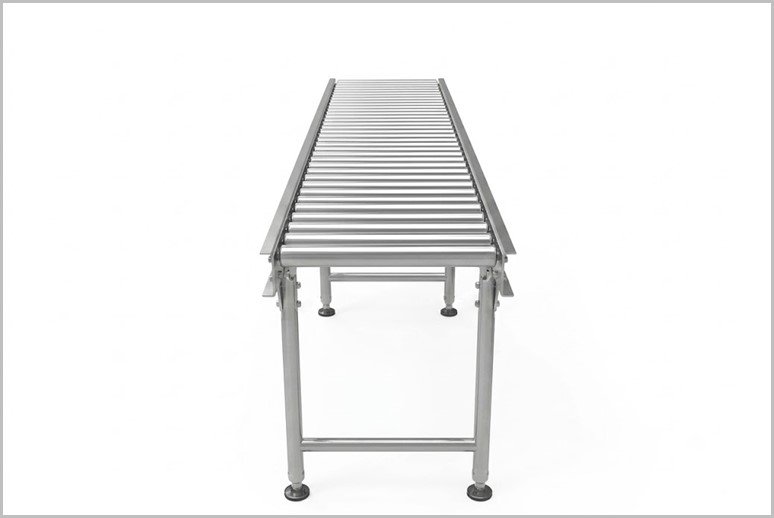
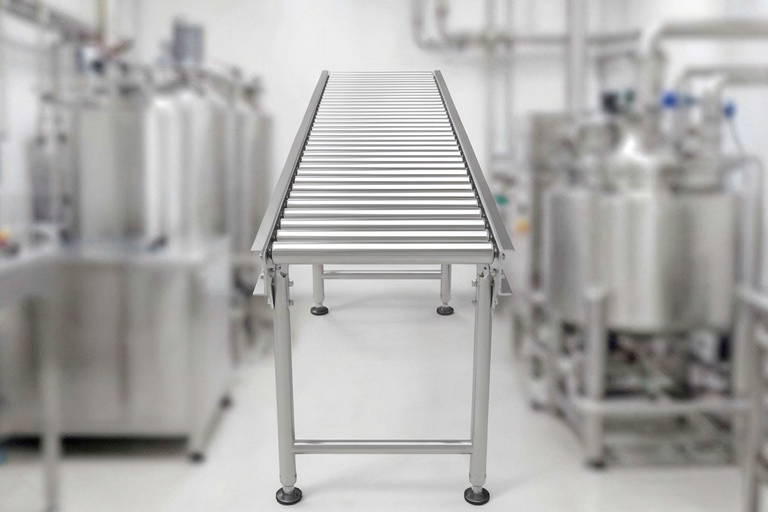
An impact gravity roller conveyor refers to a specialized non-powered material handling system engineered explicitly to endure high-impact loading and unloading cycles. Unlike standard retail or lightweight packaging lines, these rugged configurations are built for demanding environments like industrial shipping and receiving docks, freight terminals, and heavy manufacturing floors. In these high-throughput zones, heavy packages, bulky steel drums, raw automotive components, and wooden pallets are routinely dropped, shoved, or abruptly forced onto the conveyor surface.
How Impact-Resistant Gravity Systems Work
Standard gravity roller conveyors utilize natural gravitational force or manual pushing energy across a slight structural incline to move flat-bottomed products smoothly. However, when subjected to sudden shock loads—such as a heavy crate dropped from a forklift or a dense pallet shoved aggressively forward—standard-duty components fail rapidly.
An impact gravity roller conveyor mitigates this stress through heavy-duty structural design. The system absorbs localized shock energy without warping the frame, bending axles, or seizing internal precision bearings. By distributing sudden loads uniformly across multiple reinforced contact points, these systems maintain structural integrity even under punishing, repetitive industrial workflows.
Electrical Load | Depends upon the length of conveyor belt. |
Height | 815 mm with 75 mm Adjustable Height. |
Width | Table Top of 12 Working Space on both side of the conveyor Belt. |
* Power voltage can be adjusted as per customer’s domestic power voltage requirements.
* Rights of technical improvements & modification reserved.
* Illustrations & dimensions are shown for information purpose only.
An Impact Gravity Roller Conveyor is a specialized non-powered material handling system designed to withstand high-impact loading and unloading. It is built for demanding industrial environments where heavy packages, steel drums, automotive components, or wooden pallets are frequently dropped, shoved, or forced onto the conveyor surface.
It uses natural gravitational force or manual pushing across a slight incline to move flat-bottomed products. Heavy-duty construction absorbs sudden shock loads by distributing energy across multiple reinforced contact points, preventing frame warping, axle bending, or bearing damage.
Standard gravity conveyors work well for lighter packaging but fail under repeated high-impact loads. Impact versions feature reinforced frames, stronger rollers, and self-aligning bearings that maintain structural integrity during aggressive industrial use such as forklift drops or heavy pallet handling.
The structure is typically made from S.S. 304 or M.S. 32 mm square pipe (matt finish or painted). The table top uses S.S. 304 16-gauge sheet with a matt finish. Special self-aligning bearings ensure smooth, trouble-free roller rotation.
It is suitable for pharmaceutical, nutraceutical, herbal, Ayurvedic, biotech, cosmetic, and chemical industries, as well as industrial shipping docks, freight terminals, and heavy manufacturing floors that handle robust materials.
Yes. It is available in stainless steel (S.S.) or mild steel (M.S.) models and can be supplied according to the required length, height, and width to match specific facility layouts and load conditions.
Standard height is approximately 815 mm with ±75 mm adjustability. The table top provides working space on both sides of the conveyor for operator access and material handling.
Reinforced contact points and heavy-duty design distribute shock energy evenly across the frame and rollers. This prevents localized stress that would otherwise warp the structure or seize bearings under repetitive high-impact cycles.
No. It is a non-powered (gravity) system that relies on incline and manual force for product movement, making it energy-efficient and suitable for environments where powered conveyors may not be ideal or necessary.
Key benefits include durability under high-impact conditions, reduced maintenance from shock-resistant design, flexibility in length/height/width, suitability for heavy industrial loads, and reliable performance in demanding shipping, receiving, and manufacturing applications.
More Other Machines
 Flexible Moving Gravity Roller Conveyor
 Gravity Roller Conveyor
 Drive Roller Conveyor
 Bucket Conveyor
Algeria | Angola | Argentina | Australia | Austria | Bahrain | Bangladesh | Belarus | Belgium | Bolivia | Botswana | Brazil | Bulgaria | Canada | Chile | China | Colombia | Costa Rica | Cuba | Czech Republic | Denmark | Dominican Republic | Ecuador | Egypt | El Salvador | Ethiopia | Finland | France | Germany | Ghana | Greece | Guatemala | Haiti | Honduras | Hong Kong | Hungary | India | Indonesia | Iran | Ireland | Israel | Italy | Ivory Coast | Japan | Jordan | Kazakhstan | Kenya | Kuwait | Lebanon | Libya | Malaysia | Mexico | Mongolia | Morocco | Mozambique | Myanmar | Netherlands | New Zealand | Nicaragua | Nigeria | Norway | Oman | Pakistan | Panama | Paraguay | Peru | Philippines | Poland | Portugal | Qatar | Romania | Russia | Saudi Arabia | Senegal | Slovakia | Singapore | South Africa | South Korea | South Sudan | Spain | Sri Lanka | Sweden | Switzerland | Taiwan | Tanzania | Thailand | Trinidad and Tobago | Tunisia | Turkey | Uganda | Ukraine | United Arab Emirates | United Kingdom | United States | Uruguay | Uzbekistan | Venezuela | Vietnam | Zambia | Zimbabwe
Connect with our engineering team to discuss your specific production requirements. We provide customized, cGMP-compliant machinery solutions designed to optimize your manufacturing facility and maximize output.
©Adinath International | Theme Developed By Pharma Machinery Manufacturer I Website updated on: 15 October 2026
Request A Quick Quote
Impact Gravity Roller Conveyor
Please drop your requirements, one of our technical expert will contact you in next 24 working hours.
WhatsApp us
