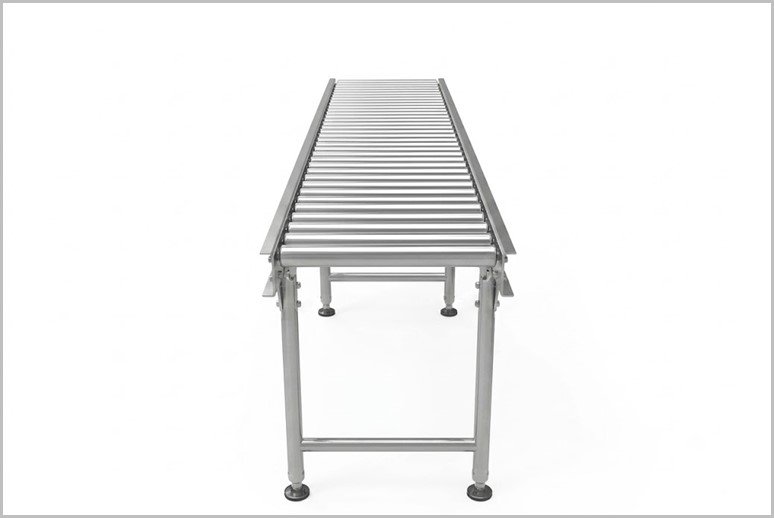
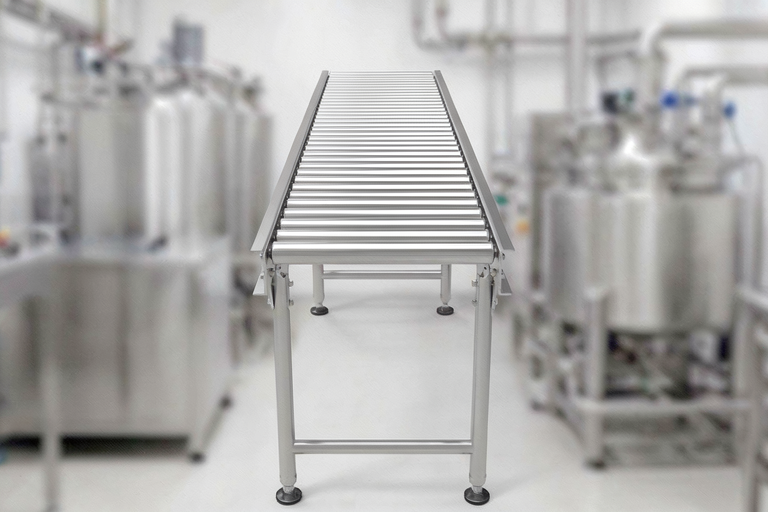
In the fast-paced world of modern industrial logistics, optimizing internal transport is essential for maintaining a competitive edge. A gravity roller conveyor is a non-powered material handling system engineered to transport products efficiently using the natural force of gravity. By utilizing a series of freely rotating rollers precisely mounted within a durable structural frame, these systems allow items to glide smoothly along a slight incline or via manual momentum.
Unlike complex powered belt or roller configurations, a traditional gravity conveyor requires no electricity, motors, or automated drives. This inherent simplicity establishes it as one of the most cost-effective, reliable, and versatile material handling solutions available for distribution centers, shipping and receiving docks, assembly floors, and manufacturing facilities.
Conclusion
How It Works
Electrical Load | Depends upon the length of conveyor belt. |
Height | 815 mm with 75 mm Adjustable Height. |
Width | Table Top of 12 Working Space on both side of the conveyor Belt. |
* Power voltage can be adjusted as per customer’s domestic power voltage requirements.
* Rights of technical improvements & modification reserved.
* Illustrations & dimensions are shown for information purpose only.
A gravity roller conveyor is a non-powered material handling system that transports products using the natural force of gravity. It features freely rotating rollers mounted in a durable structural frame, allowing items to glide smoothly along a slight incline or with manual momentum.
The conveyor frame is typically installed at a slight decline (pitch) so gravity pulls items downhill. Products with firm, flat bottoms (such as cartons, boxes, totes, skids, drums, or pallets) roll smoothly over the rollers. For horizontal movement, items can be manually pushed. Rollers are spaced on centers and commonly come in diameters like 1.5″ or 1.9″ (or larger for heavier loads).
Key benefits include low cost with easy installation and maintenance, energy efficiency (no power needed for declined setups), versatility across straight sections, curves, and spurs, support for light to heavy loads, and higher capacity than skatewheel conveyors—making it suitable even for uneven or open-bottom items like pallets.
It is widely applied in the pharmaceutical, nutraceutical, herbal, Ayurvedic, biotech, cosmetic, and chemical industries, as well as in distribution centers, shipping and receiving docks, assembly floors, and manufacturing facilities.
Models are available in S.S. (stainless steel) or M.S. (mild steel). The structure is typically made of S.S. 304 or M.S. 32 mm square pipe with a matt finish or painted surface. Special self-aligning bearings ensure smooth, trouble-free roller rotation.
Yes. It is available according to required speed, length, height, and width. Height is typically 815 mm with 75 mm adjustable height, and other dimensions can be tailored. Power voltage (if any auxiliary elements are involved) can also be adjusted to match domestic requirements.
It is ideal for products with firm, flat bottoms such as cartons, boxes, totes, skids, drums, and even pallets. It handles a range of light to heavy loads and performs better than skatewheel conveyors for uneven or open-bottom items.
No. Unlike powered belt or roller systems, a traditional gravity roller conveyor requires no electricity, motors, or automated drives for declined setups. This simplicity makes it one of the most cost-effective and reliable material handling solutions. Horizontal movement relies on manual pushing.
Standard height is 815 mm with 75 mm adjustable height. Width details reference a table top providing working space on both sides (specifics can be customized). Electrical load, if applicable, depends on the length of any associated conveyor elements. Dimensions and illustrations are provided for reference and may be modified.
It is a timeless, highly efficient asset that optimizes workflow and reduces overhead expenses by capitalizing on simple physics. These non-powered systems deliver robust performance, unmatched durability, and exceptional flexibility—whether upgrading a shipping dock or designing a comprehensive warehouse layout—ensuring long-term productivity and operational excellence.
More Other Machines
 Flexible Moving Gravity Roller Conveyor
 Impact Gravity Roller Conveyor
 Drive Roller Conveyor
 Bucket Conveyor
Algeria | Angola | Argentina | Australia | Austria | Bahrain | Bangladesh | Belarus | Belgium | Bolivia | Botswana | Brazil | Bulgaria | Canada | Chile | China | Colombia | Costa Rica | Cuba | Czech Republic | Denmark | Dominican Republic | Ecuador | Egypt | El Salvador | Ethiopia | Finland | France | Germany | Ghana | Greece | Guatemala | Haiti | Honduras | Hong Kong | Hungary | India | Indonesia | Iran | Ireland | Israel | Italy | Ivory Coast | Japan | Jordan | Kazakhstan | Kenya | Kuwait | Lebanon | Libya | Malaysia | Mexico | Mongolia | Morocco | Mozambique | Myanmar | Netherlands | New Zealand | Nicaragua | Nigeria | Norway | Oman | Pakistan | Panama | Paraguay | Peru | Philippines | Poland | Portugal | Qatar | Romania | Russia | Saudi Arabia | Senegal | Slovakia | Singapore | South Africa | South Korea | South Sudan | Spain | Sri Lanka | Sweden | Switzerland | Taiwan | Tanzania | Thailand | Trinidad and Tobago | Tunisia | Turkey | Uganda | Ukraine | United Arab Emirates | United Kingdom | United States | Uruguay | Uzbekistan | Venezuela | Vietnam | Zambia | Zimbabwe
Connect with our engineering team to discuss your specific production requirements. We provide customized, cGMP-compliant machinery solutions designed to optimize your manufacturing facility and maximize output.
©Adinath International | Theme Developed By Pharma Machinery Manufacturer I Website updated on: 15 October 2026
Request A Quick Quote
Gravity Roller Conveyor
Please drop your requirements, one of our technical expert will contact you in next 24 working hours.
WhatsApp us
