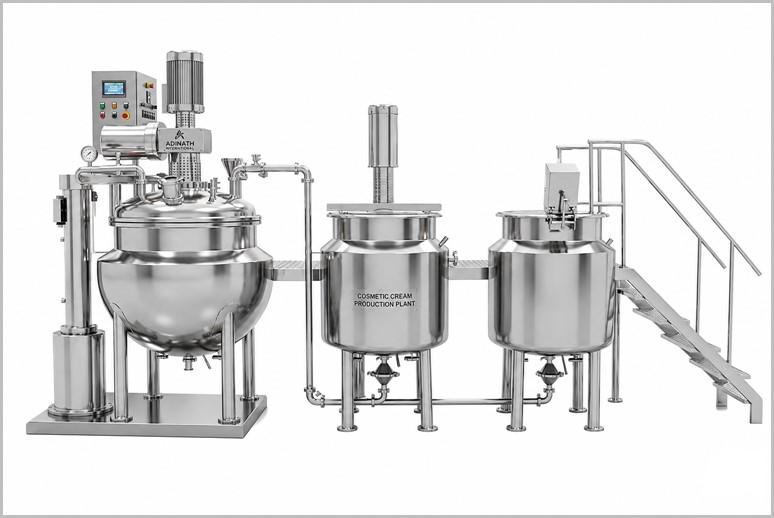
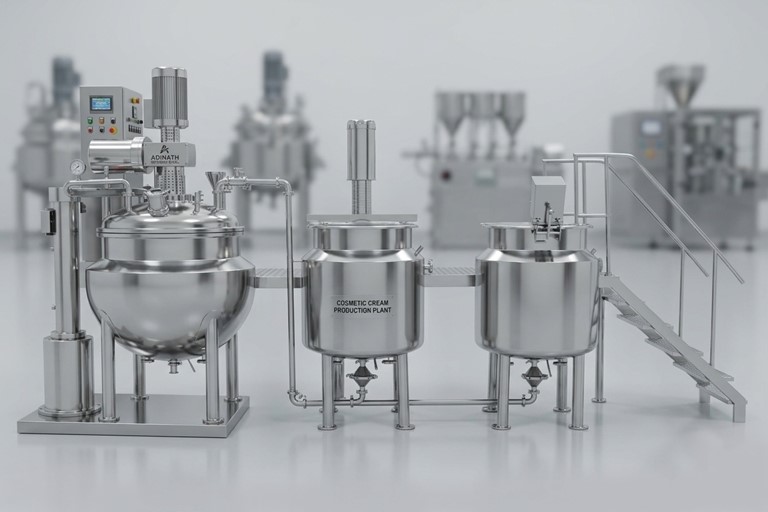
Cream Manufacturing Plant are specialized industrial facilities designed for producing semi-solid emulsion products, primarily in the pharmaceutical, cosmetic, and personal care industries. These plants are used to manufacture items such as ointments, creams, lotions, gels, toothpastes, shampoos, and similar high-viscosity products. They ensure high-quality output by minimizing human handling, maintaining vacuum during mixing to prevent air incorporation, and adhering to cGMP standards for hygiene and consistency.
These plants are typically automated or semi-automated, with capacities ranging from small batches (e.g., 5–20 kg) for R&D to large-scale production (up to 10,000 kg or more). They incorporate features like stainless steel construction for corrosion resistance, CIP systems for easy cleaning, and optional PLC/SCADA controls for automation.
If you need details on specific models and pricing, let me know!
The process follows a three-phase approach to create stable emulsions:
The entire process is designed for minimal vacuum drop and man-handling, reducing contamination risks. Batch times vary but typically take 2–4 hours per cycle.

* Power voltage can be adjusted as per customer’s domestic power voltage requirements.
* Rights of technical improvements & modification reserved.
* Illustrations & dimensions are shown for information purpose only.
A Cream Manufacturing Plant is a specialized industrial system designed for producing high-quality semi-solid emulsions such as creams, ointments, lotions, gels, and similar products. It is widely used in the pharmaceutical, cosmetic, and personal care industries. The plant ensures consistent quality through vacuum mixing, precise temperature control, and minimal manual handling while meeting cGMP standards.
The process involves preparing water-based and oil/wax phases in separate vessels, then transferring them under vacuum into the main manufacturing vessel. High-shear emulsifiers and homogenizers blend the phases to achieve fine droplet size (<5 microns). The mixture is cooled while stirring, passed through a colloid mill if needed, and transferred to storage for filling. The closed system minimizes air incorporation and contamination.
It is ideal for the Pharmaceutical, Cosmetic, Ayurvedic, Herbal, Nutraceutical, and Biotech industries. It is suitable for manufacturing medicated creams, moisturizers, gels, toothpastes, shampoos, and other high-viscosity topical or personal care products.
More Manufacturing Plants
 Alkyd Resin Manufacturing Plant
 Cosmetic Cream Production Plant
 Cosmetic Manufacturing Plant
 Cream Preparation Plant
Algeria | Angola | Argentina | Australia | Austria | Bahrain | Bangladesh | Belarus | Belgium | Bolivia | Botswana | Brazil | Bulgaria | Canada | Chile | China | Colombia | Costa Rica | Cuba | Czech Republic | Denmark | Dominican Republic | Ecuador | Egypt | El Salvador | Ethiopia | Finland | France | Germany | Ghana | Greece | Guatemala | Haiti | Honduras | Hong Kong | Hungary | India | Indonesia | Iran | Ireland | Israel | Italy | Ivory Coast | Japan | Jordan | Kazakhstan | Kenya | Kuwait | Lebanon | Libya | Malaysia | Mexico | Mongolia | Morocco | Mozambique | Myanmar | Netherlands | New Zealand | Nicaragua | Nigeria | Norway | Oman | Pakistan | Panama | Paraguay | Peru | Philippines | Poland | Portugal | Qatar | Romania | Russia | Saudi Arabia | Senegal | Slovakia | Singapore | South Africa | South Korea | South Sudan | Spain | Sri Lanka | Sweden | Switzerland | Taiwan | Tanzania | Thailand | Trinidad and Tobago | Tunisia | Turkey | Uganda | Ukraine | United Arab Emirates | United Kingdom | United States | Uruguay | Uzbekistan | Venezuela | Vietnam | Zambia | Zimbabwe
Connect with our engineering team to discuss your specific production requirements. We provide customized, cGMP-compliant machinery solutions designed to optimize your manufacturing facility and maximize output.
©Adinath International | Theme Developed By Pharma Machinery Manufacturer I Website updated on: 15 October 2026
Request A Quick Quote
Cream Manufacturing Plant
Please drop your requirements, one of our technical expert will contact you in next 24 working hours.
WhatsApp us
