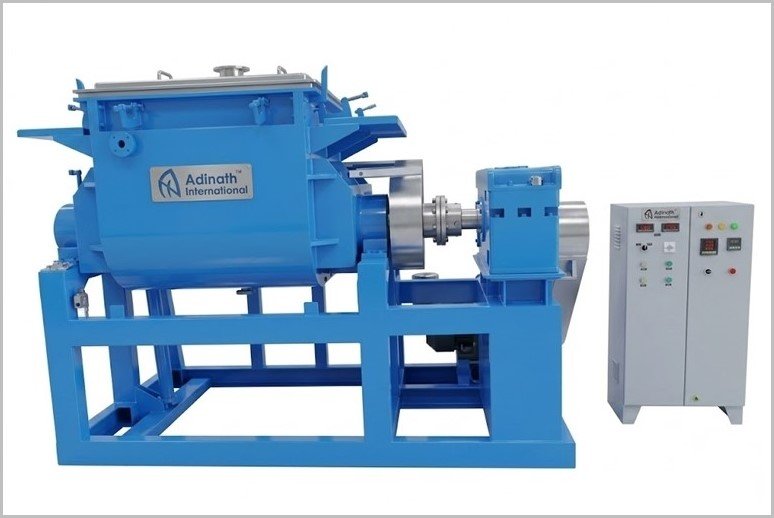
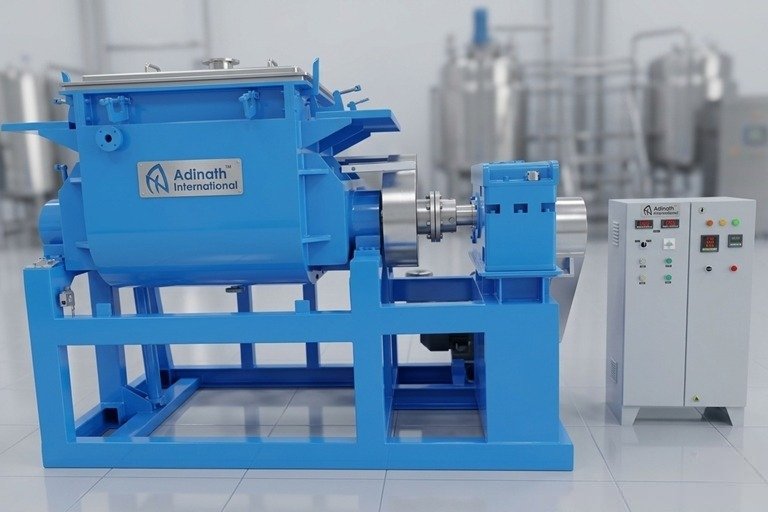
The Bubble Gum Sigma Mixer Hydraulic Kneading Machine is a strong, heavy-duty industrial mixer designed specifically for handling high-viscosity, elastic-plastic materials in the confectionery industry. It is ideal for mixing bubble gum base, chewing gum base, and other rubber-like substances. This sigma mixer performs exceptionally well with natural chicle, which is latex from the sapodilla tree, synthetic elastomers, flavorings, sweeteners, and other additives.
This machine is built for even mixing and thorough kneading, ensuring a consistent texture, smooth blending, and uniform consistency — all crucial for creating high-quality gum products such as center-filled bubble gum, chicklets-style chewing gum, sugar-coated gums, and extruded gum sticks.
Whether you’re making traditional chewing gum or newer bubble gum types, this hydraulic kneading machine provides dependable and efficient mixing. It helps improve product quality, cut down on processing time, and boost overall production efficiency for confectionery manufacturers.
Tailored for use in bubble gum production lines, the Bubble Gum Sigma Mixer Hydraulic Kneading Machine is the go-to choice for achieving top-quality results in every batch.
The machine operates on a double-arm kneader principle:
Working Principle & Mixing Action
Tangential Blade Configuration
Overlapping Blade Configuration
Model | Capacity – Liters | Motor (H.P.) | ||
Working Capacity approx. | Gross Capacity approx. | General | Heavy Duty | |
ASM – 50 | 50 Liters | 80 Liters | 5 H.P. | 7.5 H.P. |
ASM – 75 | 75 Liters | 110 Liters | 7.5 H.P. | 10 H.P. |
ASM – 100 | 100 Liters | 150 Liters | 10 H.P. | 15 H.P. |
ASM – 150 | 150 Liters | 200 Liters | 15 H.P. | 20 H.P. |
ASM – 200 | 200 Liters | 300 Liters | 20 H.P. | 25 H.P. |
ASM – 400 | 400 Liters | 550 Liters | 30 H.P. | 40 H.P. |
ASM – 500 | 500 Liters | 750 Liters | 40 H.P. | 50 H.P. |
ASM – 750 | 750 Liters | 1150 Liters | 50 H.P. | 60 H.P. |
ASM – 1000 | 1000 Liters | 1500 Liters | 60 H.P. | 70 H.P. |
ASM – 1500 | 1500 Liters | 2100 Liters | 75 H.P. | 80 H.P. |
ASM – 2000 | 2000 Liters | 2600 Liters | 80 H.P. | 90 H.P. |
ASM – 3000 | 3000 Liters | 3800 Liters | 100 H.P. | 120 H.P. |
* Power voltage can be adjusted as per customer’s domestic power voltage requirements.
* Rights of technical improvements & modification reserved.
* Illustrations & dimensions are shown for information purpose only.
It is a heavy-duty industrial mixer designed specifically for handling high-viscosity, elastic-plastic materials in the confectionery industry. It is ideal for mixing bubble gum base, chewing gum base, natural chicle (latex from the sapodilla tree), synthetic elastomers, flavorings, sweeteners, and other additives to produce consistent-texture products such as center-filled bubble gum, chicklets-style chewing gum, sugar-coated gums, and extruded gum sticks.
Two counter-rotating Z-shaped (sigma) blades operate at differential speeds (typically a 3:2 ratio in the tangential design). This creates strong shearing, stretching, folding, and kneading forces that transfer material between the blades, eliminate dead zones, and deliver even mixing with minimal gaps between the blades and trough walls for optimal performance.
The mixer is available in Stainless Steel 316, Stainless Steel 304, and Mild Steel. Stainless-steel versions can be finished to matt or mirror polish as required. Mild-steel units receive one coat of red oxide primer followed by two coats of epoxy paint. PTFE shaft sealing is provided for food-grade compatibility.
Models range from ASM-50 (approx. 50 L working / 80 L gross capacity) to ASM-3000 (approx. 3000 L working / 3800 L gross capacity). Motor power is available in both general and heavy-duty ratings, with voltage adjustable to local power supply requirements.
Discharge can be performed manually via a hand-wheel-operated mechanism or automatically via a hydraulic tilting system that allows complete emptying of the trough and simplifies cleaning. Additional options include screw extrusion or a bottom ball/automatic valve for controlled or high-volume product removal.
Yes. A jacket for heating or cooling can be fitted, complete with mineral-wool insulation and cladding. Heating options include electric, steam, or circulating hot oil, while cooling is achieved with circulating water—important for managing process temperatures and post-mixing stages.
Key features include precision-machined sigma blades that maintain minimal gaps with the trough walls, a robust U-shaped or trough-style chamber built from thick-gauge metal, a high-capacity motor and heavy-duty gearbox, safety guards and shaft seals, and a hydraulic tilting mechanism for efficient discharge of highly viscous, sticky gum bases.
Optional features include a liquid spray system, vacuum system, blades cooling arrangement, screw system, and automatic valve discharge system. These enhance process flexibility for adding flavors, removing air, or controlling product consistency.
In the tangential design (preferred for higher-viscosity materials such as gum bases), the blades meet tangentially and rotate at different speeds (usually 3:2), delivering intensive shearing and kneading. In the overlapping design, blades rotate at the same speed, provide faster material interchange, and produce lower shear—more suited to lighter-viscosity materials.
It delivers dependable, efficient mixing that improves product quality, reduces processing time, and boosts overall production efficiency. The combination of intense kneading action, food-grade construction, precise temperature control, and easy hydraulic discharge makes it ideal for both traditional chewing gum and modern bubble gum formulations in continuous production lines.
Algeria | Angola | Argentina | Australia | Austria | Bahrain | Bangladesh | Belarus | Belgium | Bolivia | Botswana | Brazil | Bulgaria | Canada | Chile | China | Colombia | Costa Rica | Cuba | Czech Republic | Denmark | Dominican Republic | Ecuador | Egypt | El Salvador | Ethiopia | Finland | France | Germany | Ghana | Greece | Guatemala | Haiti | Honduras | Hong Kong | Hungary | India | Indonesia | Iran | Ireland | Israel | Italy | Ivory Coast | Japan | Jordan | Kazakhstan | Kenya | Kuwait | Lebanon | Libya | Malaysia | Mexico | Mongolia | Morocco | Mozambique | Myanmar | Netherlands | New Zealand | Nicaragua | Nigeria | Norway | Oman | Pakistan | Panama | Paraguay | Peru | Philippines | Poland | Portugal | Qatar | Romania | Russia | Saudi Arabia | Senegal | Slovakia | Singapore | South Africa | South Korea | South Sudan | Spain | Sri Lanka | Sweden | Switzerland | Taiwan | Tanzania | Thailand | Trinidad and Tobago | Tunisia | Turkey | Uganda | Ukraine | United Arab Emirates | United Kingdom | United States | Uruguay | Uzbekistan | Venezuela | Vietnam | Zambia | Zimbabwe
Connect with our engineering team to discuss your specific production requirements. We provide customized, cGMP-compliant machinery solutions designed to optimize your manufacturing facility and maximize output.
©Adinath International | Theme Developed By Pharma Machinery Manufacturer I Website updated on: 15 October 2026
Request A Quick Quote
Bubble Gum Sigma Mixer Hydraulic Kneading Machine
Please drop your requirements, one of our technical expert will contact you in next 24 working hours.
WhatsApp us


