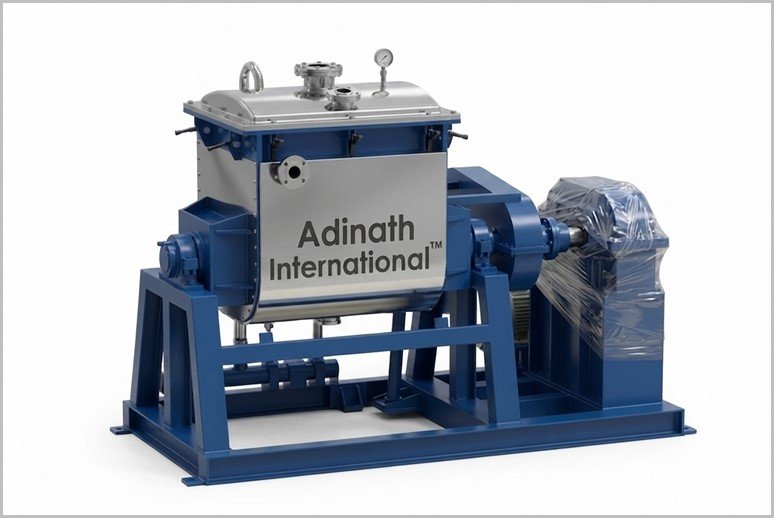
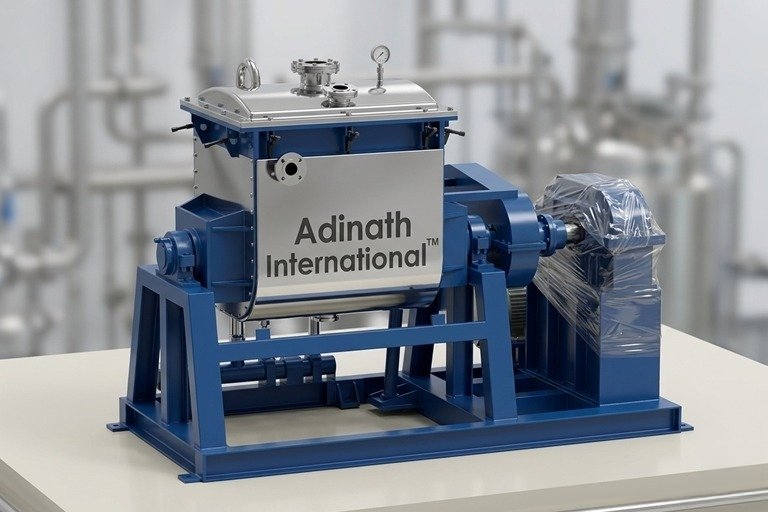
The Heavier Viscosity Mixer Rubber Compound Mixer, also known as a Sigma Kneader, Z Blade Mixer, or Double Arm Kneader Mixer, is the ideal equipment for mixing heavy viscosity rubber compounds. In rubber processing, compounding is a critical step that involves blending raw rubber (natural or synthetic) with various fillers such as carbon black and silica, processing oils, accelerators, vulcanizing agents, and other additives to create uniform, high-performance rubber materials.
This heavy-duty industrial mixer is specifically engineered to handle extremely viscous, sticky, and tough rubber compounds that standard mixers cannot process effectively. The Heavier Viscosity Mixer Rubber Compound Mixer delivers intensive shearing, kneading, and dispersive action necessary for achieving excellent filler dispersion and homogeneous batch quality.
Internal Mixing Mechanics & Thermal Sequences
Product Evacuation Pathways
Completed batches can be unloaded through three distinct ejection methods:
Rotor Architectures & Viscosity Matrix
Tangential Blade Layout
Overlapping Blade Layout
Model | Capacity – Liters | Motor (H.P.) | ||
Working Capacity approx. | Gross Capacity approx. | General | Heavy Duty | |
ASM – 50 | 50 Liters | 80 Liters | 5 H.P. | 7.5 H.P. |
ASM – 75 | 75 Liters | 110 Liters | 7.5 H.P. | 10 H.P. |
ASM – 100 | 100 Liters | 150 Liters | 10 H.P. | 15 H.P. |
ASM – 150 | 150 Liters | 200 Liters | 15 H.P. | 20 H.P. |
ASM – 200 | 200 Liters | 300 Liters | 20 H.P. | 25 H.P. |
ASM – 400 | 400 Liters | 550 Liters | 30 H.P. | 40 H.P. |
ASM – 500 | 500 Liters | 750 Liters | 40 H.P. | 50 H.P. |
ASM – 750 | 750 Liters | 1150 Liters | 50 H.P. | 60 H.P. |
ASM – 1000 | 1000 Liters | 1500 Liters | 60 H.P. | 70 H.P. |
ASM – 1500 | 1500 Liters | 2100 Liters | 75 H.P. | 80 H.P. |
ASM – 2000 | 2000 Liters | 2600 Liters | 80 H.P. | 90 H.P. |
ASM – 3000 | 3000 Liters | 3800 Liters | 100 H.P. | 120 H.P. |
* Power voltage can be adjusted as per customer’s domestic power voltage requirements.
* Rights of technical improvements & modification reserved.
* Illustrations & dimensions are shown for information purpose only.
The Double Arm Kneader Mixer comes with robust features tailored for demanding rubber compounding applications:
These capabilities make the Sigma Kneader the preferred choice for processing high-viscosity rubber compounds used in tires, automotive parts, industrial seals, conveyor belts, and technical rubber goods.
It is a heavy-duty industrial mixer (also called a Sigma Kneader, Z-Blade Mixer, or Double Arm Kneader Mixer) engineered specifically for blending extremely viscous, sticky, and tough rubber compounds. It mixes raw rubber (natural or synthetic) with fillers such as carbon black and silica, processing oils, accelerators, vulcanizing agents, and other additives to produce uniform, high-performance rubber materials with excellent filler dispersion.
Standard mixers cannot effectively process the high-viscosity, sticky nature of rubber compounds. This machine delivers intensive shearing, kneading, and dispersive action through specialized Z-profile blades, ensuring homogeneous batch quality and complete elimination of unmixed zones or residue.
Twin Sigma (‘Z’) pattern agitators rotate at differential speeds toward each other. This creates continuous counter-flow amalgamation involving mass displacement, elongation, folding, splitting, and re-fusion. Solid agglomerates are broken down by intense shear stress, tearing friction, and mechanical forces as the product rubs against the blades and trough walls.
Tangential blades (non-intersecting, typically 3:2 speed ratio) are ideal for heavy, high-viscosity rubber compounds, adhesives, and dense pigments, providing intensive kneading. Overlapping blades rotate at matched speeds for milder shear and are better suited to freer-flowing materials; they offer less intensive action than the tangential setup preferred for rubber.
The mixer is manufactured from high-grade SS 304, premium SS 316, or structural Mild Steel. Stainless steel surfaces can be finished in satin brushed or ultra-glossy mirror polish. Mild steel frames receive a red oxide primer coat plus two layers of epoxy paint for oxidation protection. PTFE shaft packings ensure sanitary, food-grade compatibility.
Models range from ASM-50 (approx. 50 L working / 80 L gross capacity) to ASM-3000 (approx. 3000 L working / 3800 L gross). Motor power varies by model and duty rating (general or heavy-duty), from 5 HP up to 120 HP. Voltage can be customized to local power requirements.
Optional temperature-control jackets allow external heating or chilling. Outer jackets are insulated with mineral wool and clad in protective metal sheeting. Blade cooling arrangements are also available. Automated sequences can switch from heating to chilling after the required process time, with pneumatic exhaust venting.
Completed batches can be unloaded by tilting the entire mixing trough (manual hand-wheel or automated hydraulic), draining through bottom-situated dump valves, or extruding via a lateral side-mounted screw mechanism. An automatic valve discharge system is also offered as an option.
Available options include liquid atomization spray systems, hermetically sealed vacuum processing chambers (to remove air and prevent oxidation), blade cooling arrangements, screw extruder systems, automatic valve discharge, variable-speed drives, and computerized controls. Micro-gaps between blades and the trough wall eliminate dead zones.
While optimized for heavy-viscosity rubber compounds, it is also widely applied in the pharmaceutical, nutraceutical, herbal, Ayurvedic, biotech, cosmetic, and chemical industries for handling high-viscosity, pasty, or semi-solid materials that require intensive kneading and dispersion.
Algeria | Angola | Argentina | Australia | Austria | Bahrain | Bangladesh | Belarus | Belgium | Bolivia | Botswana | Brazil | Bulgaria | Canada | Chile | China | Colombia | Costa Rica | Cuba | Czech Republic | Denmark | Dominican Republic | Ecuador | Egypt | El Salvador | Ethiopia | Finland | France | Germany | Ghana | Greece | Guatemala | Haiti | Honduras | Hong Kong | Hungary | India | Indonesia | Iran | Ireland | Israel | Italy | Ivory Coast | Japan | Jordan | Kazakhstan | Kenya | Kuwait | Lebanon | Libya | Malaysia | Mexico | Mongolia | Morocco | Mozambique | Myanmar | Netherlands | New Zealand | Nicaragua | Nigeria | Norway | Oman | Pakistan | Panama | Paraguay | Peru | Philippines | Poland | Portugal | Qatar | Romania | Russia | Saudi Arabia | Senegal | Slovakia | Singapore | South Africa | South Korea | South Sudan | Spain | Sri Lanka | Sweden | Switzerland | Taiwan | Tanzania | Thailand | Trinidad and Tobago | Tunisia | Turkey | Uganda | Ukraine | United Arab Emirates | United Kingdom | United States | Uruguay | Uzbekistan | Venezuela | Vietnam | Zambia | Zimbabwe
Connect with our engineering team to discuss your specific production requirements. We provide customized, cGMP-compliant machinery solutions designed to optimize your manufacturing facility and maximize output.
©Adinath International | Theme Developed By Pharma Machinery Manufacturer I Website updated on: 15 October 2026
Request A Quick Quote
Heavier Viscosity Mixer Rubber Compound Mixer
Please drop your requirements, one of our technical expert will contact you in next 24 working hours.
WhatsApp us


